


Photo Credit: Galit Yael Rodan
Photo Credit: Galit Yael Rodan

Do you ever have the feeling that you are a complete and utter fraud?
I’ve been feeling this way recently, more than usual, as I’ve been reflecting on how little of the advice I share with others that I actually follow myself. Am I a fraud, if I truly believe what I’m telling other people, but can’t internalize it or believe it for myself?
How is it possible that everyone around me deserves health, happiness and recovery but I somehow feel undeserving of even simple things?
Someone close to me commented on one of my scars this week. It was a passing comment, about noticing a scar on my hand that he hadn’t noticed before. To him it was a neutral comment, just noticing, no judgment. I told him that scar had been there since around 2002, it wasn’t new. That was the end of the conversation for him, but I started talking about and reflecting on the amount of harm I’ve done to myself over the past 20 years.
Until 2009, I hid all my scars, all of the time, from everyone. Even when I was home alone I would wear long sleeves and pants. I was so ashamed of my cuts and scars that I didn’t even want to look at them myself. In the summer, I was perpetually hot, avoiding swimming, making excuses to stay in the air conditioning. My life was being seriously limited by my self destruction.
From 2009 on, I gradually began experimenting with uncovering my scars. I wore t-shirts or skirts when I was hot, and started to swim again. I still kept a cardigan or long sleeved shirt with me at all times, so I could cover up around people who didn’t know about my habit, or for situations like interviews where I didn’t want to be judged. I used to have so much anxiety about people seeing my scars and I would imagine all sorts of scenarios where people around me judged me as crazy. I even thought that CAS would come to take away my kids because if someone saw my scars they would report me as an unfit mother. Over time, I became accustomed to uncovering my scars. I came to a place of a bit more acceptance (plus I got tired of being hot all summer!). This was a process and today, the only time I purposefully cover my scars is when I’m helping other women at work. I’m afraid that my scars might trigger others, especially those who are working on their own healing.
I still feel sad though, every spring when the warm weather returns and shorts, t-shirts and summer dresses flood the shopping malls. I feel sad because in the summer I can’t hide under my clothes. In the warm weather, I often feel exhausted when interacting with people because I am intensely aware of the visibility of my scars. It gets a little bit easier each summer, and I think about it less and less often, to the point where there are times that I almost forget about the scars. Almost.
I can’t really forget about them. I can’t forget about them because they represent a huge, unnameable, unspeakable history of trauma and pain. And at some points I feel crushed by the weight of the realization that I have been my own worst abuser.
I am my own most dangerous and most unrelenting abuser.
It’s difficult to know how to even approach talking about, thinking about or grieving the trauma I’ve inflicted on myself. It’s not something others discuss or disclose to me either. We talk about the hurt caused by other people in our lives, the betrayals, the injuries and the abuse. We talk about being hurt and being damaged. But how do I start a conversation or healing process around the trauma that I perpetuated? How do I heal from situations where I was both the abuser and the survivor, simultaneously in one person, in one experience, in one breath?
My experience of surviving sexual and emotional abuse at the hands of perpetrators, is directly linked to my “decisions” to cope by self harming in various ways. Before I was sexually abused I didn’t have anorexia, depression, PTSD, or obsessive compulsive tendencies and I did not cut or physically harm myself in response to stress. Before I was sexually abused, I considered myself a “normal” person. I didn’t have a mental illness, I didn’t have dangerous coping techniques, I wasn’t a psychiatric survivor or a survivor of violence. When I look at my scars, I see both the abuse I survived and the abuse I perpetuated. The scars are an ever present reminder that I have survived, but they are also like a road map of the destruction and self destruction that has woven through my adult life.
Yes, my scars tell a story, but I’m not sure it’s a story that I want to hear. I’m not sure it’s a story that I want to tell either.
But sometimes I do want to tell my story. That’s part of why this blog was created. There just isn’t a lot of space in our busy, day to day lives, to talk about the story my scars tell. The person who was with me during the majority of those years (my ex-husband) is no longer available or safe for me to contact. I don’t have anyone to share my memories of those dark years with. The people who know me now weren’t there with me in the emergency room while my cuts were being stitched. The people in my life now, weren’t there with me when I tried, multiple times, to end my life. Except for a few, the people in my day to day life, didn’t know me when I almost starved myself to death. People see me differently now. They see me as a whole person, a mostly well person, a successful person, a good mother, a co-worker, a friend…sometimes I feel like a fraud because I can’t, or don’t know how to, talk about these aspects of my past.
And sometimes I want to talk about them. I really want to talk about what things were like “before.” Before I left my ex-husband. Before I stopped utilizing the psychiatric system. Before I decided to stay alive.
That “before” person is still me. I’m just not sure how to heal that “before” me and this current me simultaneously. I’m not sure how to forgive myself, or to have sympathy or empathy for the me that wanted to die. I’m not sure how to look at my scars without feeling sadness for the fact that I permanently disfigured my body before I turned 25. I don’t know how to grieve my smooth, scar free skin…I barely even remember what I looked like before I started cutting.
There are days when I accept my scars. They are a part of me, they do tell a story and they do represent survival. But there are days when I hate them. I hate being different. I hate having a visible mental illness. I hate feeling ugly. I hate worrying about what others will think when they see them. I hate hating myself SO much that self harm feels like a reasonable solution.
Sometimes I look back on the past and wonder what my life would be like if I’d chosen a different way of coping. Or if I’d never been abused. Or if I’d told someone about the abuse. How different would my life be if I’d never picked up a blade, never wished to end it all?
It’s an interesting dilemma, because there are some parts of my survivor self that I like and I wouldn’t want to change. If I hadn’t had these experiences I would have chosen a different career path. I wouldn’t have had my children at a young age. I wouldn’t be as passionate about social justice and advocacy. I wouldn’t know the majority of my current friends.
My life would be very different. I don’t even want to change the past. It did make me the person I am today and I’m okay with that. What I do want to change is how much I still judge myself, berate myself and hate myself for my past choices. I want to learn to do more than accept my scars. I want to do more than tolerate my body, in an uneasy, fragile truce.
Intellectually, I know that I deserve more than surviving. Intellectually, I know that a deeper level of healing is possible. I’ve seen people around me heal and recover from unimaginable horrors. I’ve seen people build a sense of self confidence from the rubble of their lives. I know it is possible and that self-love and self acceptance are attainable goals.
But emotionally, I just don’t feel it. And that makes me sad, and maybe right now, the first step in healing self-hatred is just simply grieving the loss of that 15 year old healthy self.

Some pseudo-scientific research has shown that the 3rd Monday in January is the most depressing day of the year. It was even given a name: Blue Monday.
There isn’t any actual research behind this, and of course depression isn’t just caused en masse by a specific date on the calendar. But, evidence aside, I’m tempted to agree; mid-January is an extremely depressing time of year! Especially for folks who already live with depression, and even more so for those of us whose depression is seasonally affected (made worse by the darker winter days).
It was a stressful week, the holidays ended too soon and I’m tempted to curl up in bed and stay there until the snow melts in April.
It’s so hard to be cheerful when there isn’t any hope of seeing any green living plants for another 3 months! It’s hard to be cheerful when it’s – 1 000 000 degrees outside every day and the roads and sidewalks are covered in ice.
I took two weeks off over Christmas. I was burnt out and exhausted. I was grateful to have the time off, but it wasn’t enough. It’s very difficult to relax on demand. During the second week of the holiday break I took a vacation on my own. While I was away I walked for hours every day, as much as 20 km per day. I took photographs of all the beautiful green plants and I stood by the ocean. I walked and walked and walked to clear my head. It seemed amazing that plants, flowers and trees were growing and blooming in January and that the air was warm instead of freezing my face.
Since I came back I’ve been struggling. Work has been stressful and I don’t have any more certainty or answers in my personal life. I’ve been having a lot of memories, flashbacks and PTSD symptoms. A year ago this week my family law trial started and my PTSD has always been very sensitive to anniversaries of traumatic events.
Since I stepped out of the airport last weekend, into the -25 C air, whenever I’ve felt overwhelmed I’ve been thinking of the images from my vacation. Specifically, the lemon trees. Inside my head I’ve been saying to myself, “lemon tree, lemon tree, lemon tree” like a mantra. Visualizing the yellow fruit and the succulent plants surrounding it. Trying to bring back the warmth into this frozen, cold, blue world.
I’ve never been particularly good at positive imagery. My mind is exceptionally skilled at recreating negative, scary or traumatic imagery! But something about this lemon tree seems to be working for me.
It’s a grounding technique I’ve taught to my service users at work, but one I’m not good at using myself.
So if you are feeling blue this week, dark and hopeless about the world. Maybe try imagining a time or a place in your life when you felt safe. An image from a vacation, a childhood memory, your favourite place to relax. Breathe deeply and slowly and visualize that safe, happy place. Try to imagine yourself there. Escape, just for a moment.
Because I have a feeling this is going to be a difficult week for a lot of us.
Sending out much love and support to you all.
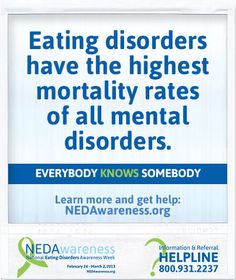
As we approach National Eating Disorders Awareness Week (Feb 1-7), I’ve been thinking a lot about my own eating disorder. I’ve also been thinking about some of the common misconceptions there are about eating disorders.
One of the myths surrounding eating disorders, that I will discuss in this post, has two parts. The first part is that eating disorders are the same as dieting and are about being thin. The second part follows, that they are about getting attention and meeting societies/media ideals of beauty.
I’ve struggled with anorexia for 20 years. In my own experience, anorexia bears no resemblance to “normal” dieting that most people engage in at some points in their lives. It is a serious mental illness, with severe physical and psychological impacts and side effects. In my experience, anorexia was not about being thin, at least not at the beginning. It certainly was not about getting attention, or competing with media ideals. A good portion of anorexia was about disappearing, taking up as little space as possible and was fueled by intense shame and embarrassment, NOT the desire for others to notice me.
I went to, and go to, great lengths to hide my anorexia from others. In fact, there are large aspects of my eating disorder I’ve never spoken about to anyone. I rarely talk about it in therapy, I almost never disclose details to friends and family and I tend to keep it secret mainly due to shame and guilt and fears that others will view me as stark, raving mad…if they really knew.
After struggling with anorexia for 20 year, I have osteopenia. This means that I have low bone density for my age. I had low bone density before I was 30 years old. This is a common physical impact of eating disorders. I’ve struggled with low iron levels which causes low energy, dizziness and fatigue. As I age, I find I have less tolerance for restricting food. I get dizzy, tired and have trouble focusing. Symptoms I didn’t experience as a teenager.
But I’m lucky. I have friends who have had heart attacks, passed out daily due to low potassium levels, lost all their teeth due to purging, have had broken bones due to osteoporosis and those who have lost their lives. Eating disorders kill. These people didn’t die because they wanted to look like the models in magazines and the stars in Hollywood. They died because they couldn’t escape from a serious mental illness.
People who have eating disorders aren’t vain. They aren’t making a choice. Anorexia isn’t a lifestyle choice. It’s a serious mental illness. It’s often a coping reaction to experiencing abuse, trauma or extremely stressful life circumstances.
Anorexia isn’t about getting attention. When I was at my sickest, I would rarely eat around other people. This led to social isolation, rather than attention seeking. I saw friends and family less, I spent a lot of time alone in my room. I would eat either before my family got up, or after they had finished in the kitchen. I avoided social occasions where food was involved (in other words ALL social events).
I was deeply ashamed about the majority of my eating disorder behaviours. I still am. When I look back on those years, I feel the need to apologize to everyone I knew back then. I want to apologize to them for making them look at 85 pound me. A skeleton in a skirt, drifting through the halls of our high school like a shadow. I feel embarrassed. I know that I looked awful and that I scared a lot of people. People who cared about me and were worried that I might die. But quite honestly, I didn’t even really believe that I was sick.
I felt like I was living on autopilot. I felt driven and I couldn’t stop. I couldn’t slow down. I didn’t exercise at the gym, but I used to walk long distances. With the amount I was eating even daily activities were over exertions. I had so many rituals it was amazing I could keep track of them all. I would measure my food, eat certain foods only on certain days, eat or drink certain things only at certain times of days. I drank a lot of coffee, tea, water and diet coke. I drank fluids to avoid eating, but I was later told that staying hydrated was probably a good part of why I had so few negative side effects at my lowest weight.
If you had asked me, I probably wouldn’t have identified myself as someone with an eating disorder. I was confused. I didn’t even know what I was doing or why. All I knew was that suddenly food was my enemy and I felt that I could survive on almost nothing. The anorexia always had an obsessive compulsive quality to it, the rituals were designed to keep me safe, not to alter my weight or physical appearance. I was never trying to lose weight. I was trying to control my trauma, my body and to numb out my feelings.
In the warped and bizarre world I lived in, slicing my half a banana into exactly 11 slices on my 1 cup of cereal kept me safe. In that world, I could buy a cookie on Tuesday and Thursday only. I had to break that cookie into exactly 4 pieces which I would eat at specific times over the course of that day.
I used to go to the library sometimes after school and read books. I remember one day my willpower failed and my hunger won. I ate my whole cookie at once. I panicked. Extreme panic. I don’t know exactly what I thought was going to happen, but it was terrible and I couldn’t undo it. I knew from reading books that bulimia existed. It was something I’d never explored, I never really ate more than a small amount at a time. But somehow on that day, that cookie felt like a binge. I felt like the world was going to fall apart because I’d broken my ritual. I went into the washroom at the library and tried desperately to make myself sick. I wasn’t able to. I never have been able to (probably a good thing). I remember crying and panicking and not knowing what to do. Eventually I must have just gone home. I remember feeling so very alone.
I’ve never told anyone about that, because of the intense shame I feel about behaving so strangely, in a way that I can objectively see makes very little sense. This is why I don’t believe that anorexia is a cry for help, or a plea for attention, because the majority of it happens in secret. Sometimes I’ve been reluctant to share details about my eating disorder because I don’t want to trigger others or give people who are not in recovery ideas about behaviours.
Objectively, I can see that anorexia doesn’t make sense. I can see that my obsessive compulsive habits, rituals, and rules don’t make sense. I can see that they don’t make me safer or protect me. I can intellectually understand the health risks of not taking care of my body. In my mind, I know that eating normally and being at a healthy weight would improve my mental health and that nothing bad would happen to me.
But Ana, spins a different web of lies in my head. The fear of what could happen, the anxiety drives the OCD cycle of obsessive thoughts leading to ritualistic behaviour related to food.
I actually see Ana (my eating disorder voice) as a separate person. I have a visual image of her in my head. I experience her telling me things and I feel I have to listen. She’s angry. I know she isn’t a good friend and the majority of what she tells me (if not everything) is a lie. But I feel some strange loyalty and attachment to her. It’s hard to let her go. I sometimes feel like I’d be lonely without her.
Eating disorders are serious mental illnesses. You don’t have to fully understand my experience, in a way, I’m glad if you can’t understand it, because it means you haven’t lived through something similar. But the stigma and myths about anorexia and other eating disorders need to be challenged. People with eating disorders need your compassion and they need specialized, accessible and trauma informed treatment options in their own cities. There is a woeful lack of eating disorder treatment available and people die while waiting for treatment. Ending the stigma and increasing public education about these serious illnesses can help change this situation.
The holidays can be a difficult time for people struggling with invisible illness such as mental illness or chronic pain. During the holidays we are “supposed” to be happy. We “should” relax and have fun. We are “meant” to connect with friends and family. It’s happiest time of the year, right?
But what if you aren’t happy? What if you want to be happy and connected more than anything else, but you can’t be? What if depression is stealing the happy, the relaxing, the fun and the connection right out of your holidays?
People all around me have been cancelling plans due to the flu, a cold and other winter illnesses. This is acceptable and even expected in the winter time. It’s even considered polite and good manners to stay home and keep your germs to yourself. It’s understood that you aren’t feeling your best and that you have no energy when you have the flu. It’s okay to stay in bed and eat soup and sleep for hours. People are sympathetic and nobody expects you to just “cheer up.”
I can’t even tell people that I’m sick. I can’t cancel plans. I can’t stay in bed. I feel disapproving looks from people around me when I’m not smiling and when I sit quietly or lose my temper more easily that usual. I’m exhausted, and I won’t feel better after a few days in bed. Even if I could spend a few days there.
It’s Christmas time and I’m living with depression and anxiety.
Yes. I’m sick. I’m more severely depressed and anxious than I’ve been in a long time.
I want to call in sick to life. I’m not even suicidal, I don’t want to die. I just want to give up on “acting normal” and “keeping up appearances.” I can’t imagine going back to work next Monday, the thought makes me panicky almost to the point of tears. I have fantasies about developing some serious physical illness…nothing TOO serious, just enough to get me about a month off work with no questions ask, but not SO serious that I’d be in the hospital. I want someone to take care of everything and take all the stress away.
This is what happens when society doesn’t acknowledge mental illness in the same way it does physical illness. People who are depressed are lowered to the point of imagining horrible illness as a reason to be “justified” in taking sick leave, or even just taking the day off to rest.
Because when you are depressed you get treated like a misbehaving, whining child when you are not happy and not feeling connected. When you are depressed you feel like a shitty parent when you don’t want to play with your kids, or you can’t enjoy your time with them. When you are anxious and don’t want to leave the house you have to push yourself through it, even when you don’t enjoy a single minute of the activity you are doing.
When you are depressed, a “good night’s sleep” won’t fix it. When you are depressed, “just cheering” up won’t work.
When you are depressed, you can’t just “lighten up” or “just relax.”
Believe me. I WANT to relax. I WANT to lighten up. I want to laugh with my children. I WANT to have fun with you. I WANT to feel connected. I WANT to feel like more than an empty shell marching through the tasks of the day. I WANT to have energy. I’m fully aware that I’m not acting normally and I’m terribly self conscious about it. I feel guilty all the time about how depression impacts me and those around me.
I didn’t ask for this, any more than you asked for that cold, flu or stomach bug.
I didn’t ask for this, any more than anyone ever ASKS to be ill.
I don’t need to be fixed. I don’t need suggestions on how I can help myself. I don’t need to be told to look on the bright side. (by the way neither do people dealing with chronic physical illnesses!)
I need you to keep me company while I shuffle through this dark period. I need you to be there for me and to not judge me. I need you to remember that I’m sick and not malingering or misbehaving or ungrateful or lazy. I need you to remember that I’m trying my best and sometimes MORE than my best just to get through each day. I’m using every ounce of energy to hide the depression from you, from my kids, from everyone.
I’m in pain. I’m tired. I don’t feel hopeful. The world seems like a dark place and I can’t see the end of it because my thoughts aren’t clear. Just as a runny nose and cough are symptoms of a cold, depression makes me think that everyone hates me, that I’m worthless and that I don’t deserve basic things. Just as a flu causes a high fever and aches, anxiety causes me to imagine horrible things and obsessive irrational thoughts.
These are symptoms. It’s not a choice.
I’m depressed and anxious. I’m sick and that is not a choice.
I had the best holidays I could, while not feeling well or happy.

It’s frustrating trying to explain invisible disabilities to people who don’t understand disability.
It’s even more frustrating when people, places or organizations which claim to specifically accommodate or treat folks living with a specific disability or illness, don’t even remotely accommodate the symptoms of that condition.
I live with chronic, complex PTSD which has remained somewhat unresponsive to treatment. I consider it a disability because for me, at this time, it appears to be permanent and it impacts my life on a daily basis. It changes the way I think, act and complete tasks of daily living. It also changes on a daily basis, which means some days I am quite simply more “able” than other days.
I recently sought alternative treatment at a clinic which claims to specifically treat people with PTSD. This is their main focus is on helping clients with PTSD that has not responded to psychiatric medicine.
Logically, I thought that this clinic would be expert at accommodating the disability of PTSD. Makes sense right?
I had a pretty good first experience there. The doctor and the counselor I met with were helpful. But the receptionist…not so much.
I had some issues with the treatment that was prescribed. This was nobody’s fault. But I needed to make another appointment to change the plan, shortly after the first appointment and sooner than planned.
To someone without PTSD and extreme anxiety this wouldn’t have been a big deal. Just call, re-book the appointment and move forward.
But for me, it was a nightmare.
I felt like it was my fault. I’d chosen the wrong plan to begin with. They were going to think I was crazy for changing my mind. They weren’t going to believe me about the side effects. They were going to question me. I felt embarrassed. I felt ashamed. I avoided making the call. I invented stories in my head about how bad it would be going back. I felt angry that the plan hadn’t worked out.
I avoided calling the secretary and emailed the counselor. He had told me I could contact him if I had any issues and had seemed approachable.
Person with PTSD is going to choose to approach the least threatening person. Person with PTSD (me) is going to choose email rather than speak to a person on the phone if they feel embarrassed. The phone sometimes seems extremely intimidating to me. What if I get nervous and say the wrong thing? What if they say something that upsets me? With email I can plan what I’m going to say and the response. There is time to react calmly and clearly.
The secretary called me back. I missed the call.
Then I avoided calling her back. Anxiety was making the decision.
She called me again. I missed the call.
I avoided calling her back. Anxiety was making the decision.
My kids got sick, I had a stressful week at work, I procrastinated calling her back. I was busy with other things. But I was also working through the anxiety, getting myself to a place where I felt I could make the call.
She left me three messages and probably about 3 weeks went by.
Today I called her back, expecting to apologize for not returning the call sooner, make an excuse about my kids being sick and then re-book my appointment.
But receptionist was cold and very abrupt.
“You waited too long to call me back. There are no more appointments.”
I was confused. I asked her until when.
“Until the new year”
I said that was no problem, could she book me in for January.
“I don’t have the schedule for January”
Um….okay…I was getting really anxious by this point. I asked her to call me back in January and ended the call.
When I got off the call I was frustrated and angry. I’d been anxious to return the call because I was afraid of being judged for needing to re-book the appointment in the first place. I waited because of anxiety. I waited because I felt stupid and I was judging myself. The anxiety was related to my PTSD and anxiety is a common symptom of PTSD. PTSD is the reason I was seeking the treatment in the first place.
I told myself the fear of being judged was irrational and that the clinic staff would understand and assist me in booking an appointment because they were there to help me. I told myself that they would understand that someone with PTSD might be anxious about making a call and thus might procrastinate. They might understand that someone could have a few rough weeks and not return a call. I reassured myself.
I made the call.
But it turns out my anxiety wasn’t misplaced. I wasn’t able to re-book my appointment. They were annoyed that I didn’t call back right away. And I’m now seriously questioning how well that receptionist knows how to accommodate someone living with the disability of PTSD.
It’s not about the fact that there was no appointment until January. I’m fine with that. I procrastinated, I wasn’t expecting to see the doctor tomorrow. But the phone call could have been handled differently:
“I’m sorry to hear your kids have been sick and you weren’t able to return my call. I’m glad I have you on the phone now. Unfortunately our appointment slots are booked up until after the holiday break, but can I fit you in for the New Year?”
Another option might be
“It sounds like getting phone messages and returning calls is difficult for you, and email is easier. Sometimes people with PTSD find calls difficult. Don’t worry, we can book your appointments over email as an accommodation. Let me book you in for January.”
This post isn’t about that one receptionist and this one situation. This post is about not making assumptions about why people behave the way they do. Especially if you work in an organization providing health care services!
It’s also about realizing that accommodation for people with disabilities means more than just building a ramp (though ramps are needed too, I’m not knocking ramps!). It means realizing that disabilities impact different people in different ways. Accommodation isn’t always something complicated or expensive. Sometimes it could be as simple as using email as a way of communicating, or offering choices for methods of booking appointments or receiving information. Accommodation starts with realizing that not everyone lives life the same way you do. We all have different abilities and that’s okay.

On December 6, 1989, fourteen female engineering students were murdered at school in Montreal. They were murdered because they were women and their murders were extreme acts of gender based violence.
Just last week, on December 1, 2016, a Toronto doctor was murdered by her physician husband. Someone posted something on facebook, commenting that this murderer must be “sick,” or “mentally ill,” and I was angry.
Violence against women, domestic violence, and gender based violence that escalates to femicide is not caused by seriously mentally ill men. That’s a myth and it’s a dangerous one which overlooks the very real structural and societal causes of violence against women. Causes such as patriarchy, rape culture, poverty, racism, sexism, homophobia and other types of oppression and inequality that impact women and gender non-conforming folks. Mentally ill and other folks with disabilities are far more likely to be the victims of violent crime than the perpetrators of it.
Tomorrow night I will be attending a vigil to remember those women and gender non-conforming folks who have lost their lives as result of gender based violence. In particular, the victims of the Montreal massacre.
So many times over the past few years, when I’ve heard news stories about domestic violence escalating to murder, I’ve thought to myself: that could be me. That could be me. What makes me different from those women? What is it that made that particular man, escalate his violence in that particular way, on that day? Statistics show that women are most at risk of being killed around the time when they are planning to leave the perpetrator, or just after leaving. I often wonder what would it take to make my ex snap? What does it take for someone to cross a line between sexual assault, and murder? How thin is that line? How safe am I really?
I could be that woman. I am that woman.
Truth be told, a lot of us could be that woman. And that’s not a reality that many of us want to face. Instead we talk about how the murderer must be seriously mentally ill, a crazy person, someone that must be fundamentally different from us, different from our neighbour, our doctor, our religious leader, our school teachers, our lawyers, our engineers and our bankers. We think of the victims as misfits, as street folks, addicts, people who are “different” or somehow to blame.
But the honest truth is that the victims of domestic violence are all around us. They are you, they are me and they didn’t do anything to provoke the violence.
The perpetrators are all around us too. They are sitting next to you in the cubicle beside you at work, they just served you at the restaurant you ate lunch at.
Gender based violence is everywhere and we all have a responsibility to look for the signs, see the signs, believe survivors, speak out, speak up, ask questions, don’t turn our backs on it and remember those who have lost their lives. Remember them tomorrow on December 6th, say the names of those who have lost their lives, and remember them every day.
I would also like to remember my friends who have not survived their battles with PTSD due to gender based sexual violence. Suicide as a direct result of PTSD that was caused by repeated and horrific sexual assault is akin to slow murder by the perpetrator. My friends were some of the bravest people I have ever known and they were survivors even though they did not survive.
On December 6th, I will remember you.
The 14 women murdered at l’École Polytechnique de Montréal were:
| Geneviève Bergeron Hélène Colgan Nathalie Croteau Barbara Daigneault Anne-Marie Edward Maud Haviernick Barbara Klucznik Widajewicz |
Maryse Laganière Maryse Leclair Anne-Marie Lemay Sonia Pelletier Michèle Richard Annie St-Arneault Annie Turcotte |

I identify as a person with disabilities. The thing is, that I live in an interesting position where some of the time I have the privilege of “passing” as a non-disabled person and some of the time, it’s obviously visible that I’m different, strange, mad, crazy, mentally ill, or whatever label people might want to put on my experience.
I experience my PTSD as a chronic disability rather than an illness. It’s something I live with and cope with and I don’t expect it to suddenly be cured or disappear. I don’t consider myself “sick” but I’m not really well either.
One of the ways in which I coped with having undiagnosed and improperly treated PTSD was to cut myself. I cut myself for many years of my life. Because I had severe adverse effects from psychiatric medications I cut myself deeply, chaotically and severely. As a result I have visible scars over the majority of my body. These scars are covered by long sleeves and long pants, but can be seen wearing any other type of clothing.
I have a number of close friends who also identify as having disabilities, and I work in a field where I have read, heard about and studied oppression related to disability. What I want to talk about is the situation I encountered last night. The one in which able-bodied, sane, or well people feel the need to STARE at, or comment on, disabled bodies. The staring makes me feel instantly like a circus freak, instantly judged, instantly “less than” and instantly oppressed.
I was out at the dance last night and I’d invited along a woman I’ve met up with a few times. It’s been winter weather so this was the first time she’d seen me in a short sleeved shirt. I hadn’t mentioned the self harm to her. I had mentioned my past abusive relationship. When I arrived, I noticed her staring at my arms. I noticed her staring at them on and off over the course of the evening. She never said anything about them, just looked at them awkwardly.
I was already struggling yesterday. I was having a lot of body dysphoria and feeling self conscious and negative about my body. I’d been at a party earlier and I was hot in my sweater but I didn’t want people looking at my arms, so I left it on. Often I forget about my scars now, but some days I’m hyper sensitive because I don’t want to risk being under the “judgemental gaze” of able-bodied or sane folks.
Here’s what I wish folks would do when they notice my scars:
And here is a list of answers to some commonly asked questions about my scars. Maybe this will help you to not ask these questions to other people who self injure, maybe it will help others understand a bit better. To be fully honest, people rarely ask me questions about my scars. I sometimes wish they did ask me. I’d rather be asked questions than be stared at and be left wondering what the person was thinking. But there are some common questions and questions I imagine folks have.
The take home message is simple:
Don’t stare at people whose bodies may be different than yours.
If you must ask questions, do so politely and privately if possible. Ideally, don’t ask a lot of questions of complete strangers. Questions as part of a friendship come across completely differently and can be more acceptable as a part of getting to know someone over time.
I notice you staring at me, and I don’t interpret it as polite concern. I interpret it as intense othering.
I was just there for the dance.
It’s been a difficult week for so many of us, including women and gender non-conforming survivors of sexual violence. I’m struggling with my PTSD symptoms.
Marian was the only one I could ever talk to about some of my more intense PTSD symptoms. She was the only person I’ve ever met who I really felt completely understood what I was going through. I never felt “crazy” when I talked to her. I could call her, say what happened and every time she would know exactly what I was talking about because she’d experienced it too.
I’ve learned with symptoms of mental illness that there are some things that are more acceptable to talk about, and some things which are more highly stigmatized. There are some symptoms which almost nobody ever talks about, for fear of being judged or experiencing discrimination or persecution.
In 2016, almost everyone knows someone who has struggled with depression, anxiety or who has issues related to food. These are things we talk about.
People very rarely talk about suicidal thoughts, self harm, paranoia, delusions and seeing and hearing things that aren’t real.
It’s almost like there is a divide between the mental illness that society accepts and the mental illness that is forced to exist in the closet.
When PTSD is really acting up for me, I see things that aren’t there.
I’ve rarely told anyone about this because I know that most people won’t understand. Marian understood. I felt so accepted, like there was at least one other person in the world who experienced seeing things as a symptom of PTSD.
This week, there have been three separate occasions where I’ve “seen” my ex in public places. It’s so hard to explain how this feels. The first person was in the food court at the mall. He had a coat, scarf and haircut similar to my ex, and even though I looked at him and my intellectual mind recognized it wasn’t him, I kept looking back over and over, convinced it was somehow him. My heart was racing and I felt panicky. It isn’t just the feeling of mistaking someone else for him. I actually SEE him, in someone else. Someone else is replaced by him for that moment and I’m afraid.
This happened again today when I was buying my coffee. The person didn’t even look like my ex, but he became him for a moment. My intellectual mind tries to reassure me that what I’m seeing isn’t real, but it feels real. It happens with cars that look like his too. Sometimes, I have to check and check again, sure that the car is his, even though intellectually I know it is not.
I’ve had this experience before, in the past, in the years leading up to me leaving my ex. I would see X sometimes, when I was triggered. I remember talking to Marian about it.
It’s an unsettling feeling. Sometimes when I’m very stressed and have been sleeping poorly, I also see tricks of the light which aren’t there. These experiences are all more illusions than actual hallucinations, but they are still disturbing and they signal to me that my brain is over-stressed, overtired and in need of relief. My doctor assures me that none of these are psychotic symptoms, but they are symptoms of PTSD.
These experiences of “seeing things” are different that what happens during flashbacks. They seem to happen just out of the blue when my brain is stressed.
During flashbacks, it also happens that my brain sees something from the past rather than what is in the present. The person I’m with, “becomes” my abuser, I can’t trust what I’m seeing, my brain is mixing the past and the present into a mash up of confusion.
Nobody really talks about these things. As a survivor it can be very isolating and it can make me afraid to speak out about the symptoms. Sometimes I don’t know what is more terrifying: feeling crazy or worrying that people will perceive me as crazy. I know, intellectually, somewhere deep inside, that I’m not actually crazy. My brain is coping with trauma and it is doing what it needs to do to survive. Sometimes this coping mimics, looks like, and produces symptoms of mental illness. But often the symptoms are my brain letting me know that I need to reduce my stress. If I don’t listen to the early warning signals, my brain escalates to more dramatic signals like suicidal thoughts and seeing things.
Learning to listen to my own inner voice is part of the healing journey.
Essentially, I think society needs to talk about these stigmatized symptoms of PTSD and mental illness. I think we need to break down the misconceptions and the misinformation and realize that for the most part, folks are just doing the best they can to cope. When you are living it, all mental illness is terrifying. It’s just a matter of degrees. Sometimes the fear of stigma is what keeps people silent and stops them from reaching out for help. Talking openly and without judgment heals.
I sometimes see things, but if Marian could understand, maybe you can to.

Depression doesn’t always look the same. Sometimes it is most clearly described by how I feel when it lifts. When I’m depressed I’m not actually myself and when the depression lifts I wake up and I’m me again.
When I’m depressed, I am physically exhausted by social contact and social situations, but at the same time I don’t always want to be alone. One of the reasons social situations are so difficult is because social anxiety is a symptom of my depression, and depression is fueled by my social anxiety.
Over the past few weeks, interactions with others leave me drained. Probably because half the time I’m spending with people I’m hyper aware of whether or not I’m behaving appropriately. Because depression blunts and numbs some feelings and amplifies others, I’m constantly monitoring myself and thinking:
“Am I acting normally? Can this person tell I’m acting? Am I smiling enough? Am I smiling too much? What should I do with my hands? Stop picking at your skin! Remember to make eye contact! Not too much eye contact! Stop fidgeting! Is my facial expression appropriate for what they just said? Make sure your face is responding like a normal person! That was a joke, laugh. But don’t laugh too much. Did that sound stupid? Do they hate me? Did I make a mistake? Is my facial expression appropriate? Oh my god, did I even hear what she just said? Smile. Act normal“
After a short interaction I’m exhausted and I want to flee to a place where I can just be. This usually means being alone. I’m completely relieved to be alone. I often hibernate under quilts and blankets where I feel safe.
But then the loneliness hits. I text. Texting is much easier than phone calls or in person hang outs. When I’m texting I just have to think about the words and not all the other complex social dance behaviours that I’m sure I’m completely mangling. Texting is safe. Texting breaks isolation, without crowding me or making me self conscious.
When I’m lonely and depressed, I start to believe I’m literally the only person on the planet who doesn’t have plans at that moment. All logical reasoning to the contrary is dismissed by my social anxiety brain. I start to think that nobody likes me, that I’m boring or annoying, that I’ve said terrible things to offend everyone I know. I feel jealous about the plans and social gatherings of others. And yet, ironically, I often cancel plans or say no to things I am invited to. The contradiction of depression is frustrating and impossible.
Depression is panic attacks in crowded places. Panic attacks about choosing food, or anxiety about eating around other people. Depression is feeling “fat” when my body hasn’t changed. Depression is anxiety that everything I say or do might get me into trouble or make my situation worse. Depression is reading my emails over and over and over and over, obsessively, worried that I made a mistake, said the wrong thing or was oppressive. Depression is paranoia that the email was accidentally sent to the wrong person, somehow ruining my life. Depression is knowing I have to do something at work, but feeling incapable, afraid and ashamed to ask for help, thus procrastinating and avoiding.
Depression zaps energy. I’m literally exhausted almost every minute of the day. It’s not something that can be fixed by more sleep. Though less sleep makes it much worse. My body feels heavy and I struggle to get out of bed in the morning. My bed feels warm and safe in the mornings, but physical pain and stiffness in my body prevents me from lying down for too long. Sometimes I’m drained and have to lie down after taking a shower in the morning. But somehow I push through it.
I feel like robot, automatically going through the motions of my day. I check each task off against a mental list. Breakfast, check, kids to school, check, commute to work, check. Each day moves through a series of tasks to be completed. I’m always counting time until the next time I can be alone and rest. I’m often watching the clock, but I’m never comforted by it. Then after about one day of a weekend alone, I’m lonely and waiting for my kids to return. It’s a terrible feeling, like you have nothing to look forward to, but are always looking forward to something unimportant. Maybe the next day will be brighter, maybe the next _____ will break the cycle, maybe I’ll wake up tomorrow and feel better.
Depression is being unreasonably and intensely irritated by innocuous things. Like the sound of someone chewing near me. I could scream. My whole body is tense, I can hear every sound. Depression is losing patience in a split second, in situations I would normally be able to cope with. Depression is feeling frustrated when people repeat themselves or take a long time to get to the point of their stories. Depression is hating myself because I know I’m not being as kind as I should be. Depression is losing my temper at my children, when they are barely doing anything wrong and my rage is uncontrollable like a volcano, then dissolves into guilty desperate tears. Depression is intense compassion fatigue. Not having enough energy to have empathy for others and then beating myself up with self judgment afterwards.
Depression means rarely living in the moment. Depression is being caught in a tangle of awful memories from the past, or absorbed in worries or thoughts about the future. Or more often, ping ponging back and forth between memories and worries. In the moment, there is often zoning out, disassociation, numbing and that floating feeling of being something less than human, unable to connect with anyone. Feeling like my essence of humanness is just beyond reach.
Depression is either crying too much, or (this time) not being able to cry at all. Depression is either all the feelings right at the surface every single minute, or all the feelings pushed down and boxed up into controlled spaces inside me.
Depression is the darkness in the Fall and Winter months. Depression is waking in the dark, coming home from work in the dark and forgetting what the warmth of the sun feels like. Depression is like sitting at a dirty window, watching the normal world proceed just outside my grasp.
Depression is feeling suicidal, obsessing about death and dying. Sometimes it is destructive impulses, or sometimes, wishing I hadn’t been born at all. Sometimes it is a passive thought of just not wanting to be alive. And then the torturous, trapped feeling of knowing that suicide is no longer an option.
Depression is boring. Like this blog post feels boring.
It’s a world without light. Depression is obsessive, recurring thoughts. Depression is feeling like a bore to others, feeling self-obsessed, immature and uninteresting. Depression is feeling unlovable and like you will always be alone.
Depression lies.
Even if I know that depression lies, it’s not so easy as just snapping out of it.
When I’m depressed I’ve learned that the best I can do is to stay as safe as possible, sleep regularly, eat and drink regularly, self care, be patient with myself, lower my expectations of myself and just do my best.
Because depression always lifts. It’s not forever. But it feels awfully bleak.
 hopeforsanity