Darkness and Light

indexindex

It’s been almost 3 years now since my last full-out episode of major depression lifted.  It started to shift about 4 years ago and lifted when I moved away from my ex-husband.

The last 2 months I’ve been struggling a little.  I developed low iron and I was feeling burnt out and stressed.  For a short time I was depressed again.

I wanted to write a little bit about my experiences with the difference between depression and a clear mind.  Usually the shifts are subtle, but startling, and it’s all to do with darkness and light.

The last few days, I felt startled, caught of guard by the brightness of the colours around me as I drove through the city.  Granted, it is spring and the leaves, buds, grass and flowers are growing, but this is something more than noticing natures beauty.   Today I was driving home with my kids and I saw a set of traffic lights across a field.

My mind: “Wow, those traffic lights are SO bright, so colourful, so orange yellow, they are jumping out of that field”  They looked almost psychedelic and other worldly to me.  Yesterday, as I was driving, the green grass looked almost neon and startled my eyes.  It’s a striking yet not unpleasant feeling waking up from a time of depression.   Suddenly there is light in the world, when you were not always aware of the depth of its absence.

When I get depressed I also struggle with varying levels of disassociation related to my PTSD.  Depression tends to blunt feelings at the best of times, while disassociation can leave you numb.

The last few months I described my feelings as “being a zombie.”  Going through the motions of my day to day life, functioning on the surface, but feeling like I didn’t care, wasn’t connected, wasn’t engaged and wasn’t happy.  Depression feels like living in a world without colours.  Everything pleasant is muted because I cannot connect with my feelings or my environment and then I start to feel hopeless.  It’s like looking through a dirty lens and being wrapped in a blanket that prevents me from feeling things fully.  I can see people around me, I know how I “should” be acting, but it’s an effort to complete the actions in a genuine manner.

For many years, I was severely depressed and this became my “normal” state.  I remember in 2012, I had been depressed consistently since 2009, with 2011 being a particularly bad year.  In July 2012 I was in England on a family holiday.  One day we were at the beach, my family, my cousins and my cousin’s children.  It was a warm day, not hot, but sunny and very pleasant.  We were walking by the seaside along a rocky beach.  I sat down on the stones and I placed my hand on them.  I remember the moment so vividly because I was aware that the stones were warm.  I sat soaking the warmth from the stones into my hand and I felt alive.  I felt something that probably saved my life (again).  I felt hope.  It was the first moment I truly felt connected with the world around me in all its vivid reality in many years.

That moment was one impetus on the journey towards finding my path away from my abusive marriage.  Just those smooth warm rocks and a single moment of the depression cloud lifting and hope streaming in.

People often wonder what moments have changed your life, and sometimes the truth is that the most simple, unplanned moments can elicit major change.

Christmas 2013 I had another moment of hope, it was bittersweet though as I realized how dark my world had been.  We were at my parents house and my younger cousin and her boyfriend at the time were teasing me about someone I was dating.  I was laughing and laughing because the situation was funny, hilarious even.  My children were playing in another room and my older daughter ran in, looked at me confused, then ran into the kitchen shouting “Grandma! Why is  Mommy laughing?”

My daughter needed reassurance that I was happy, she hadn’t heard me genuinely laughing in years, maybe never.  Connection.  In that moment I was connected with the world and I was enjoying my life.   During a dark depression I don’t laugh very much, I feel isolated in a room full of people, I feel like a shadow with clouds hanging over me.  I sometimes don’t even feel like a real person!  My memory is terribly bad after a period of depression.  I think I’m functioning normally, but later, because of disassociation, I realize that I didn’t form proper memories of the events.  I’ve realized that without connection, sometimes memories aren’t completed and stored correctly.

Seeing those yellow traffic lights today felt similar to the stones on the beach and the Christmas laughter.  Yellow shining beacons of hope and connection!  Maybe the opposite of depression is connection?

I’m very lucky that my periods of depression are much further apart now and usually very brief.  They don’t last long enough for me to truly lose hope.  I can always hold onto the memories of those moments of connection.

Even if you are struggling with depression you feel will never lift, please don’t lose hope.  Look for small moments of connection in your day to day life.  It could be as small as noticing a flower that has bloomed, feeling the warmth of the sun on your face, feeling the cool water while you are washing your hands, enjoying a smile with a friend.  I believe you can build on those moments and slowly build a path to recovery.


Misdiagnosis.

20160425_190808[1]

This is the piece of paper I was given as a “formal” diagnosis back in 2001.  It was the first time I learned about PTSD.  It was also the first time I was misdiagnosed with Borderline Personality Disorder.  In reality, my PTSD is severe, my current Dr told me it was one of the worst cases he had ever seen.  But Dr. X, in his wisdom, after knowing me for a only a few months decided the impact of my trauma was “mild” and instead the main factor in my illness was untreated borderline personality disorder.  As far as I can see, this assumtion was made due to my self cutting behaviour.  He failed to take into account that before being abused I had no mental health problems.  He failed to take into account that self harm and anorexia are common coping techniques for sexual abuse, especially in young women.  He failed to notice that my out of control self harming behavior and suicide attempts began only AFTER taking a cocktail of psychiatric meds. He failed to see that I have almost none of the diagnostic criteria for BPD, except the self harm.  I had long term friends, stable relationships in my life.  I was not impulsive or risk seeking, except with regard to the self harm.

Over the next few months Dr X also placed a value judgment on this misdiagnosis of Borderline.  He was the first person I talked to about the sexual abuse, and as such I trusted him and looked to him for support.  This was a mistake.  I didn’t have a choice as to what psychiatrist I saw, he was the one assigned to me.  He gradually saw me less and less in his individual practice.  I would show up for appointment only to find he had left for the day or was on call in the ER.  Then he changed his practice to work solely in the urgent psychiatry clinic.  The only way to get an appointment was through the ER.

I had no family Dr and nobody to renew, monitor or change my medications.  He told all the psychiatrists at South Street that I was borderline and so they would not take me on as a patient.  He refused to give me a referral to a community psychiatrist and I had no family doctor.  I felt betrayed.  I felt rejected.  I felt worthless.

I started to use the ER on a regular basis, mainly after cutting myself.  I would ask for a psych consult about 50% of the times I cut myself.  I would ask the doctor on call to please assign me a regular psychiatrist to follow me.  I begged.  I pleaded.  I was rejected.  I was sometimes given an appointment at the urgent psychiatry clinic, where I knew I would see Dr. X again.  No way to break free, systemic barriers and misdiagnosis kept me trapped.  The more I protested, the more I harmed myself, the worse the situation got for me.

The treatment that I received at South Street was appalling. I know I am not the only one and I know this hospital is not the only one with issues.  Women survivors of childhood sexual, emotional and physical abuse are often misdiagnosed with borderline, a diagnosis I see as basically a wastepaper basket label.

I remember during my second last year at South Street, 2003, I attempted suicide again.  This time I cut myself extremely deeply, diagonally across my arm.  I remember lying on the floor in the hallway of the apartment I shared with my boyfriend.  I was dizzy, almost blacking out.  I felt the quiet empty feeling in my head and I tried to decide whether or not to keep pressure on the cut or let it bleed and let myself give in to the pull of unconsciousness.  I lay there for a while, I’m not sure how long.  I finally decided to go to the hospital.  I think I took a cab, but I’m not sure.

At the hospital, the medical doctor that first assessed me actually put me on a Form.  He got a security guard to sit in my curtained area to watch over me.  I remember I was studying for my 4th year Health Sciences exams.  Somehow the irony of this was lost on me at the time.  I had just tried to kill myself, I had a security guard watching me and I was studying for a university exam in the ER.  The medical doctors fixed up my cut with stitches.  By this time the routine of receiving stitches was, just that, routine.  I had received hundreds, sometimes as many as 50 at a time.  After I was fixed up I was transferred to the psych section of the ER.  I don’t remember too much about what happened but I do remember I was told that there were no beds, that I could not be admitted.  I told them that the cut had been a suicide attempt, not “just” self harming like I usually did.  I begged to be admitted. But the psychiatry doctor was firm, there were no beds for me.  I couldn’t understand it, the medical doctor had thought I was a risk to myself, so much so he had security watch over me, but psychiatry released me.  I learned over the years at South Street that as soon as a doctor had access to my past charts I was treated very differently.  I was generally taken seriously when a health care provider spoke to me and listened to me.  When that same health care provider saw my chart, I was turned away, disrespected, ignored and mistreated.  This is what misdiagnosis with BPD means to me.

I remember being discharged from the ER that day.  I was desperate.  I still wanted to die.  I remember standing in between the double doors of the ER crying.  I didn’t know where to go or what to do.  I felt hopeless.  It was late evening, it was spring or summer and it was still light outside.  As I stood there crying a door opened, it led out to the ambulance bay right beside the place I was standing.  Our of the door came a gurney, with a black body bag on it.  The door led to the morgue which was also in the basement of South Street.  The body was loaded into a funeral home vehicle and drove away.  The image impacted me and haunted me.  I wondered if my friend Darlene was wheeled out that very same door a year before. I was preoccupied with death.  I felt scared and I felt lost.  I just wanted someone to help me.  I’m not even sure I really wanted to die at that point, I just wanted the pain and confusion to stop.

Eventually I left.  I took the bus home, back to the apartment where I’d tried to end my life a few hours earlier.

I think that people often conclude that because an injury is self inflicted, that the person chose it.  That they are not traumatized by it or impacted by it.  But I believe that self inflicted trauma also needs to be recognized as a contributor to PTSD.  I think that my experiences within the psychiatric system alone could have caused PTSD in a healthy person.  In a person who was already traumatized they were that much more severe.  Sometimes comfort and sympathy are not provided to self injuring people.  We are treated as though we “knew better” and are essentially “wasting time and health care resources” or taking away care from those who “really need it.”  I believe that every person who self harms would have chosen a different option if they felt they truly had a choice.  Self harm isn’t cool, it’s not fun, it’s not something to envy or idolize.  It’s dangerous, it’s terrifying, it is not glamorous in any way.   It leaves lasting scars.  Scars I will live with for the rest of my life, and scars that trigger memories of times in my life I would much rather forget.  I get flashbacks around my self inflicted trauma in the same ways I do to the abuse inflicted on me by others.  And because I was abused in the health care system the two are not distinct.

There is no easy solution to these problems.  People who self harm need and deserve compassion.  PTSD should be taken seriously and not dismissed as a disordered personality.  PTSD is treatable.  Believing survivors is the first step.  Yes, this means as a society we all have to step up and acknowledge that violence and abuse is much more prevalent than we ever imagined.  We need to collectively work to end victim blaming and shaming and fight rape culture.  Because powerful white male doctors, with all their privileges, labeling my personality as disordered is rape culture.  I became sick and disabled because of abuse; I’m not disordered, I am a survivor.


Cumbersome.

elaws_regs_900741_ev001-5

“I have become cumbersome to this world…”  Seven Mary Three

Trigger warning

This song was playing on the radio in my boyfriend’s car.  We had parked outside the engineering building at the University of Western Ontario.  I waited in the car while he ran inside to hand in a late assignment.  It was about 3pm in June 2001.  I was deeply depressed and in the grips of side effects of benzos and SSRIs, toxic soup which turned my brain into an impulsive, self destructive, hopeless mess.  I felt like the song was a sign and a message to me that it was time to die.  we drove home and a few minutes later I was in the bathroom, taking my 3rd overdose.  I was serious this time and not messing around.

I remember sitting in my room, waiting to see what would happen.  I started feeling bad fairly quickly and this time I was fully aware of the entire experience.  My boyfriend drove me to the hospital and I remember during the drive realizing that an ambulance would have been more appropriate.

I remember sitting at the triage desk in the South Street ER, the nurse asking me questions: “How many pills did you take?”

Either my answer or my vital signs snapped everything into motion.  I remember her checking the E for Emergent on the triage form and I was taken immediately back into the department.  Things started to go downhill from there.  I was given activated charcoal to drink, this time I was fully awake and the taste and texture was horrific. I still have regular nightmares and flashbacks about this.  Even typing this I’m having flashbacks and feeling nauseous.  The nurses took blood samples and started an IV.  As we had found out on OD #2, I’m actually highly allergic to the antidote to the drug overdose.  This meant I was having a life threatening allergic reaction.

I remember my face getting hot and swollen.  I was receiving IV benedryl along with the antidote.  I was vomiting over and over, the charcoal wouldn’t stay inside me.  Eventually I was vomiting blood.  I was given IV gravol.

My sense of time was somewhat confused but at one point I remember them paging the internal medicine experts.  It was at this point I realized that I had F*#ed up.  I realized that I wasn’t going to die, clearly.  I felt like a failure at everything.  I couldn’t even get this right!  But at the same time I was petrified because I knew my body was not doing well.  My liver was having trouble processing the OD.  The specialist told me I needed the charcoal to absorb the drug and I would need the IV antidote for about 24 hours, I was being admitted to a medical floor.  He also told me if I ever did this again I would die from the allergic reaction to the antidote.

Shortly after the Dr  came back into my curtained area.  A tube was placed down my throat and into my stomach.  I was fully conscious and had no pain relief.  I could not longer speak.  My eyes were watering from the pain.  The nurse was supposed to come immediately to pour the charcoal directly into my stomach.  But for whatever reason she didn’t come and I was lying there unable to speak with a tube down my throat.  Finally the nurse came, poured the charcoal into me and then pulled out the tube.  I was gagging and crying.

Late that night I was taken upstairs to the 5th floor which was a cardiac monitoring floor. I needed a monitored bed because I had been admitted involuntarily on a Form 1 (72 hour psychiatric hold under the Mental Health Act).  I remember waking up, if I had even slept at all, and dragging my IV to the washroom to vomit black charcoal.  I could barely walk. I noticed that this part of the hospital was much fancier and the beds were much more comfortable than on the psych wards.  I remember at one point using the phone in the nursing station to speak to my parents.

In the morning breakfast came on a tray.  There was cream of wheat in a plastic bowl.  A few hours late the psychiatrists came to assess me.  I remember being angry and frustrated because they made me walk all the way down a long hallway to a meeting room to talk.  I could barely walk and it felt like an eternity.  I remember thinking they were punishing me on purpose, but maybe they just didn’t realize how terrible I felt.

I was moved to a bed on the 2nd floor, it was a general medical unit.  Since I was not in a monitored bed and not on the psych floor (locked ward) I was assigned a “sitter.”  Basically someone to sit in the room and watch me, presumably to ensure I did not harm myself again.  It was embarrassing and invasive.  This person just sat on a chair in my room.  If I went to the washroom they would stand outside the door and listen.

I remember the day being overwhelming and scary.  I was not grateful to be alive, I didn’t see it as a second chance.  I felt sick and I felt trapped.  I felt incompetent and alone.

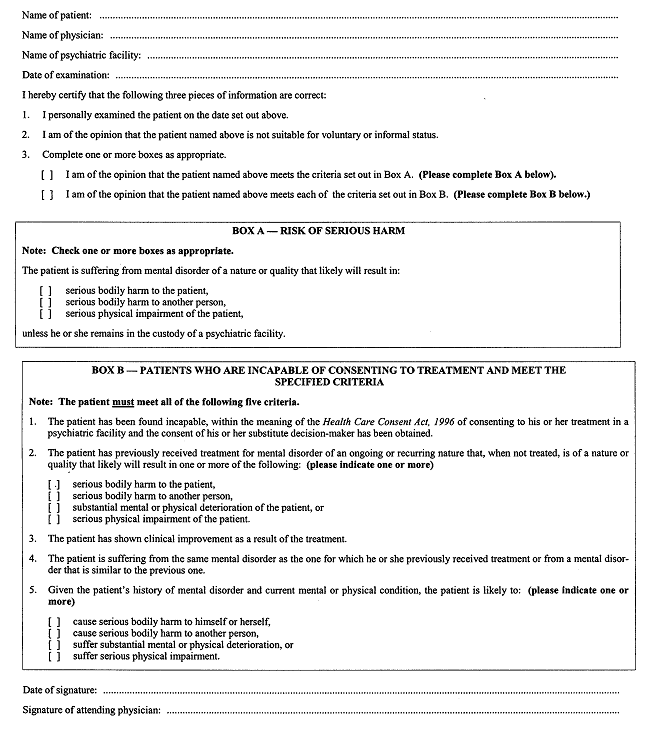
Late that evening I was medically cleared, the IVs were removed.   I was moved to the 7th floor.  I was not allowed to leave the unit.  After the 72 hours passed my Form was extended to a Form 3 which allowed them to keep me for up to 7 days.  Dr. X was the one to sign the papers.  He informed me that things had gone too far and he would not release me from the hospital unless my parents came to collect me.  I had no choice but to agree.

Involuntary hospitalization feels like being imprisoned.  Your right to freedom of movement is removed.  You must stay on the psych unit and you can’t go outside.  Sometimes they will let you go outside supervised but only on hospital property.  Did I need to be involuntarily held at that time? Probably yes.  Would I have harmed myself again at home?  Probably yes.  In fact, I went on to continue harming myself for years after this admission and I would be held involuntarily again.  I couldn’t talk myself out of this one.

It’s very difficult to explain what is in the mind of a person who wants to die.  Sometimes it feels like a terrible emptiness.  Sometimes it feels like looking at the world through dark glasses.  Sometimes it feels like a crushing weight, when you feel like you are separate from all living things, a shadow of yourself.  Sometimes it is racing, impulsive thoughts of harm.  Other times it is absolute quiet.  I’d be lying if I said I don’t still have thoughts of dying.  They come and go, as they have since I was 17 years old.

Thoughts of suicide are a warning sign for me.  They are a giant red flag waving.  Stop! Your stress levels are too high.  You have too few spoons.  You have too many triggers.  You need to slow down and self care.   Suicide is a symptom of depression and PTSD.  Hopelessness is a symptom.  It’s not a sign of weakness and it is not a sign of being “crazy.”  It’s a symptom of depression in the same way sniffling and coughing are symptoms of a cold. Suicide and suicidal attempts can also be a side effect of many psych meds and this was certainly true in my own life.  This is an issue with many layers.  Ironically, suicidal thinking can be a way of coping and trying to survive desperate times.

I am a suicide survivor.

.

No, you don’t have the right to torture me

20160418_215945[1]

This is what the stigma of being misdiagnosed with borderline personality disorder means to me.  Trigger warning for description of self harm and abuse.

Monday November 8, 2004

I presented to the Emergency Room at South Street Hospital with a self inflicted cut on my arm.  By this time I had been using hospital psychiatric services for over 3 years.  I was a frequent flyer, a regular, a repeat customer and I was not popular.  I had experienced many unpleasant experiences in the ER.  I had grown accustomed to medical students poking at me and asking ridiculously offensive questions.  The worst was “Why don’t you cut yourself deeper so it would hurt more?”

I’m only going to say this once.  In my opinion someone who uses psychiatric services heavily is actually in MORE need, likely MORE desperate and experiencing MORE complex issues that someone who is visiting for the first time.  As mental illnesses progress folks become sicker and more marginalized by society.  What is needed are more individualized care plans, more compassionate care, more empathy and more listening to the survivor.  The survivor themselves is the expert in her own healing.  One size fits all models of care do not work, they have never worked, and will never work.  Each person is unique and experiences a unique mix of oppression and marginalization as they live with their illness.  Social and structural factors are an important thing to consider.  The survivor does not exist in a vacuum.

Believe me, if someone truly had options, they would NOT choose to spend their lives in psychiatric institutions.

Part of the reason I used the Emergency Room so frequently at that time was because I had neither a family doctor, nor a psychiatrist seeing me for ongoing care.  Lack of access to primary and preventative mental health care is a huge issue.  Another major barrier is the existence of a two-tiered mental health care system; whereby folks who have financial resources are able to access private care from psychologists and social workers and economically marginalized people (the sickest and most at risk) often face long waiting lists, lack of affordable housing and gaps in services.

By that time Dr. X had stopped seeing me.  This happened over a period of months.  First he would cancel appointments, then not show up for them.  I was busing across town to meet him and he just would not be there.  Then he switched from an outpatient practice and seeing inpatients on the 7th and 8th floor to working full time in the Urgent Psychiatry Clinic and the ER.  When he switched his practice I was not assigned to another doctor, nor was a given a community referral.  Thus, my only option was to attend at the ER to get a psych consult and an appointment with Urgent Psychiatry.  I begged and pleaded and searched for a new doctor but I was not able to find one.  I found out later that Dr. X had essentially blacklisted me at South Street and no psychiatrist would take me on because I had “borderline personality disorder.”  I was also denied access to the PTSD treatment program, after waiting on their list for 18 months.  I was told I didn’t meet the criteria for the program.  Ironic since PTSD is my main, if not only, diagnosis.

But I digress…back to November 8, 2004.

I waiting in the waiting room for about 1 hour before being brought back into the curtained treatment area known as OR 2.  When I was directed to a bed I began crying and was visibly upset.  A nurse arrived to take my history, but she was interrupted by Dr. P who dismissed her saying “you are wasting your time.”   Dr. P spoke to me in a curt and derogatory manner, asking to see my laceration.  He took a quick look at it and said he was going to staple it.  I began crying and asking him to please stitch the cut instead because staples really scared and triggered me.  Dr. P laughed at me and asked me to lie down and proceeded to quickly clean the cut.  He then held my arm down and proceeded to place 8 sutures into my forearm without using any local freezing or pain relief.  I was sobbing and screaming and he continued offering no sign of sympathy or concern.  I couldn’t understand why he was not following procedure and I was confused and distressed.  I felt as though I was being purposely targeted and tortured because my wound was self inflicted.  I felt like Dr. P wanted to “teach me a lesson.”  I was known to him from previous visits and I got the sense he did not want to see me in “his” ER again.

After he was finished the nurse came back and tried to calm me down.  She reported the incident to the charge nurse who also comforted me and offered me Advil.  I was then taken to the psych waiting area to meet with the doctor on call.  I was very upset, triggered and in a lot of pain.  I remember curling up into the smallest ball I could make in the uncomfortable plastic chair which was bolted to the ground.  The floor was covered in green tiles.  All the furniture was bolted down, presumably to stop patients from injuring themselves of others.  It was a cold room, I remember I was shaking and probably in shock.

I reported the incident to the College of Physicians and Surgeons a few days later.  The treatment I received was abusive and was physical assault.  I came to the hospital (already living with PTSD) and I was traumatized in a time of crisis.  I firmly believe that if my cut had not been self inflicted and if I had not been labelled within the hospital as a “hopeless case” this assault would not have taken place.

Procedure allowed Dr. P to write a response to my complaint.  In his response he actually admitted to speaking with Dr. X who told him that I “had long standing borderline personality disorder and that none of his colleagues would take [me] because of this.”  Incredible!  Psychiatrists in the hospital were actively denying me care due to a psychiatric misdiagnosis?  I wouldn’t believe it except I’ve seen my charts and I know it to be true.

Dr. P’s explanation for not using freezing was that he thought my arm was so full of scar tissue that I would not be able to feel the sutures.  This made no sense since I was screaming while he stitched my arm.  He wrote that he offered me anesthetic which was a lie.  Luckily the two nurses who were working supported my account of events.  Also the Dr did not note in the chart that I had refused local anesthetic which is standard protocol before proceeding without it.   I found out later that my complaint was not the first one made to the College about Dr. P and his behaviour in the ER.

The College upheld my complaint and Dr. P was ordered to appear before the College for discipline.   I’m not 100% sure what that entailed but my complaint was heard.  I did feel validated by that, but it did not undo the trauma that I experienced.

I experienced torture within a Canadian hospital.   This happened because of the label of borderline personality disorder.  This happened because I wasn’t getting better quickly enough, because I wasn’t acting in a way that was expected of a survivor of violence.

But this should not have happened, not to me, not to any person.  Especially not to a survivor of abuse.  Self harm was a normal coping reaction for me.  My personality is not disordered, I survived ongoing sexual and emotional abuse; as well as dangerous side effects to the very medications the hospital kept pushing at me.

My message to the world:

Please treat folks who harm themselves with care and compassion.  Chances are they are already judging themselves far more harshly than you ever could.  Self harm is a misunderstood coping technique, it is not a way to get attention.  If you haven’t harmed yourself, please don’t judge, you haven’t walked in our shoes.  The reasons why people turn to self harm are complex and layered. By showing love and compassion to the self-injuring person you could be literally saving their life.  We don’t want or need to be saved, we just want to be respected, heard, and valued.

If you do harm yourself, please know that you are loved and important.  I hope one day you will find other ways to cope.I support you and I am glad you are fighting rather than giving up.

The world is a better place because you are in it.


Day 1 (aka welcome to hell)

20160411_194740[1]

The first time I was admitted to South Street hospital was in January 2001.  I had been in crisis since around October 2000, shortly after meeting a new boyfriend.  I had begun self harming with increasing frequency.  I was struggling with overwhelming memories of the sexual and emotional abuse I had survived as a teenager which I had almost blocked from my consciousness.

I was 20 years old.

When the memories began to resurface one day in the middle of a lecture a lecture hall at the University of Western Ontario I had an intense panic attack.  My brain was overwhelmed with connections being made and I felt incredibly unsafe, wanting to run.  I started having regular panic attacks at school and I became increasingly depressed and socially isolated.

One day I called the local Mental Health Crisis line.  It seemed like a reasonable idea.  The person I spoke to realized that I had no resources in the city and offered me an appointment with the psychiatrist who saw patients once a week at the Mental Health Crisis office.  Seeing little other option, and feeling it was logical to accept any help that was offered to me I went a few days later to meet with the Dr.

Dr X will remain nameless in this blog.  Anyone living in London, Ontario who has accessed emergency psychiatric care within the last 20 years probably knows him and his snakeskin boots well.  15 years later I still can’t see snakeskin boots without shuddering.

As my mental health unraveled in the following weeks Dr. X offered to admit me to the hospital.   The plan was to start me on some psychiatric medication and to stabilize me.   By that time I was barely sleeping or eating and I was desperate.   I believed that doctors helped people who were sick and that the hospital could be a safe place.

My first admission was on 8 East.  The top floor of the hospital, where Dr. X’s offices were located in another wing.  I barely remember going to the hospital or what happened when I first arrived.

What I do remember is being terrified.

My nurse was a kind man named Grant.  He took me to my room.  It was evening and I was handed a bunch of pills.  I didn’t know what they all were but I took them.  The rest of the evening is a blur.  I was told later that a friend of mine came to see me, but I have no recollection of it.  My first experience with anti-anxiety medication and sleeping medication all mixed together and I remember nothing.  At some point my boyfriend at the time must have left, visiting hours ended.

I woke up early the next morning, suddenly aware of my surroundings.  At this point I was beyond afraid, I was almost frozen with terror.  What had I gotten myself into?

It was a fairly small hospital room.  I had one roommate and there was a bathroom with a toilet and sink.  I remember a lot of greens and beiges and linoleum floors. My bed was by the window and my roommate’s bed was by the large metal door.  There was a curtain separation our beds, I think it was green.  There was an antiseptic hospital smell in the air, the sheets smelled institutional.  If you don’t know what institutional smells like, sniff the sheets and blankets in any hospital.

The door to the room was closed.   I was curious about what was going on in the hallway.   Would breakfast arrive?  Was I allowed to leave my room?  How many other patients were there on the unit?  Where was I allowed to go?  What was I supposed to do?  Would the nurse come back to answer my questions?

At last, I worked up enough courage to open the door, just a crack, enough to see out into the hallway.  My heart was racing.  The hallway was empty and quiet.  I could see other doors which looked like mine.  I could see what I assumed was the nursing station, with its glass wall, diagonally across from my room.  At each end of the short, corridor were locked doors.  I knew one led off the unit, to the elevators and freedom, but I didn’t know where the other one went.

I remember going back and sitting on my bed and just waiting, too afraid to leave my room.

Finally, my nurse Grant arrived.  He explained some things, that meals would be delivered on a tray, showed me where the shower was, how to ask for help at the nursing station etc.  He also brought a little paper cup filled with tiny plastic bags, each one contained a single pill.   Morning medication.  He checked my hospital bracelet, matching the ID # to the little bags of pills. I took the pills without questions.   I was here to get better right?  The doctor is an expert, he knows what is best.

I don’t remember very much about that admission except the intense panic I felt and how desperately I wanted to leave almost the moment I got there.

I realized very quickly that the psych ward was filled with other sick people.  This atmosphere was not always the most conducive to my healing.  My first roommate had an eating disorder and insisted on talking about it graphically to me.  She was taking huge amount of laxative pills in our room.  I also struggle with anorexia, which at that time was fairly well managed.  I remember being confused, didn’t this woman want to get help?  Why didn’t the staff take away the medications she was abusing?  Why was she sharing triggering details of her eating disorder behaviour with me?  Didn’t she know I was here to get better?

After less than 48 hours, I had had enough and I learned, during my very first inpatient admission, the vital skill of the psychiatric survivor.  How to tell carefully crafted lies (or sometimes desperate unplanned lies) to hospital staff to get yourself out of sticky situations.

I told Dr. X I was feeling better.  I would take the medications at home and see him as an outpatient.  I was there voluntarily so he allowed me to leave.

Less than 48 hours later, head spinning, on a cocktail of psychotropic drugs I was home.

I didn’t know at that time that this was the start of a vicious cycle of becoming desperate, seeking help at the hospital, experiencing trauma at the hospital, running home, problems unsolved, becoming desperate again and REPEAT.  This cycle continued and escalated for the better part of 4 years.


Flashbacks. Better out than in?

Yes, doctors do give you medication that makes you worse.

Yes, misdiagnosis and mental illness stigma are real.

Yes, I spent the better part of 4 “lost years” on the psychiatric wards of beaten down hospitals that had been slated for closure decades before.

Yes, I left the system an order of magnitude more traumatized than when I first “sought help.”

I survived sexual abuse, emotional, psychological and physical abuse by multiple perpetrators.  But I also survived what I call, for lack of a better word, institutional abuse within the mental health care system.

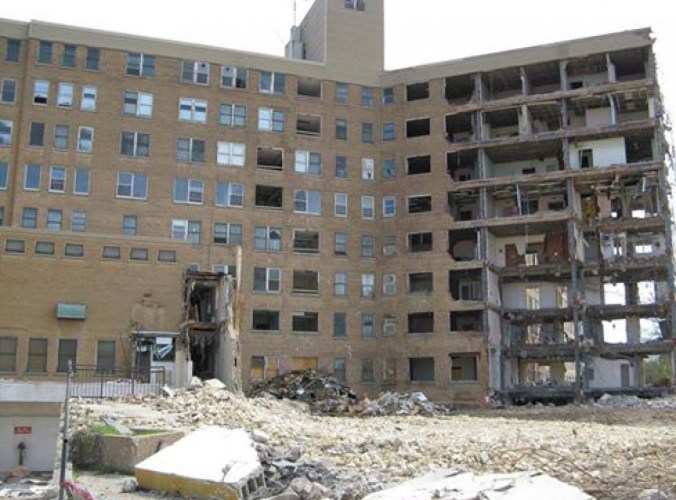
South Street Hospital in London, Ontario has now been torn down, demolished to the ground.  The psychiatric wards were the last ones to be closed, years after all the medical inpatients had been relocated to a newer and more adequate facility.  Once the building was abandoned I re-visited the grounds, the building stood like a ghost, an empty shell, holding the untold stories of so many people just like me.  Some of them, like my friend Darlene, didn’t survive those years and lost their lives to suicide.  But I made it out and I now provide feminist based peer support to survivors of violence as my full time job.

So many memories from those years mix together with memories of the other traumas in my life and have been resurfacing more than usual recently as intrusive flashbacks.  Sometimes I worry that those around me tire of my ongoing struggle with post-traumatic stress disorder (PTSD) and it is difficult to share the memories.  At times I fear I will face disbelief, dismisal or disgust rather than validation and acceptance.  I’ve decided the memories are surfacing for a reason and they have to go somewhere.  Better out than in?   Why not share them with the world?

I am a psychiatric survivor.cropped-10267763_10152018756625936_5945078775421952754_n.jpg