Celebrating One Year of Hopeforsanity Blog!

anniversary-background_23-2147508481

It’s been one year since I started writing this blog.  If you are a new reader I encourage you to go back and read the first few posts of this blog.  To all of you who are reading, following, liking, sharing and commenting: THANK YOU!  I’m writing this blog for the dual purpose of expressing myself and connecting with others who are struggling, letting them know they are not alone.  You are not alone.   Though this blog has dealt with graphic and dark topics, I aim for the overall message to be one of hope and resilience.

Twenty one years ago tomorrow (April 12, 1996) the entire course of my life changed.  I was 15 years old and I entered into an abusive relationship that altered my relationship to myself, my friends, my family and my body.  I went from a relatively happy, self assured, popular 15 year old girl, to an anorexic, withdrawn, self-hating, 16 year old young woman.

I believe Ana was born at this time.  It’s no coincidence that Ana is 15 years old.  Ana is my traumatized child self personified.   Ana is angry in ways my younger self could not be.  Ana is all the fear, shame, guilt and hopelessness personified into a rebellious teenager who only wants to hurt me and say a giant F U to the rules of the world.

Sometimes I wonder how my life would be different if I’d never dated X.  If I’d never tried to befriend him.  If I’d never believed that I could help him feel better about himself.

I also wonder how my life would have been different if I’d been taught as a child that it’s okay not to be “nice” to someone who is hurting you.  I wonder how my life would have been different if I’d been less concerned with being “perfect” and more concerned with protecting myself.  I wonder how my life would have been different if I’d realized that saving myself was even an option.  I was an easy target for perpetrators of abuse.  I played the role of rescuer, helper, caretaker and I never wanted to let anyone down or disappoint anyone.

People who don’t understand normal coping reactions to sexual violence have asked me:  Why didn’t you just scream?  Why didn’t you tell someone?  Why didn’t you push him and run away?

All I can say is that the answer is so complicated.  The answer lies in the social conditioning of some women living in a patriarchal, rape culture.  The answer lies in being taught to be “good” rather than to be true to oneself.  The answer lies in physiological responses which caused me to freeze and disassociate rather than fighting or fleeing.   Those physiological responses were not random, but were connected to the socialization of being a “good girl.”

My 15 year old self never would have considered screaming or fighting back.  Because she was ashamed, blamed herself and never wanted to make a scene.  My 15 year old self was confused and inexperienced and it took her a while to figure out that she didn’t like the sexual experiences that were being forced on her.  It took her a while to figure out that she wasn’t really choosing.  By the time she realized it wasn’t right, she was already coping by disassociating to lessen the impact of the abuse.  By the time she started firmly saying no, the pattern of abuse and the cycle of violence was already firmly established.   And because she was not naturally an assertive child and had not been taught to fight back in self defense, when her no wasn’t listened to, she began to shut down even further, withdraw further and develop other ingenious coping techniques such as anorexia, self harm and disassociating completely.

These reactions weren’t accidental.  They were conditioned from a young age.  Adults have to teach children to fight back.  Adults have to teach children that being nice can stop when someone crosses a boundary.  Adults have to teach children to fight like hell to escape a dangerous situation.  And even if a child learns all these things, it is still possible that in a violent situation freezing can be the only available option.   Many people being abused feel that fighting back would only result in further violence and physical injuries.

In my case, what kept me frozen was guilt and shame.  I thought I was doing something shameful by being sexual.  I thought that his family and my family would judge me.  I thought that my friends would judge me for neglecting them (as I was being socially isolated by the abuser).   Self blame kept me frozen and not fighting back.

Even as an adult, 21 years later, I still cope with conflict and stress by freezing or disassociating.  I’m still not skilled at saying no.  I also have difficulty saying yes or asking for what I need.

I think for a person who has experienced sexual violence it is difficult to say no.  Because in the abusive situation no was ignored and pushed past.  So staying silent feels less painful than having no not respected.  If I never really say no, I can’t be abused again.  It’s warped logic.  It is not productive or helpful, and it also prevents me from comfortably saying yes.

For someone whose boundaries have been consistently violated, setting boundaries can become a life long struggle.  A skill that must be learned or relearned gradually and with patience and self compassion.

Quite simply, I survived in abusive relationships for many years because I literally felt I had no other option.  I didn’t even feel like I deserved to be respected and I was gaslighted into believing the abuse was my own fault.

It’s never helpful to ask a survivor “Why didn’t  you just leave?”

Keep those thoughts to yourself.

They would have left if they could have.  And if they did leave, they are successful.  It doesn’t matter how long it took.  It took as long as it needed and not a moment longer.  Celebrate the reality, don’t question why it didn’t happen sooner.  “Why didn’t you just leave?” is a type of victim blaming statement.   If you don’t understand how someone could be trapped into an abusive relationship, educate yourself.  Don’t ask the survivor to educate you on their own painful lived experiences.  Survivors need to feel believed and validated, not questioned into justifying their existence.

Every year on April 12, I count another year of my life that has been impacted by sexual violence.  It is a grim reminder that for many survivors, myself including,  that the abuse was not “a long time ago” and we can’t “just get over it”  or “just move on.”  For people living with PTSD, time is a slippery beast.  Ana is still 15 years old.  Ana is me, she’s a part of me.  A part of me that never really grew up.  A part of me that needs parenting.

I’ve never parented a teenager before. I have no experience.  But I guess I’ll have to start somewhere.  And starting with acknowledging she is here, and she has unmet needs, is as good a place as any!
 

Calories on Restaurant Menus: a Rant.

index

When Ana and I first started hanging out together, I used to go to the bulk food store and buy candy.  Specifically, gum drops and red licorice bits.   I used to drink diet coke and eat twizzlers licorice from the 7-11 on my way home.  I used candy and diet pop as a replacement for proper nutrition.  I would bring exactly 5 gum drops to school and I would eat them slowly, while sipping diet coke and pretend it was a meal.  Those gums drops and the occasional licorice were some of the only treats allowed into my strict food rituals.  I loved that candy.

Then one day, the bulk food store started posting nutritional information on the lids of their bins.

And I never ate those gum drops again.  In fact, I stopped eating candy.  I mostly stopped shopping at bulk food stores!  Something that had been considered “safe” was suddenly off limits and forbidden.  The only reason?  Because I now knew exactly how many calories were in that licorice piece and 5 gum drops.  I was devastated and angry.  Why did the store need to post the caloric content of the gum drops?  Why?!?

When I was an inpatient receiving treatment for anorexia, I was encouraged not to read food labels, not to look at calories.  I was encouraged to eat based on my body’s cues, or even mechanically an appropriate amount to sustain health.

For the most part, I did this for years.  When my children were diagnosed with severe and life threatening food allergies, I was forced to confront food labels.  I was forced to read all the ingredients and check carefully for potential allergens.  I struggled with this, because again my eyes could not avoid seeing the nutritional information, calories and fat in the items I was consuming.  But I did it for my kids health and safety.

Recently, the government has decided that it is mandatory to post nutritional information and caloric content right up on the menus of all restaurants.

I was furious!  This is so incredibly triggering for many people with eating disorders.

I absolutely did not want to know exactly how many calories were in the Starbucks cookie I was having for a snack.  I did not want to know how many calories were in my caramel latte.  I just did not want this information.  I don’t want it!  I will never want it.  Because once I know it, I can’t “unknow” it!  This information is not useful to my life.  It does not make me healthier or happier.

On a good day, the information won’t change the choices I make.  But on a bad day, a day when Ana is in the driver’s seat…

Suddenly I’m struggling over deciding what snack to choose at Starbucks.  Suddenly I’m ordering a black coffee, rather than that cinnamon latte.

On a bad day, nutritional information and caloric content listed in large ominous letters on the menu in front of me, can put a dark cloud over my enjoyment of that snack or meal.

I understand that nutritional information must be available at restaurants.  It should be available for those with food allergies or sensitivities or religious dietary restrictions.  It should be there for those with diabetes.  It should be there for viewing ON REQUEST!  But does the caloric intake of my Starbucks beverage REALLY need to be right in my face as I attempt to order?

I think the answer is no.  I go to Starbucks for a break.   I go there to relax.  I go there to treat myself and rest from the stress of my life.  I don’t go there to have an extended and upsetting debate with Ana.

I just want to drink my coffee in peace!

Capitalism = Isolation

capitalism-and-freedom

We live in a society that glorifies productivity, busyness and wealth.  I’ve been thinking a lot recently about how this capitalist value system doesn’t work for people with disabilities including chronic mental illness.  I’ve also been thinking about how glorifying busyness means devaluing human connection, caring and many tasks that are associated with women’s unpaid labour (housework, childcare, health care); as well as, devaluing self care (especially for women).

Those are a lot of big words.  As I’m adjusting to reduced energy levels and increased amount of symptoms related to my physical and mental health issues, I’ve been recognizing the need to slow down.  I’ve been more aware of my disability than usual.  I’ve been very keenly aware of how many people around me are addicted to, or glorify, being busy to the point of workaholism.  I’m aware of how many people around me are literally too busy to make a human connection.  I’m aware of how many people are putting careers first, trying to get ahead, trying to get rich…and putting off connection “for later” or for “when I’m successful enough.”   It’s incredible how many people are too busy to spend time with friends.  Too busy to go on a date.  Too busy to have a telephone call other than in the car in between “essential” tasks.

I’ve been reflecting on what is actually important to me and why I often feel like I just don’t fit in anywhere.

Quite honestly I have no interest in being so busy that I am too exhausted to enjoy my life.  I don’t want to be rich.  I don’t want to be famous.  I don’t want to have a bigger house or a fancier job. I don’t want to be the boss.  I don’t want to have fame.

I just want human connection, peace and happiness and I don’t think money can buy those things.  Neither can workaholism achieve them.  I want to have time to enjoy  my kids while they are young.  I want to spend the day cuddled in bed with a partner.  I want to have someone to cook for.  I want long talks over coffee.  I want to have someone to talk about my day with.  I want to be comforted when I’m afraid.  I want to create memories.  I want to feel like I have space to breathe!  And I want someone else who feels the same way.

It’s occurred to me that there is a much larger social problem going on around me when people I talk to don’t have time to meet for a coffee.  Not just one or two people, but the majority of people I know are so busy they have almost every minute of their lives scheduled.   I’ve been thinking a lot about how our society glorifies being busy.   Society equates being busy with being valuable.   Being productive with having inherent worth.

But where does that leave people who choose to stay home to take care of their children?  Where does it leave those who are living with either permanent disability or temporary illness?   When we don’t value unpaid caring labour we are not valuing some of the most important work in our society.  When we equate productivity and earning power with self worth we perpetuate abelism and the view point that disabled people are somehow less than whole, less than valuable or even expendable.

Equating productivity with self worth means that I’ve been conditioned to believe that resting, self caring, and hobbies have no inherent value.  This is not true.

Equating earning power with value, means that when I entered the workforce my years of full time parenting were not viewed as relevant experience, even though I was applying for jobs in the helping profession.

Capitalism creates a world where burn out is expected.  It is almost worn as a badge of honour by some people, how many hours they work and how much money they earn.

Lately as I’ve been forced to slow down and accept my own limitations, I wonder if some workaholics will have regrets.  I wonder when people are old and rich, but alone if they will feel sad.  I wonder if people feel satisfied with the lives they have, or if like me, they are yearning for more.  I wonder how many people in our society are deeply yearning for connection.  Connection to one another, connection to community, connection to nature and connection to something bigger than themselves.

It could be a radical act to accept our self worth is not connected to our net worth.

It could be a radical act to deeply value self care and caring for others.

It could be a radical act to care for our communities and help those around us who are less able, while still viewing them as complete and valuable human beings.

It could be a radical act to value connection.

(please note this blog entry is NOT meant to devalue the struggles of those who don’t have enough money for the basics of life, or who need to work long hours to provide the basics for themselves. Captialism is responsible for this as well, because a more communal philosophy would place stronger social safety nets in place, including a living wage!)

Internalized Stigma.


20170314_165530[1]

Stigma causes me to make terrible choices.  Internalized stigma is dangerous to my health.  This is what I learned over the past few weeks.

Why do I feel so many complicated feelings about taking an anti-psychotic medication, but completely different feelings about taking arthritis medication?  The answer is internalized stigma.

Mental health stigma has taught me to be ashamed that I take psychiatric medication.  Internalized stigma causes me to think that I shouldn’t take the medication, that I should try to stop taking it as soon as possible, that I’m weak and somehow not good enough because I need medication to stay functional.  Basically, stigma lies.

Recently I started an alternative treatment which was helping me to sleep.  Because I was able to fall asleep, I decided to reduce my anti-psychotic medication.  I don’t need this!  I can function without it!  I’ll be fine as long as I’m still sleeping!  I feel okay!  What could go wrong?

As it turns out, a lot could go wrong.

Within a week of reducing my prescription medication, I was having multiple panic attacks a day, having paranoid thoughts, thinking that I was seeing my ex everywhere, afraid to leave the house and almost impulsively quit my job!

I was physically sick, dealing with a lot of triggers and somehow I thought it was going to be absolutely fine to reduce my psych meds!

I’m going to blame this on stigma.

I’m also going to blame stigma for how long it took me to realize that the change in medication was directly linked to my crisis state.

I mentioned it to my psychiatrist over the phone.  We talk very infrequently since I’ve been stable for the past few  years.  He told me to take the medication.  He told me that I have so much going on and so much stress that I don’t need to justify to anyone that I need the medication.  He said, just take it.  Just take it and don’t worry about it.

I thought about it and I realized he was right.  Why was I fighting so hard to reduce the dose of a medication that wasn’t causing me terrible side effects and, in fact, was reducing some of the most unpleasant PTSD symptoms (panic, paranoia, seeing things as a result of flashbacks)?  Why was  I judging myself so harshly?  Why was it more important to reduce the medication and not be “dependent” than it was to keep my job?

The answer was that it wasn’t more important.  That I didn’t need to judge myself.  That I needed the medication to keep the symptoms at bay.  Yes, the anti-psychotic medication (as it’s name implies) was ACTUALLY keeping me functional and not on the edge of psychosis!

I started on the higher dose that night.  Within 2 days I was back at work, within 4 days the panic attacks were reduced and almost back to “normal” levels.  Within a week, I’m feeling more hopeful and less terrified.

These pills help me.

Yes, I’ve had horrific experiences with psychiatry and psychiatric medications.  Yes, some of these drugs have made me worse and almost killed me.  Yes, there is a social stigma associated with anti-psychotic drugs.

But I’m going to work on not internalizing this stigma.  I’m going to work on accepting what is.  Accepting my current limitations.  Accepting that PTSD is a brain injury and it’s logical to take medication if it helps balance things out.

So next time I start talking about decreasing my medication, please remind me to re-read this post.  Please remind me that my health is more important than stigma.  That I’d rather be functioning and medicated, than in crisis and able to say that I don’t take any medication!  Remind me that going off my medication is NOT a good idea right now.  And maybe be gentle with yourself too…do what you need for your recovery.  Do what you need and don’t let judgment (by self or others) get in your way.  You are the expert in  your own healing.  Trust that.


Sick Days.

20170307_164945[1]

I’ve been home sick the past few days and sick on and off for a while now. It’s really difficult sometimes to separate physical and mental health symptoms.  Everything is all blurred together and it’s hard to tell when to push myself harder and when to rest.  This past week has been an explosion of physical and mental health struggles that are creating a storm of symptoms and have forced me to (uncharacteristically) stay in bed.

I haven’t met very many people who understand the complex intertwined experience of having both physical and mental health issues simultaneously.   Most doctors aren’t very trauma informed and also struggle to validate that both physical and mental health issues can occur simultaneously, and be either linked, not linked or both linked AND not linked to each other!

One of the things I’ve been coping with in the past few weeks is a urinary tract infection.   Obviously, an infection is caused by bacteria and isn’t a mental health issue.  But I was also really triggered in the past few weeks and this made me extremely reluctant to seek medical care.  I was afraid to go to a walk-in clinic, afraid to see a doctor, afraid to be examined.  This was linked both to past trauma around the medical system AND generally high levels of panic and anxiety related to stress with my ex and my kids experiencing abuse.   Thus I waited for over a week to go to the doctor, by that time my symptoms were much worse and I felt pretty awful physically.

This is an example of how physical and mental health issues can be both separate and linked at the same time.  The infection itself was physical, but my avoidance of the doctor was mental health and trauma related.   Of course you might also argue that my high levels of stress and anxiety also generally lower my immune system and make it harder for me to fight off infections.

By the end of last week I was on antibiotics, but I also developed a sinus cold.  I had a migraine related to receiving a nerve block to treat the migraines, but the sinus congestion put pressure on the nerves that were being treated.   My anxiety was causing panic attacks and making me afraid to leave the house for fear of running into my ex.

Thus again, my high levels of stress probably didn’t help any of these physical issues that I was dealing with.

When someone has an infection, generally they are advised to rest.  But resting is difficult when you are also struggling with severe anxiety and panic attacks.  My head gets filled with worries about work and what I’m missing and what people think about me being away and creating all sorts of worries and fears, many of which are not realistic.

Anxiety causes me to feel like a failure.  It causes me to feel like making a mistake is a terrible thing which can’t be recovered from.  It causes me to feel like everyone around me hates me and thinks I’m doing a terrible job.  Or worse, they think I’m faking being sick to avoid responsibilities.  A lot of my irrational worries centre around feeling like nobody believes me and that nobody likes me.

Experiencing abuse, and extending periods of emotional abuse, as well as abuse within systems, has lead me to fear and avoid conflict of any kind.  I want everyone to be happy all the time.  I get very anxious when there are disagreements and I’ll often apologize even when I’m not sure I have done anything wrong.   I’ll do what I can to avoid conflict, because when interpersonal conflict levels are high around me, my anxiety levels feel unbearable.  Because ongoing interpersonal conflict is a trigger.  I try to keep people around me happy because I want to feel safe and BE safe.

Unfortunately, in the real world, conflict is unavoidable.  Disagreements are part of life.  As the saying goes, you can’t please everyone all the time.

But I want to!  I need a lot of reassurance from people around me that I’m doing an adequate job.  I need reassurance that conflict isn’t dangerous.  I need reassurance that people believe me, that they believe I experienced abuse, that they believe I’m trying my best.  I need reassurance so badly because my internal dialogue is so self critical and judgmental.

I know it’s not the responsibility of those around me to constantly reassure me.  I know I’m an adult and I have to take responsibility for my own feelings and fears.  The difficult part is that while I’m experiencing ongoing abuse and conflict which is outside of my control, my self esteem is constantly being eroded and challenged.  I need reassurance because I haven’t yet learned to fully believe and reassure myself.

I believe this is very common for survivors who have experienced long periods of gaslighting or complex emotional abuse.    It’s hard to build up a stable sense of self when you are being confused, beaten down and made to feel like you are crazy and nobody will believe you.

Survivors need a lot of patience.  Sometimes you might get frustrated with me.  Sometimes you might feel like I’m being unreasonable.  Sometimes you might not understand why I’m SO upset over something SO little.   Please remember that it’s not little to me.  My reaction could be related to feeling triggered and that trigger is making me feel like a failure.   If you have the energy and patience to reassure a survivor, please do so.  She might need to hear thousands of times that you believe her and that you don’t think she is crazy.

I need to hear it a thousand times.  Especially on weeks like these where I feel crazy, broken and like a failure.

Being physically and emotionally sick at the same time isn’t a lot of fun.  Taking sick days when you are struggling with severe anxiety and PTSD isn’t fun.  It’s not relaxing.  It’s not “a break.”

I guess sometimes we have to carry on, try to move forward, even if we don’t believe or have faith that everything will work out for the best.

Be Your Own Hero.

sometimes-you-have-to-be-your-own-hero-2

It’s been a difficult time for me.  I’ve been waiting 90 days+ for the verdict in my family law trial.  I’m experiencing a lot of triggers and finding it harder to stay positive and optimistic about the future.

Quite frankly, it is terrible for my mental and physical health to have contact with my abuser.  It upsets me, it triggers me, it causes flashbacks and disassociation, it confuses me, gaslights me, makes me doubt myself, my abilities, makes me feel crazy and like nobody believes me.

Unfortunately, he is the father of my children and I can’t just go no contact.

It’s awful.  It’s awful being told I have to “get along” with someone who treated me so badly.  It’s frustrating being told by many institutions such as the kids school, the CAS and some doctors, that I should be more neutral, not let my past impact me, that he’s a loving parent and basically a good person.

Hold on a minute….basically a good person?

That’s what I told myself for years.  It’s just sexual abuse.  It’s just the sexual stuff, he’s otherwise “basically a good person.”  Telling myself that kept me locked into the relationship for years longer than I should have stayed.

Someone who doesn’t believe in consent is not “basically a good person” they are an abusive person.  He is an abusive person.

Privilege in society allows abusers to “pass” as basically good people.  They know how to act, to charm, to make their victims look crazy or unreliable or unbelievable, they know how to discredit others, they know how to tell different lies to different people to suit their needs.  Most abusers can make you think they are basically good people, but in reality, the signs are there that they are not good people.

The saddest part is that because abusers are expert liars and manipulators they can often convince everyone who might be able to help you, that they are good people!   So the abuse they perpetrate goes unnoticed and unacknowledged by anyone who might be able to support or rescue you.

Suddenly, they are “basically good people” and you are perceived as mentally ill and crazy.

Abusers gaslight the system.  That, combined with the societal privilege, rape culture, and patriarchy, allow them to pass unseen, and unnoticed through our world, abusing people as they please and not being stopped.  In a parallel experience, the survivors are believed less and less, as a web of lies is spun about them by the abuser to those around her who might assist her in escaping.

This is what I’m experiencing in my life.  It’s been 3.5 years since I left my abuser but I’m still locked in a web of abuse.  Very few people within the “system” believe me, and those who DO believe me and my kids, are seen as biased!  It’s an unbelievable, frustrating and maddening situation.

The more I protest, advocate and fight for myself and my kids, the more I am labelled radical, crazy, not neutral, too angry etc.

So what are my options?

I feel like the only option is to be my own hero.

At the end of the day, my ex-partner would like nothing more than for me to fall into a crisis and commit suicide.  He wants me to kill myself so that he can be right.  So he can prove that I’m crazy and that I don’t care about, and have never cared about, my kids.  He won’t stop punishing us until he reaches this goal.

But it’s been 3.5 years, and generally I’m more mentally healthy than I was before.  Generally, I take care of myself.  I’m working full time.  I’m becoming more confident in myself and my career.  I have some supportive friends and a supportive family.  I’m not falling into a crisis.

I won’t let him destroy me.  I’ll stay alive as long as I can just to spite him.

I’ll be my own hero, if nobody else will step up to protect my kids.  I’ll protect them and myself and do everything in my power to survive.

Survival is the best revenge.

If you are experiencing abuse, be your own hero.  Believe yourself.  Support yourself.  The rest will slowly follow.

On Valentine’s Day, Celebrate YOU!

16729394_10154320715376623_9141058924879110748_n

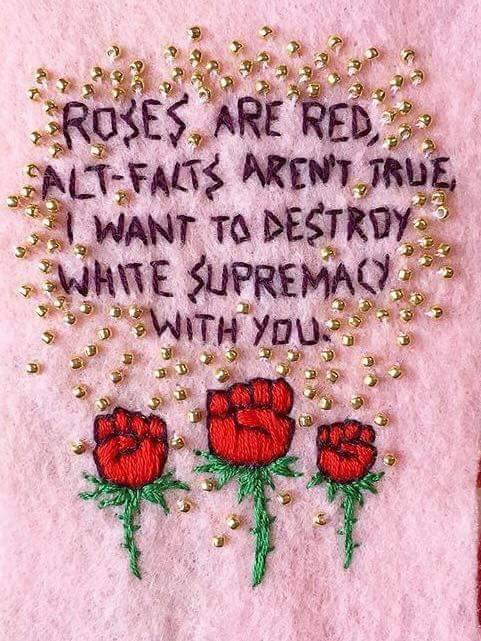
Valentines against white supremacy
By Kate Madeira

On Valentine’s Day this year celebrate yourself!  It’s perfectly okay to take a day to acknowledge yourself and all the work you’ve done.  Celebrate yourself and all your awesome qualities!  Feel proud of the fact that you are a survivor.  You are surviving like a boss.

I’ve been doing a lot of self reflection and taking a long hard look at my life recently.  I’ve been confronted with accepting the fact that it’s not my abusers standing in the way of my recovery (at least not entirely).  What is standing in my way are my own negative, self hating, self-destructive core beliefs.  If I don’t believe that I deserve recovery, health and happiness, then I can’t expect those things to just fall into my life with the wave of a magic wand.

I’m not ready to let go of lifelong core beliefs.  Not yet.  It’s going to be a long journey.

But that journey is beginning with a single step.

Acknowledging that maybe, just MAYBE, my core beliefs aren’t true.  Maybe, just MAYBE, there is another option for me.  Maybe, just MAYBE, I could live a life where I do celebrate myself, I do believe in myself and I do believe that I deserve good things.

This Valentine’s Day, I hope that you find love.

Trust me, self love will last a lot longer than that box of chocolates.

Though you deserve chocolates too!  Buy them for yourself tomorrow, they’ll be 50% off!


Healer, Heal Thyself.

20170206_2044451

Do you ever have the feeling that you are a complete and utter fraud?

I’ve been feeling this way recently, more than usual, as I’ve been reflecting on how little of the advice I share with others that I actually follow myself.   Am I a fraud, if I truly believe what I’m telling other people, but can’t internalize it or believe it for myself?

How is it possible that everyone around me deserves health, happiness and recovery but I somehow feel undeserving of even simple things?

Someone close to me commented on one of my scars this week.  It was a passing comment, about noticing a scar on my hand that he hadn’t noticed before.  To him it was a neutral comment, just noticing, no judgment.  I told him that scar had been there since around 2002, it wasn’t new.  That was the end of the conversation for him, but I started talking about and reflecting on the amount of harm I’ve done to myself over the past 20 years.

Until 2009, I hid all my scars, all of the time, from everyone.  Even when I was home alone I would wear long sleeves and pants.  I was so ashamed of my cuts and scars that I didn’t even want to look at them myself.  In the summer, I was perpetually hot, avoiding swimming, making excuses to stay in the air conditioning.  My life was being seriously limited by my self destruction.

From 2009 on, I gradually began experimenting with uncovering my scars.  I wore t-shirts or skirts when I was hot, and started to swim again.  I still kept a cardigan or long sleeved shirt with me at all times, so I could cover up around people who didn’t know about my habit, or for situations like interviews where I didn’t want to be judged.  I used to have so much anxiety about people seeing my scars and I would imagine all sorts of scenarios where people around me judged me as crazy.  I even thought that CAS would come to take away my  kids because if someone saw my scars they would report me as an unfit mother. Over time, I  became accustomed to uncovering my scars.  I came to a place of a bit more acceptance (plus I got tired of being hot all summer!).  This was a process and today, the only time I purposefully cover my scars is when I’m helping other women at work.  I’m afraid that my scars might trigger others, especially those who are working on their own healing.

I still feel sad though, every spring when the warm weather returns and shorts, t-shirts and summer dresses flood the shopping malls.  I feel sad because in the summer I can’t hide under my clothes.  In the warm weather, I often feel exhausted when interacting with people because I am intensely aware of the visibility of my scars.  It gets a little bit easier each summer, and I think about it less and less often, to the point where there are times that I almost forget about the scars. Almost.

I can’t really forget about them. I can’t forget about them because they represent a huge, unnameable, unspeakable history of trauma and pain.  And at some points I feel crushed by the weight of the realization that I have been my own worst abuser.

I am my own most dangerous and most unrelenting abuser.

It’s difficult to know how to even approach talking about, thinking about or grieving the trauma I’ve inflicted on myself.  It’s not something others discuss or disclose to me either.  We talk about the hurt caused by other people in our lives, the betrayals, the injuries and the abuse.  We talk about being hurt and being damaged.  But how do I start a conversation or healing process around the trauma that I perpetuated?  How do I heal from situations where I was both the abuser and the survivor, simultaneously in one person, in one experience, in one breath?

My experience of surviving sexual and emotional abuse at the hands of perpetrators, is directly linked to my “decisions” to cope by self harming in various ways.  Before I was sexually abused I didn’t have anorexia, depression, PTSD, or obsessive compulsive tendencies and I did not cut or physically harm myself in response to stress.   Before I was sexually abused, I considered myself a “normal” person.  I didn’t have a mental illness, I didn’t have dangerous coping techniques, I wasn’t a psychiatric survivor or  a survivor of violence.   When I look at my scars, I see both the abuse I survived and the abuse I perpetuated.  The scars are an ever present reminder that I have survived, but they are also like a road map of the destruction and self destruction that has woven through my adult life.

Yes, my scars tell a story, but I’m not sure it’s a story that I want to hear.  I’m not sure it’s a story that I want to tell either.

But sometimes I do want to tell my story.  That’s part of why this blog was created.  There just isn’t a lot of space in our busy, day to day lives, to talk about the story my scars tell.  The person who was with me during the majority of those years (my ex-husband) is no longer available or safe for me to contact.  I don’t have anyone to share my memories of those dark years with.  The people who know me now weren’t there with me in the emergency room while my cuts were being stitched.  The people in my life now, weren’t there with me when I tried, multiple times, to end my life.   Except for a few, the people in my day to day life, didn’t know me when I almost starved myself to death.  People see me differently now.  They see me as a whole person, a mostly well person, a successful person, a good mother, a co-worker, a friend…sometimes I feel like a fraud because I can’t, or don’t know how to, talk about these aspects of my past.

And sometimes I want to talk about them.  I really want to talk about what things were like “before.”   Before I left my ex-husband.  Before I stopped utilizing the psychiatric system.  Before I decided to stay alive.

That “before” person is still me.  I’m just not sure how to heal that “before” me and this current me simultaneously.  I’m not sure how to forgive myself, or to have sympathy or empathy for the me that wanted to die.  I’m not sure how to look at my scars without feeling sadness for the fact that I permanently disfigured my body before I turned 25.  I don’t know how to grieve my smooth, scar free skin…I barely even remember what I looked like before I started cutting.

There are days when I accept my scars.  They are a part of me, they do tell a story and they do represent survival.  But there are days when I hate them.  I hate being different.  I hate having a visible mental illness.  I hate feeling ugly.  I hate worrying about what others will think when they see them.  I hate hating myself SO much that self harm feels like a reasonable solution.

Sometimes I look back on the past and wonder what my life would be like if I’d chosen a different way of coping.  Or if I’d never been abused.  Or if I’d told someone about the abuse.   How different would my life be if I’d never picked up a blade, never wished to end it all?

It’s an interesting dilemma, because there are some parts of my survivor self that I like and I wouldn’t want to change.  If I hadn’t had these experiences I would have chosen a different career path.  I wouldn’t have had my children at a young age.  I wouldn’t be as passionate about social justice and advocacy.  I wouldn’t know the majority of my current friends.

My life would be very different.  I don’t even want to change the past.  It did make me the person I am today and I’m okay with that.   What I do want to change is how much I still judge myself, berate myself and hate myself for my past choices.  I want to learn to do more than accept my scars.  I want to do more than tolerate my body, in an uneasy, fragile truce.

Intellectually, I know that I deserve more than surviving.  Intellectually, I know that a deeper level of healing is possible.  I’ve seen people around me heal and recover from unimaginable horrors.  I’ve seen people build a sense of self confidence from the rubble of their lives.  I know it is possible and that self-love and self acceptance are attainable goals.

But emotionally, I just don’t feel it.  And that makes me sad, and maybe right now, the first step in healing self-hatred is just simply grieving the loss of that 15 year old healthy self.

 Note: The illustration was drawn by me around 2004


Can’t make everyone happy.

One of the ways I’ve coped with trauma in my life is to try to make everyone happy all the time.  When I was a child I thought my role was to “be nice” and to “be a good friend” and to take care of others, pay attention to my friends’ feelings, be considerate, be polite and do well in school always.  Essentially to be perfect all of the time.

I took this to such an extreme that I thought it was my responsibility to save, fix and adapt to my abusers.  Somewhere along the way I did not learn that it’s okay to be mean to protect myself.  It’s okay not to be nice to abusive people.  It’s okay to say NO, even to scream it and it’s not something to feel guilty for.  As an adult I STILL struggle with internalizing this.

I’ve spent the majority of my life trying to figure out what part of all my traumas is my fault.   What could I have done differently?  How could I have seen it coming?  Maybe if I’d been a better friend, she wouldn’t have died.  What if?  Maybe people are mad at me?  Maybe I made a horrible mistake at work and everyone blames me.   A good portion of my internal dialogue is convinced that somehow I’m a terrible mistake.  I’m not really a good person.  If only everyone could see!  Then they’d know the truth.

So as an adult, in most areas of my life I try to be the peacemaker.  I try to listen to everyone’s side of the story.  I try to minimize or avoid conflict at all cost.  I feel incredibly uncomfortable, even panicky when people around me are angry.  And if there is a conflict, you can bet it’s somehow my fault and I will feel guilty about it.

The irony, is I support survivors of violence every day.  I’ve told over a hundred or more women that what happened to them isn’t their fault.  I’ve told friends, I’ve told family members.  Heck, I’ve even told my abusers that things that happened to them weren’t their faults.  You were a child!   You couldn’t have known!   You did everything you could to protect yourself!   You aren’t to blame, he’s an abusive person.   You were in the wrong place and the wrong time.  You couldn’t have prevented it.  Your are doing what you can to take care of yourself.  It’s not your fault.  I believe you.

But at the end of the day, I treat myself with contempt and blame.  I feel like literally everything is my fault.  Always.  I try to depersonalize.  I know intellectually that most people aren’t even thinking about me, let alone blaming me for things that go wrong.  But deep down, I fear that I’m just a flawed person and I feel panicky when I realize I can’t keep everyone happy all the time with sacrificing myself.  And even if I do sacrifice myself, people around me have their own feelings and can be mad, hurt, angry and scared and there is not a connection to me.

A lot of women grew up with the message to “be good” and not to show anger.  Angry girls get labeled bitches.  Assertive girls get labeled bossy or rude.  Angry girls are judged.  People like calm, pretty, patient and loving girls.  We are surrounded by this covert and overt messaging from birth.  The labels put on us almost before we take our first breaths.

Why do so many girls and women feel such intense guilt and even shame around saying no?  Why do so many girls and women feel that anger is an unacceptable emotion and that they are bad for having it?  Why do I feel this way?  How do I make room for myself without feeling guilty?  How to say no without feeling afraid and ashamed?

These days, the world has become a scary place.  I’ve had to take breaks from social media and the news because I’m so devastated by the hatred and violence I see.  I feel the urge to isolate myself, connect less, spend more time alone.  Because I don’t feel very safe in the world anymore.  It’s rare that I feel truly safe.  As a survivor of violence, living with PTSD I feel scared most of the time.  But current events have triggered a different level of fear.

And sadness.  Because all the caring in the world can’t fix this mess.  I could be the best person in the world and I couldn’t make all my friends feel safe.  I want everyone to be in a bubble where they feel safe and protected.

I am a good person. I genuinely help people because I care about them and I want to.  It’s not because it’s an obligation or how I was raised.  It’s not just the expectation placed on me.  I think I was always this empathetic person. I always cared deeply, perhaps too deeply.  And it’s always hurt me.

But right now it hurts too much.  I just want to say NO MORE TRAUMA and hide from the world.  My brain feels overwhelmed with conflict.  I’m afraid about everything I do, that it will somehow make things worse.  When I’m alone at least I can think and I only have to monitor myself and my environment, not other people and their reactions.  Sometimes the guilt feels too much and I just don’t want to make a mistake or let someone down.  I’m also terribly afraid of being hurt or betrayed by someone else.  Sadly, this is a lonely way to live.  I just want to be in a bubble and feel safe and protected too.

Being lonely feels safer right now.  Because I can’t make everyone happy all of the time.  Sometimes I feel like I can’t make anyone happy, ever.

I can’t even make myself happy.