You’ve washed your hands clean of this

20160518_214015[1]

2003

I graduated from my undergraduate degree in June of 2003.  While I was completing my degree I took a number of classes taught by the same professor.  Let’s call him Professor L.  Towards the end of my degree and certainly over the summer that followed Professor L and I became friends.  I didn’t think much about it, I was engaged, clearly unavailable, he was my teacher.  We used to talk about ethics and academic topics.  I visited his house once or twice and he came for dinner with my finance and me at our house.  Over the summer I helped him with some research projects.   In the Fall he was out of town for a few months for work.  We would email back and forth.  He’d send me poetry.

I was 23 years old and he was 45, almost twice my age.  I was fairly naive and I overlooked some obvious red flags.

About a week before Christmas, December 2003, we had plans to meet and go shopping for Christmas gifts together.  He was back from his trip and we hadn’t seen each other in a while.  He came by my apartment to pick me up and when he arrived he said he was tired. He asked if he could come inside to rest for a few minutes.  I hesitated, I felt uncomfortable, I wasn’t sure…but I trusted this man I’d known for almost 4 years and I let him in.

Looking back on that day, I wish I had listened to my body’s signals and said no.

Professor L came inside and we sat on the couch in the living room.  He sat down very close beside me.  I felt nervous, anxious to go out and go shopping as we had planned.  It was the first time we’d been alone in my apartment together.

To be honest I don’t remember exactly what happened next.  I know he began stroking my arm.  He asked if he could see my scars, he asked me if I wanted him to touch the scars.  I still have flashbacks 13 years later if someone touches the scars on my arms or asks to touch them.

I was wearing a black long sleeved shirt, it was one of my favourites that I’d purchased on a trip to New York in 2002.  It was soft and beautiful.  After that day I shoved it in a drawer and I never wore it again.  I couldn’t bring myself to put it back on and eventually I donated it to charity, even though I still loved it I didn’t love the memories of him touching me while I wore it.

He was wearing a black scarf with gold flecks in it.  The gold made a design or pattern on the black scarf.  I remember staring at that scarf until the gold spots blurred together.  That scarf became the focus for my disassociation.

I didn’t say no. I didn’t say stop. I froze and I disassociated.  And I’m lucky because it could have been a lot worse, I could have been raped and I wouldn’t have resisted because I checked out.

I remember him stroking my arm and then touching my breasts.  I think he kissed me, but I mostly remember the touching.

I don’t know how much time went by, but at some point he realized that I was gone, that I wasn’t participating or responding, even when he spoke to me directly.  He got up and went to the bathroom.

I remember crying softly.  I don’t remember how much time went by, it seemed like hours but it probably was less than 20 minutes.  I sat curled up on the couch crying and unable to speak.  He spoke to me and tried to make things better and I didn’t respond.

Eventually I came back to reality and I asked him to leave.  He left.  I was so relieved.  I knew I’d been incredibly lucky to escape.  I was terrified knowing that I couldn’t have defended myself.  I felt like my body had betrayed me by disassociating rather than fighting back.

I couldn’t understand what had just happened? Why did he do this?  He knew I was in a serious relationship, I was 20 years younger than him, I never asked him to touch me, I didn’t invite him into the house…

I spoke to him by email.  I was crushed, I thought he was my friend, but I realized that I might have to end the friendship.  I asked him to take responsibility for what he had done.  I knew it was premeditated because he invited himself in.  But he wouldn’t admit it was planned.  A few months later I cut off contact with him because he was never accountable for assaulting me.

I remember going home for Christmas that year.  I was so triggered by what happened.  I remember crying.  I remember moving the bed in my room up against the wall so I would feel safer at night.

The worst part about what happened was that Professor L was the person I planned to use for reference letters to get jobs or to get into graduate school.  I hated the idea that I would have to ask him for a reference letter.  I felt like he would write a good letter only because he thought of me sexually.   It made me feel used and sick in ways I can’t even describe.

I went to the University and I told the academic counselor that I would need reference letters but I wasn’t comfortable contacting Professor L myself.  They were understanding but said that likely nothing could be done about his behaviour because I was no longer a student, so we were essentially just two adults.  That wasn’t entirely true because he still had power over me in terms of being my academic reference.

In 2008, I applied to go back to school for my Masters degree.  Professor L mailed the reference letter to me and I didn’t have to speak to him.  When I received the letter, I got immediately upset.  I remember leaving the house after the kids were asleep and walking to meet my friend.  I was holding the letter, crying and shaking, having flashbacks to the assault, just because I was touching a letter that he had also touched.  It was awful.  My friend helped me calm down and I was able to send the reference letter in.

I got into Grad school.  No thanks to Professor L.

Silence means no.

Migraines.

635787012203546833-1156820432_01-memorable-quote_2x.imgopt1000x70

This will be a short post because I’ll be heading back to bed shortly.

Migraines and other chronic pain issues seem to overlap frequently with PTSD.

My migraines are genetic and heavily hormone related. I also have certain food triggers and stress is a factor, especially in the severity and duration of the migraine.

Basically for 10-14 days of the month my migraine threshold is lowered due to hormonal changes.  If during that time I also have a high amount of stress, I will be more likely to get severe migraines that last for multiple days without relief.  If I also eat certain things like caffeine, chocolate, red food dyes and artificial flavours or colours during that time…well…you get the idea.  It’s not a pretty picture.

If you have never experienced a migraine consider yourself lucky.  If you do live with migraines, you have my sympathy.

For me, migraines are much more than “just a headache.”  I get visual distortions and blurry vision in my right eye.  This makes it difficult to drive and difficult to focus.  I get a fog in my brain which makes it hard to think clearly (probably due to the severe pain).  I often get nausea and occasionally in the past even vomiting.  I become extremely sensitive to smells and the smells make me more nauseous and make the pain worse.  The worst smells are perfumes, peeling oranges, and coconut scented lotions or air freshners.  A random collection of scents, but things I can’t tolerate during a migraine.  Bright lights hurt my eyes and cause me to squint.  Loud noises and even vibrations will cause increased pain and sensory reactions.  During some migraines I also experience a lot of dizziness and sometimes shaking or general feelings of weakness.

But I don’t look sick and this happens on a regular basis so I can’t just put my life on hold, take day off or stop caring for my kids.  Sometimes I have to leave work early or ask for help with the kids, but the majority of the time I just keep on going.

I have had trouble getting treatment for my migraines for various reasons.  One of them is that because of my scars and my mental health history doctors don’t believe me.  They won’t prescribe me narcotics, even though pure codeine does help me with a severe migraine.  I’m always afraid to go to Emerg for pain relief because sometimes I will be believed and treated and other times ignored as a “drug seeker.”

The intersection between chronic pain and mental health stigma is real.  I also have a less common form of arthritis which took years to be properly diagnosed and treated because doctors blamed the pain on my depression and eating disorder.  They didn’t seem to understand that it is possible to have a physical and mental health problem simultaneously.

When my migraines are bad I know that I need to get a referral to a neurologist and explore other treatment options.  But when they are bad I have no energy to get this done.  When I’m feeling better I go into avoidance mode due to my fears of facing discrimination when seeking health care.  It’s a vicious cycle resulting in more pain because I don’t have a doctor following this.

Today I’ve spent quite a few hours lying in bed with ice on the back of my neck, the room spinning whenever I open my eyes.  It’s discouraging.  I have things I want to do, I have plans, I have work…but my body is saying NO! and I am forced to listen.

People with chronic pain aren’t lazy.  They don’t want to be sick or to need to slow down.  People with chronic pain are doing the best they can and even if their limitations are invisible they are valid.

Please don’t say “you don’t look sick” to anyone ever again.  You never know what battles people are facing (physically or mentally).  As with surviving trauma, sometimes the most helpful thing to hear about my chronic pain is “I believe you. How can I help?

Scars.

20160515_210419[1]

What is it like parenting two children when you are a psychiatric survivor?

Pretty damn scary.

I remember when I first got pregnant and for the first 2 years of parenting my kids, my biggest fear was that someone would call Children’s Aid and report me as an unfit parent.  I worried that my first baby would be taken from me at birth.  You might ask why would someone whose baby isn’t even born worry so much about being an unfit parent?

My body is covered with scars from self inflicted wounds.  I was terrified someone would see this, make assumptions about me, and consider me a danger to a child, especially my child.

I’ve been parenting for almost 10 years now and so far this fear has never materialized.  I still worry about being considered “crazy” and thus “dangerous” and thus “unfit.”  In fact, this is the weapon my ex-husband has used against me since the time I began leaving him.  Just accusing someone of being crazy tends to impact the way others view that person.  My ex-husband took moves out of Dr. X’s playbook and began telling everyone, including the children’s health professionals, our neighbours, the kids’ school AND Children’s Aid that I had borderline personality disorder.

Despite the fact that my own doctor and many other doctors have testified that I do not have borderline personality disorder, this label is still haunting me 15 years after it was first, incorrectly, applied by Dr. X.

Let’s just break this down for a minute.

In the days of insane asylums, a man could have his wife committed against her will since she was essentially his property.  I’m sure asylums were full of women who were wrongly diagnosed as “hysterical” or something, just because they spoke out against the men in their lives.  Maybe they were being abused and dared to say something, maybe they didn’t conform completely to patriarchal societal standards, but one way or another they were put away.

The days of asylums are gone, but the stigma of diagnoses like borderline personality disorder remains.

It’s a very convenient excuse to deflect responsibility for perpetrating abuse.  “Oh, she’s crazy don’t you know.  You can’t believe her story because she’s mentally ill!”

Sound familiar to anyone?  Yes, accusing survivors of being “crazy” is an aspect of rape culture.  Survivors are not crazy.  They are speaking a truth that many in society do not want to hear and thus they are labelled, marginalized and stigmatized.

Every spring when the weather gets warm and t-shirts start to appear, my fear returns.  In the winter I can usually “pass” as “normal.”  My scars are safely hidden under layers of winter clothing.  In the summer, I stand awkwardly with my hands behind my back when I meet new people and when I pick the kids up from school.  I keep a cardigan at work to throw on before meeting with service users.  I see the scars myself, day after day, and sometimes it triggers me and makes me think about a time in my life I’d rather forget.

I still worry that people will view me as an unfit parent because of the coping choices I made.  But I wear t-shirts, because it’s hot outside in the summer.  I won’t hide under clothing everyday for the rest of my life.

If you have used self harm to cope, don’t be ashamed.  You survived and that is the most important thing.  Your scars tell the story of your survival.  If I could tell you a hundred times that you aren’t crazy I would.  But honestly, I’m spending a whole lot of energy reassuring myself that very same thing these days.

My scars tell my story.  Sometimes I wish my story was different, or that I had the privilege of having an invisible mental illness, but that isn’t my reality.

And believe it or not, some people think my scars look pretty damn cool.


PES (Psychiatric Emergency Services)

INEWS101A-MentalHealthHolds

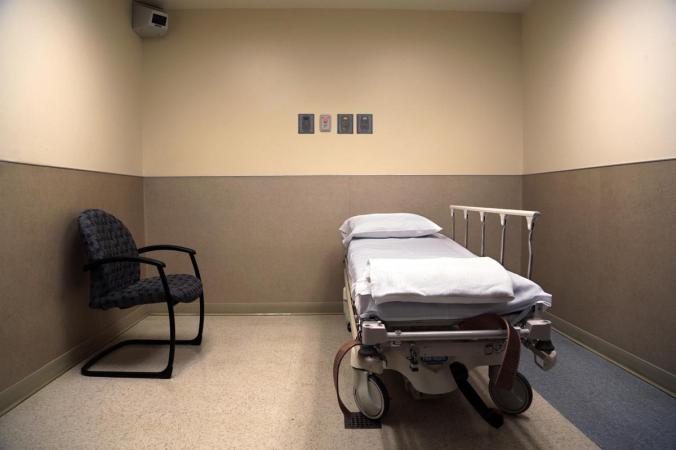
I’d been in the psychiatric emergency rooms at South Street hospital more times than I could count.  But that was an old hospital. The rooms were basically just regular rooms, except the chairs were bolted to the ground.  One of them had an ugly green tiled floor.  One of them had a stretcher in it.  There were chairs just outside for the security guards to sit.

In July 2011, I was in a different hospital emergency room.  This hospital was newer and had an updated PES (Psychiatric Emergency Services) department.  The door to the department was locked at all times.  There were 4 small rooms, similar to the one in the picture above except the chairs were bolted down, and one washroom.  In the washroom the toilet was metal and had no seat.  The sink was metal and attached to the wall.  In the central area between the 4 rooms there was a water fountain and two telephones attached to the wall.  In the central area there was also a stretcher with restraints on it. Separated by another locked door was the nursing station.  Each of the rooms had cameras in them (except the washroom).  The nursing station had a window which looked into the department.  The washroom reminded me of what I imagine a jail looks like.  In fact the whole experience was like being in jail.

My family was out of town visiting my ex-husband’s extended family.  I was in my last weeks of the practical placement that would complete my Masters degree.  Ironically my placement was in a psychiatric hospital.  The depression that had crept back into my life in the Fall of 2009 had worsened.  There were many reasons for this.  I felt desperate and I had tried all the medications that were available.  I began to seriously consider ECT (electroconvulsive therapy aka shock treatments).  This had been suggested to me in the past around 2004, fairly early on in my psychiatric survivorship story.  At that time I felt it was too soon, I hadn’t tried a whole class of medications.

In 2011 I felt like my options were suicide or ECT and I preferred the ECT.

I wasn’t coerced, I wasn’t pressured into it.  I sought out the treatment myself with the support of my outpatient psychiatrist.  Since he has no privileges at the local hospitals my best bet was to go to the ER and ask for a consult.

My plan was to do this as an outpatient.  But things went awry.   When I told the psychiatric resident how much I was struggling and how suicidal I was she wouldn’t let me leave.  The doctor on call told me I had to be admitted to the hospital and that if I didn’t agree to stay she would admit me on a Form, involuntarily.  At this point, locked in PES, I decided my best option was to cooperate.   I hadn’t brought anything with me, and there were no beds open on the Mental Health Unit, so I was forced to spend 24 hours locked in PES.

I can’t remember exactly when I cracked, but I phoned a friend.  I told him where I was and that I wasn’t allowed to leave.  I cried to him on the phone. He was a friend from school and I was so embarrassed to be calling him from the hospital.  I felt like it was my one call to the outside world after being arrested.   I didn’t want to tell my parents, but the next day I finally did, so they could bring me some clothes and items.

Staying overnight in PES was not a pleasant experience.  The lights were always partially dimmed in the center hallway.  There were no windows to the outside world.  This place was literally a prison.

The white sheet on the bed left lint and little pills all over my lululemon yoga jacket.  They are still there to this day!  Also to this day the smell of the soaps and sheets in hospitals triggers me.  Hospitals have this very specific smell, a mix of bleach and antibacterial soap (the cheapest kind).

Meals arrived on a tray, but there was nothing I wanted to eat.  Somehow in the morning, after almost no sleep and nothing to eat, I convinced the nurse to let me go to the cafeteria to buy a snack.  I argued that since I was a voluntary patient I should be allowed and for whatever reason they reluctantly agreed.  I ate a muffin and drank some hot coffee.

The doctors came back the next day, and eventually I was moved up to the 4th floor.  I stayed for one night on the unit.  I told the doctors what I wanted: outpatient ECT.  We called my ex-husband and discussed this with him.   Everything was agreed upon and I was given an appointment to meet the doctor the next week.  I convinced them that I would be safe at home and they discharged me.  They wanted me to stay but I wanted to leave.

The hospital always seems like a good idea from the desperation of home.  But once you are there you realize that it isn’t a very safe place either.  A good part of this is because you are at the mercy of others and have very little control over your own life.  That and the doctors have the power to hold you against your will at any time.

I wonder…why do they make PES look like a prison?

Why are psychiatric patients treated like criminals?

Surely someone could design a safe and secure section of the hospital that actually looked and felt healing.  I’m willing to bet the person that designed PES had previous experience designing prisons.

I’m not a criminal.  I would heal and relax more quickly if I was in a hospital environment that felt welcoming and relaxing.  The very environment of PES conveys a lack of respect and a perspective on the status of the patients/prisoners.  PES brings up a deep sense of shame in me.  I begin to feel crazy because I am trapped and forced to comply with the orders of the staff.  In PES, you feel you have hit rock bottom.

“You are crazy.  You can’t be trusted.  We think you are going to hurt us.  You need to be locked up for our safety and for your own.  Behave or you will be locked up here indefinitely. We couldn’t be bothered to make this place welcoming or comfortable.  Because you are crazy your comfort is not our priority.  Get used to it”

This is what mental health stigma looks like.


Post-it notes

images

Possibly one of the saddest moments in my entire story revolves around a post-it note.

During a particularly dark time in my life, sometime in early 2011, I wrote a series of 3 suicide post-it notes.  This is something I haven’t really shared with anyone.

I was completing my Master in Social Work, I was about to start my final placement.  I was working as a Teaching Assistant, attending classes and taking care of my kids.  On the outside I was functioning, but on the inside I was consumed with depression.  Looking back, I know a good part of the darkness was being caused by my increasing unhappiness within a sexually abusive marriage.  I began to feel like I had exhausted every option for recovery, every medication, every type of therapy, every treatment program and as a parent of two young kids I felt I had even fewer options.  I felt trapped and disconnected from myself and the ones I loved.

I don’t remember why I was upset or what happened that day, I do remember I wanted the pain to stop.  I was home alone, the kids were at school or daycare.  I saw a pad of yellow post-it notes one of the kids had left in my bedroom.  On it I scrawled three separate notes, one for my husband and one for each of my kids.  The notes basically said “I love you ___” and had a heart drawn under the words.   They looked like innocent little notes, the kind family members leave for each other to wish them a happy day.

But to me those were the most tragic post-it notes in existence.  In that moment where nothing was really making sense, I was saying goodbye.

I did hurt myself that day, but I went to the hospital to get it taken care of.  I didn’t tell the hospital staff about the post-it notes or about my despondent thoughts.  I let them fix me up and I went home.  I rarely discussed my suicidal thoughts in the Emergency Room unless I wanted to be admitted to the hospital.

When I got home my family was there and so were the post-it notes, unassuming and cheerful yellow papers.  But seeing them reminded me of my dark plans.  I hated those post-it notes with great passion.  They made me angry every time I saw them, but luckily anger was at least a feeling and not just numb emptiness.

The post-it notes stuck around the house for months before I finally threw them away.  I won’t ever forget them though.  They are a symbol of just how little anything ACTUALLY makes sense when you are severely depressed.  Things that seem logical in the moment are completely ridiculous and nonsensical when you are feeling brighter.  Choices that seem like the only option are revealed as unhelpful and fatalistic when you are recovered.

It’s important to hold onto this realization.  When you are severely depressed you are not thinking clearly.  When you are starved from an eating disorder you are not thinking clearly.  When you are triggered and in the middle of flashbacks you are not thinking clearly.

Don’t make decisions that could harm you or someone else when you are not thinking clearly.  Chances are you might regret it when you are calmer.   If possible focus on grounding and self care, or get help from others if you realize you are not thinking clearly.

Suicide wouldn’t have solved the problems in my life, it would have passed them on to my children, my parents and my close friends.  I can say this now, but I know for a fact that in a dark place I just won’t care.  The only thing I will think about is getting the pain to stop.

Luckily, in recovery, I know that depression is temporary and impulses to harm myself are passing thoughts.  Suicidal thinking and gestures are symptoms of depression and PTSD for some people.  Thinking about suicide can be a normal coping reaction to surviving violence.  Just thinking about suicide is not necessarily dangerous.  Sometimes it can be a way of feeling in control of something, which is actually a method of self preservation.  It is necessary to challenge the self destructive behaviours, but I try not to judge myself for the thoughts.

At the end of the day there is no difference between a person who sometimes thinks about suicide and one who does not.  There is not a special “crazy” class of folks who contemplate dying.  Suicide doesn’t discriminate.  Anyone can have the thoughts and it doesn’t make them weird, dangerous or a person to be feared or shunned.

Suicide survivors walk among us.

Sometimes the best thing you can do for a friend who contemplates suicide is to allow her to talk about her thoughts and impulses and listen without panicking and without judgment.  Validate her, let her know that you are sorry she is feeling SO awful that she feels life is hopeless.  Allow her to explore the thoughts with you, or encourage her to talk to a counselor, support worker, crisis line or doctor.  It isn’t your job to save her, it’s your job to be her friend.  Thank her for trusting you.  Let her know you care. By letting someone talk about suicide, you are reducing shame and creating a connection.

Connection is the opposite of depression.

Hold On, Hold Onto Yourself, for this is going to hurt like hell

20160509_204157[1]

Summer of 1996.  The Woods.

Picture taken 20 years later.  Spring 2016.

This is one of the places X sexually abused me.  It’s one of the first places I remember actively disassociating.

I remember floating, slightly outside my body while he kissed and bit my neck, breasts and stomach.  Hard enough and long enough to leave marks.  I felt like he was marking his territory and his territory was all across my 15 year old body.  I remember feeling ashamed of those kiss marks, trying to hide them from my friends and parents.  I remember making a lame excuse when my parents noticed a red bruise-like mark on my neck one day that summer.

While he lifted up my shirt and I lay on my back on the large stone, his weight on top of me making it difficult for me to move; I floated.  I floated and I observed the trees around me.  I remember noticing a circle of trees with straight trunks around me and the rock.  I felt like it was a clearing, almost a circular chapel with the rock as an alter in the centre.  The trees around me comforted me, but I remember feeling disgusted and wishing that the kisses would stop.

I remember the feeling of the hard rock below me.  The rock was cool compared to X. I always associate X with the colour red, like fire burning away the blue ice I associated with the numbness of disassociation.

At the time I would never have considered the abuse by X as sexual assault, or even abuse.  But looking back I know I often said no, I set boundaries, I asked him not to ever do certain things and he ignored me.  Eventually I tired of saying no and I began to submit quietly, not really resisting, just trying to get it over with and minimize the impact on me.  It was during this time that I learned to please X as quickly as possible so that he would not spend much time touching my body.  I  learned that a way of exerting some small amount of control over the situation was to try to speed up the process and distract X.  When he was touching me I often just froze.  I didn’t move, I didn’t fight, I didn’t scream and I didn’t resist.  This still impacts my healthy sexuality now, 20 years later.

Fight. Flight. Freeze. Fawn

Disassociating is a normal coping reaction to experiencing violence.  Freezing.

Trying to please the abuser in order to minimize risk to self is a normal reaction.  Fawning.

Doing the best you could to survive is the best you could have done.

It’s easy to look back harshly on our young selves and say “You should have run, you should have left him, you should have told someone, you should have screaming…should…should…should”

But I believe if you could have done better, you would have done better.

If I could have done better I would have done better.  My younger self had reasons for not running, not leaving, not telling and not screaming.  I didn’t run because I disassociated. I didn’t leave because I was worried he would commit suicide.  I didn’t tell because I thought I would be in trouble and I thought people would think I was a slut for being sexual.  I didn’t scream because I was raised not to make a fuss, to be kind to others and because I believed I would be judged.

I’m sure you have valid reasons too and if you are reading this (and I’m still writing it!) you have survived which means your best was enough.  You are enough.


Darkness and Light

indexindex

It’s been almost 3 years now since my last full-out episode of major depression lifted.  It started to shift about 4 years ago and lifted when I moved away from my ex-husband.

The last 2 months I’ve been struggling a little.  I developed low iron and I was feeling burnt out and stressed.  For a short time I was depressed again.

I wanted to write a little bit about my experiences with the difference between depression and a clear mind.  Usually the shifts are subtle, but startling, and it’s all to do with darkness and light.

The last few days, I felt startled, caught of guard by the brightness of the colours around me as I drove through the city.  Granted, it is spring and the leaves, buds, grass and flowers are growing, but this is something more than noticing natures beauty.   Today I was driving home with my kids and I saw a set of traffic lights across a field.

My mind: “Wow, those traffic lights are SO bright, so colourful, so orange yellow, they are jumping out of that field”  They looked almost psychedelic and other worldly to me.  Yesterday, as I was driving, the green grass looked almost neon and startled my eyes.  It’s a striking yet not unpleasant feeling waking up from a time of depression.   Suddenly there is light in the world, when you were not always aware of the depth of its absence.

When I get depressed I also struggle with varying levels of disassociation related to my PTSD.  Depression tends to blunt feelings at the best of times, while disassociation can leave you numb.

The last few months I described my feelings as “being a zombie.”  Going through the motions of my day to day life, functioning on the surface, but feeling like I didn’t care, wasn’t connected, wasn’t engaged and wasn’t happy.  Depression feels like living in a world without colours.  Everything pleasant is muted because I cannot connect with my feelings or my environment and then I start to feel hopeless.  It’s like looking through a dirty lens and being wrapped in a blanket that prevents me from feeling things fully.  I can see people around me, I know how I “should” be acting, but it’s an effort to complete the actions in a genuine manner.

For many years, I was severely depressed and this became my “normal” state.  I remember in 2012, I had been depressed consistently since 2009, with 2011 being a particularly bad year.  In July 2012 I was in England on a family holiday.  One day we were at the beach, my family, my cousins and my cousin’s children.  It was a warm day, not hot, but sunny and very pleasant.  We were walking by the seaside along a rocky beach.  I sat down on the stones and I placed my hand on them.  I remember the moment so vividly because I was aware that the stones were warm.  I sat soaking the warmth from the stones into my hand and I felt alive.  I felt something that probably saved my life (again).  I felt hope.  It was the first moment I truly felt connected with the world around me in all its vivid reality in many years.

That moment was one impetus on the journey towards finding my path away from my abusive marriage.  Just those smooth warm rocks and a single moment of the depression cloud lifting and hope streaming in.

People often wonder what moments have changed your life, and sometimes the truth is that the most simple, unplanned moments can elicit major change.

Christmas 2013 I had another moment of hope, it was bittersweet though as I realized how dark my world had been.  We were at my parents house and my younger cousin and her boyfriend at the time were teasing me about someone I was dating.  I was laughing and laughing because the situation was funny, hilarious even.  My children were playing in another room and my older daughter ran in, looked at me confused, then ran into the kitchen shouting “Grandma! Why is  Mommy laughing?”

My daughter needed reassurance that I was happy, she hadn’t heard me genuinely laughing in years, maybe never.  Connection.  In that moment I was connected with the world and I was enjoying my life.   During a dark depression I don’t laugh very much, I feel isolated in a room full of people, I feel like a shadow with clouds hanging over me.  I sometimes don’t even feel like a real person!  My memory is terribly bad after a period of depression.  I think I’m functioning normally, but later, because of disassociation, I realize that I didn’t form proper memories of the events.  I’ve realized that without connection, sometimes memories aren’t completed and stored correctly.

Seeing those yellow traffic lights today felt similar to the stones on the beach and the Christmas laughter.  Yellow shining beacons of hope and connection!  Maybe the opposite of depression is connection?

I’m very lucky that my periods of depression are much further apart now and usually very brief.  They don’t last long enough for me to truly lose hope.  I can always hold onto the memories of those moments of connection.

Even if you are struggling with depression you feel will never lift, please don’t lose hope.  Look for small moments of connection in your day to day life.  It could be as small as noticing a flower that has bloomed, feeling the warmth of the sun on your face, feeling the cool water while you are washing your hands, enjoying a smile with a friend.  I believe you can build on those moments and slowly build a path to recovery.


It’s Census Time and a box is missing

flexible-gender-identity

I’d like to write about something different today.

Canadians across the country are excited about the 2016 Census.  So many of us wanted to be counted that we collectively crashed the website on the first day.

So why is an entire diverse group of individuals in Canada not able able be counted?

The 2016 Census reads like a 1950 Census.

The options for gender are:

Male

Female

And that’s it. Even though our Prime Minster says he is a feminist, and was often quoted after being elected as saying “Because it’s 2015,” the government completely lost the plot when they created this Census document.  Why?  Because it erases an entire group of folks who already face systemic discrimination and oppression.

Transgender folks, non-binary folks, gender non-conforming folks, intersex folks, two-spirit folks

How can all of these folks correctly indicate their gender when many of them do not identify as male or female, but maybe as both, neither or something that doesn’t fit into any check box?

My Census form would include the following options for gender:

Man

Woman

Transgender Man/Boy

Transgender Woman/Girl

Intersex person

Two-spirit person

Non-Binary Person

Other:__________

Give us options!

Also, for the record sex and gender are not interchangeable terms!

I am a cisgender (born female, identifying as a woman) person who realizes that this is a privilege and I would like to use my voice to be an ally for those who are gender non-conforming.   I certainly do not want to speak over voices of people who are not cisgender.  I do want to tell my government that I do not want their voices ignored. I will write more about why this issue is one I feel passionately about in another blog entry.

This entry is relates directly to the mental health theme of my blog. Supporting, validating, hearing, recognizing and empowering gender non-conforming folks contributes to better mental health outcomes for them.   Also, transphobia is a form of systemic oppression.  Being oppressed isn’t conducive to health.  It’s also important to remember that oppression is layered and multiplicative.  Trans and gender non-conforming folks who are also People of Colour face even more risks and exclusion because they experience with racism and transphobia.  Same goes for trans folks who live with disabilities (abelism) and those who identify as, or are read as women (trans misogyny).

The 2016 Census, in my humble opinion, does not support, validate, recognize or empower gender non-conforming Canadians.  It erases their very existence and clings to the rigid gender binary.  It further marginalizes a marginalized group of  diverse citizens.

Shame on you Census!  It’s 2016 and everyone’s voices deserve to be heard.

Self doubt.

self-love2

One of the side effects of surviving any type of abuse, including abuse within the psychiatric system, is self doubt.  Emotional abuse and gaslighting are particular triggers for self doubt.

I’ve been struggling with so much self doubt this week.  I felt hopeless at times. I felt I was almost back where I started 3 years ago.  I felt like I wasn’t going to be able to do my job. I felt like a shit mother.  I felt like I was letting everyone down.  I felt exhausted and depressed.  I felt like there was little meaning to my life.

I know I was triggered.  Some of these feelings were related to past trauma.  Some of them were related to life stresses.

Today, I’m feeling a little bit better.  I had a good day at work.  I met some challenges successfully.  I realized that there is no possible way to keep everyone happy all the time and that my best has to be good enough.  It’s all I’ve got!  Not everything in the world is my fault!

I realized that when I was feeling depressed I failed to take, or even consider, the advice that I give to almost all of my service users at work.  I often tell survivors that the journey to recovery and health does not go in a straight forward line.  While we are healing we move forward, backwards, side to side, up and down, but as long as we are moving we are coping and surviving.  In dark times, when all seems lost we have never lost the previous gains we made.  When we feel better we are not starting from zero.  We can never lose the progress we have made, we can only lose sight of it from time to time.  Any progress you make in your healing journey stays with you.  It’s okay to relapse, it’s okay to feel down, it’s okay to feel hopeless…but don’t give up.  Your hard work is paying off.  Recovery from trauma is not a race, and it if WERE a race it would be a marathon and not a sprint.  It’s a marathon with no clear finish line, sometimes we are beaten down with exhaustion but even if we are crawling forward at a snails pace we are heroes.

Sometimes when times are dark the best thing we can do as survivors is to self care.

Sometimes when times are dark the hardest thing to do is self care.

Let us first acknowledge that as survivors, especially as women, we have often learned various messages about self care, from our families, from our abusers and from society.  Many of those messages are negative.  If you take care of yourself you are lazy, you are wasting time, you should be productive, you need to put others first…blah blah blah!

Self care is very simple but it is not easy.  It’s is often challenging for so many reasons.

I’m want to tell you that self care is a radical act.  By caring for ourselves and putting ourselves first we are combating patriarchy and rape culture.  By believing that we deserve to be cared for, that we deserve to listen to our inner voices, that we deserve to rest, to be validated, to have fun, to laugh and to relax, we are fighting against the harmful messages that women are not worthy of self care.

In order to self care, we must first identify and tune in to what we need in any given moment.  It can be helpful to think of your basic needs first.  Have you eaten in the last 4 hours?  Are you hydrated?  Have you slept?  Do you need to  move your body or breathe some fresh air?

Are you having strong feelings?  If you are scared, maybe things that make you feel safe can be self care.  Wrapping up in a cozy blanket, holding a pet or stuffed animal, talking to a supportive friend.  If you are angry, maybe you need to assert yourself, exercise, move your large muscle groups.  If you are sad, maybe you need to cry, get comfort, talk to others.

Yes, I am giving you permission to express your feelings!  Whatever they are they are normal, healthy and important.

Let’s put ourselves first today.  Fight self doubt with self care!

Who is with me?


Isn’t it Ironic?

20160425_215013[1]

Strangely enough, a whole group of adults, many of them health care professionals, spent years trying to figure out why I developed anorexia nervosa at the age of 16.  People had lots of different theories, but as far as I could tell the main theory of the adults was that I was suffering from existential angst.  Quite simply I was too smart for my own good and pondering too deeply about lives mysteries.  Somehow, the theory went, I was thinking too much, too hard and taking life too seriously.  My eating disorder was an expression of my perfectionism and my drive towards excellence and a result of being aware that life was essentially cruel, brutal and unfair.

It’s somewhat ironic to me.  I don’t really remember what I told the psychologists and doctors I was seeing.  I do remember learning very quickly what they WANTED me to say and I would say it.  I was very unhappy about missing school to attend counseling and I thought that if I said the magic words I would be released and declared cured.

Those doctors weren’t very smart.  Either that or I was a superbly good liar.  Since I know for a fact that I’m a terrible liar, I’m left with the conclusion that they didn’t know very much at all about the connection between trauma and eating disorders.  Sure, I had a genetic predisposition to anorexia.  Yes, I was a perfectionist and yes, I did struggle with existential angst over the tragic state of the world.  I still do on a regularly basis and it often leads to periods of depression and hopelessness.   But these reasons alone would not have caused me to get so sick that I almost died.

Ironically enough, I remember the exact moment I discovered self starvation as a coping mechanism.  I was walking down my street to my boyfriend’s house, I think we were about to take the bus to school.  I think it was possibly Fall.  I had been sick for a few days with the stomach flu.  I really wanted to go to school that day but my mother wanted me to stay home.  She said if I wasn’t well enough to eat I wasn’t well enough for school.  I remember taking a granola bar with me to appease her worries.  I walked down the street, holding the granola bar.  I felt light, empty and my mind was quiet.  I felt like I was floating down the street.  I remember loving the feeling.  It made me feel powerful and in control.  I didn’t need that granola bar! I wouldn’t eat it!  I didn’t want to lose this feeling.

From that moment forward I restricted food as a way of controlling my strong feelings. I used it as a way of controlling my body and thus attempting to control my world.  It seemed harmless enough at first, I never even gave it a second thought.  I didn’t consider myself as having an eating disorder, I didn’t think I was sick.  I just became slowly more and more numb.  I was embracing disassociation.  Eventually I became addicted to self starvation and I couldn’t stop.  It morphed into a form of obsessive compulsive disorder as well, a set of complex rules I had to follow in order to stay safe.

The adults were so confused.  I wonder if anyone actually asked me why I wasn’t eating.  Maybe they did and I don’t remember.  Maybe they did and I lied.  Maybe I told the doctors about the empty feeling.  But I think I actually just accepted what adults were telling me.  I accepted the idea of existential angst and I went with it.

After a few months I almost completely blocked out the real reason I wasn’t eating.  It was all to do with the sexually and emotionally abusive relationship I was in.  I was coping with something I did not understand, something I did not want and something I could not express to anyone.

Ironically, part of the abuse was X forcing me into social isolation.  But anorexia caused me to isolate too.  I would avoid occasions where I knew there would be food involved. I would rarely eat around anyone except my immediate family and even then I would often eat alone. I continued to isolate myself even after the abuse ended. It’s not often than we consider how many social rituals involve food.  Almost all of them do and when you can’t eat, you can’t be social.  I was so lonely.  I also felt that nobody wanted to be around me.  Because during the abuse I “neglected” my friends (ie I was not allowed to see them).  I felt my friends would not want to talk to me again after the relationship ended.  I felt embarrassed and I felt a deep shame.

Less than one year after leaving the abusive relationship with X I was seriously ill.  I had no idea how sick I was.  I was living mechanically, driven like a wind up toy.  I have some extremely vivid memories from that time, and some complete blanks in my mind.

I do remember sitting in my psychologist’s office, one winter day.  She was looking at me intently, as if she had something very serious to say.  I was sitting there, wishing I could be just about anywhere else. I remember there was a clock ticking on the wall.  The chair was uncomfortable, but then sitting in general was uncomfortable at that point, bones in direct contact with surfaces.

She looked at me and she said “You are going to die.  Not in a year, not in a month, but soon.   You have two choices, go voluntarily to Homewood to their eating disorder program or wait until you have a medical crisis and be admitted at CHEO involuntarily.”

I looked at her.  I don’t remember if I said anything.  I just remember sitting there feeling numb.  Surely she couldn’t be talking about me, I wasn’t even sick!  I knew I had been for multiple blood tests and ECGs recently, but I didn’t even consider the reason why. I was in denial so deeply.  My brain was so starved I don’t think it was working properly.  All I wanted to do was continue school and finish the year.

I must have chosen at some point, because a few weeks later I was heading to Homewood.  I had friends who had been at CHEO for eating disorders and it didn’t seem pleasant to me.  I never told my friends I was going to Homewood. I went to high school until the day before my admission. I didn’t tell anyone, I just disappeared from school one day.  I suppose my parents or my teachers must have told my friends, because I received cards and letters from them.

When I got to Homewood, I found out years later, that the staff told my parents I was too sick to attend the program.  They worried that at 85 pounds and 5’9″ I was not medically stable.  They ran a series of tests on me and after my parents begged them, I was allowed to stay.

I still did not believe I was sick!  I remember the psychiatrist for the program administered a series of diagnostic tests for eating disorders.  He showed me the results in order to “prove” to me that I was sick.  I remember a graph of my answers, the norm near the bottom, a line of average eating disorder patients above that, and my answers above that. I was apparently sick, even among a sample of sick people.

A few days after the refeeding process began, I brewed a cup of tea in the unit kitchen. I had a large Eeyore mug. I walked back down the hall carrying the large mug and suddenly realized my arm was shaking.  I had to stop, I was so weak I could barely hold a mug of tea.  And a few days before I’d been going to school, walking, living “normally.”  I think it was at that point, my arms shaking from the exertion of holding the mug that I realized something was wrong.

It’s strange to me that with all the treatment I received, nobody figured out that I had been abused.  It’s ironic, because I knew I started restricting to numb out, but along the way I became so sick that the root causes became irrelevant and all anyone wanted was for me to eat.

I one picture of myself at my low weight.  Ironically, X was the photographer and the one who mailed it to me at Homewood.  I kept it as a reminder of where I do not want to be.  Never again.  Though I have struggled with anorexia to some degree for 20 years, I never went back to that low point.  I couldn’t because I was too aware.

Ironically, at the age of 17, I almost died from anorexia by accident.

I didn’t speak about the abuse until I was 20.  Ironically, my method of coping almost killed me.