Blue Monday.

20170105_1853591

Some pseudo-scientific research has shown that the 3rd Monday in January is the most depressing day of the year.  It was even given a name: Blue Monday.

There isn’t any actual research behind this, and of course depression isn’t just caused en masse by a specific date on the calendar.  But, evidence aside, I’m tempted to agree; mid-January is an extremely depressing time of year!  Especially for folks who already live with depression, and even more so for those of us whose depression is seasonally affected (made worse by the darker winter days).

It was a stressful week, the holidays ended too soon and I’m tempted to curl up in bed and stay there until the snow melts in April.

It’s so hard to be cheerful when there isn’t any hope of seeing any green living plants for another 3 months!  It’s hard to be cheerful when it’s – 1 000 000 degrees outside every day and the roads and sidewalks are covered in ice.

I took two weeks off over Christmas.  I was burnt out and exhausted.  I was grateful to have the time off, but it wasn’t enough.  It’s very difficult to relax on demand.  During the second week of the holiday break I took a vacation on my own.  While I was away I walked for hours every day, as much as 20 km per day.  I took photographs of all the beautiful green plants and I stood by the ocean.  I walked and walked and walked to clear my head.  It seemed amazing that plants, flowers and trees were growing and blooming in January and that the air was warm instead of freezing my face.

Since I came back I’ve been struggling.  Work has been stressful and I don’t have any more certainty or answers in my personal life.  I’ve been having a lot of memories, flashbacks and PTSD symptoms.  A year ago this week my family law trial started and my PTSD has always been very sensitive to anniversaries of traumatic events.

Since I stepped out of the airport last weekend, into the -25 C air, whenever I’ve felt overwhelmed I’ve been thinking of the images from my vacation.  Specifically, the lemon trees.  Inside my head I’ve been saying to myself, “lemon tree, lemon tree, lemon tree”  like a mantra.  Visualizing the yellow fruit and the succulent plants surrounding it.  Trying to bring back the warmth into this frozen, cold, blue world.

I’ve never been particularly good at positive imagery.  My mind is exceptionally skilled at recreating negative, scary or traumatic imagery!  But something about this lemon tree seems to be working for me.

It’s a grounding technique I’ve taught to my service users at work, but one I’m not good at using myself.

So if you are feeling blue this week, dark and hopeless about the world.  Maybe try imagining a time or a place in your life when you felt safe.  An image from a vacation, a childhood memory, your favourite place to relax.  Breathe deeply and slowly and visualize that safe, happy place.  Try to imagine yourself there.  Escape, just for a moment.

Because I have a feeling this is going to be a difficult week for a lot of us.

Sending out much love and support to you all.


It’s not for attention, it’s a serious mental illness.

d1c15546d7c44c71b480dbc9ff332819

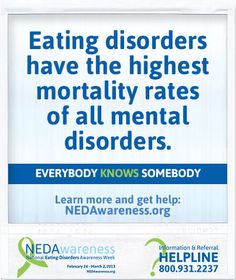
As we approach National Eating Disorders Awareness Week (Feb 1-7), I’ve been thinking a lot about my own eating disorder.  I’ve also been thinking about some of the common misconceptions there are about eating disorders.

One of the myths surrounding eating disorders, that I will discuss in this post, has two parts.  The first part is that eating disorders are  the same as dieting and are about being thin.  The second part follows, that they are about getting attention and meeting societies/media ideals of beauty.

I’ve struggled with anorexia for 20 years.  In my own experience, anorexia bears no resemblance to “normal” dieting that most people engage in at some points in their lives.  It is a serious mental illness, with severe physical and psychological impacts and side effects.   In my experience, anorexia was not about being thin, at least not at the beginning.   It certainly was not about getting attention, or competing with media ideals.  A good portion of anorexia was about disappearing, taking up as little space as possible and was fueled by intense shame and embarrassment, NOT the desire for others to notice me.

I went to, and go to, great lengths to hide my anorexia from others.  In fact, there are large aspects of my eating disorder I’ve never spoken about to anyone.  I rarely talk about it in therapy, I almost never disclose details to friends and family and I tend to keep it secret mainly due to shame and guilt and fears that others will view me as stark, raving mad…if they really knew.

After struggling with anorexia for 20 year, I have osteopenia.  This means that I have low bone density for my age.  I had low bone density before I was 30 years old. This is a common physical impact of eating disorders.  I’ve struggled with low iron levels which causes low energy, dizziness and fatigue.   As I age, I find I have less tolerance for restricting food.  I get dizzy, tired and have trouble focusing.  Symptoms I didn’t experience as a teenager.

But I’m lucky.  I have friends who have had heart attacks, passed out daily due to low potassium levels, lost all their teeth due to purging, have had broken bones due to osteoporosis and those who have lost their lives.  Eating disorders kill.  These people didn’t die because they wanted to look like the models in magazines and the stars in Hollywood.  They died because they couldn’t escape from a serious mental illness.

People who have eating disorders aren’t vain.  They aren’t making a choice.  Anorexia isn’t a lifestyle choice.  It’s a serious mental illness.  It’s often a coping reaction to experiencing abuse, trauma or extremely stressful life circumstances.

Anorexia isn’t about getting attention.  When I was at my sickest, I would rarely eat around other people.  This led to social isolation, rather than attention seeking.  I saw friends and family less, I spent a lot of time alone in my room. I would eat either before my family got up, or after they had finished in the kitchen.  I avoided social occasions where food was involved (in other words ALL social events).

I was deeply ashamed about the majority of my eating disorder behaviours.  I still am.  When I look back on those years, I feel the need to apologize to everyone I knew back then.  I want to apologize to them for making them look at 85 pound me.  A skeleton in a skirt, drifting through the halls of our high school like a shadow.  I feel embarrassed.  I know that I looked awful and that I scared a lot of people.  People who cared about me and were worried that I might die.  But quite honestly, I didn’t even really believe that I was sick.

I felt like I was living on autopilot.  I felt driven and I couldn’t stop.  I couldn’t slow down.  I didn’t exercise at the gym, but I used to walk long distances.   With the amount I was eating even daily activities were over exertions.  I had so many rituals it was amazing I could keep track of them all.  I would measure my food, eat certain foods only on certain days, eat or drink certain things only at certain times of days.  I drank a lot of coffee, tea, water and diet coke.  I drank fluids to avoid eating, but I was later told that staying hydrated was probably a good part of why I had so few negative side effects at my lowest weight.

If you had asked me, I probably wouldn’t have identified myself as someone with an eating disorder. I was confused.  I didn’t even know what I was doing or why.  All I knew was that suddenly food was my enemy and I felt that I could survive on almost nothing.   The anorexia always had an obsessive compulsive quality to it, the rituals were designed to keep me safe, not to alter my weight or physical appearance.  I was never trying to lose weight.  I was trying to control my trauma, my body and to numb out my feelings.

In the warped and bizarre world I lived in, slicing my half a banana into exactly 11 slices on my 1 cup of cereal kept me safe.  In that world, I could buy a cookie on Tuesday and Thursday only. I had to break that cookie into exactly 4 pieces which I would eat at specific times over the course of that day.

I used to go to the library sometimes after school and read books.  I remember one day my willpower failed and my hunger won. I ate my whole cookie at once.  I panicked.  Extreme panic.  I don’t know exactly what I thought was going to happen, but it was terrible and  I couldn’t undo it.  I knew from reading books that bulimia existed.  It was something I’d never explored, I never really ate more than a small amount at a time.  But somehow on that day, that cookie felt like a binge. I felt like the world was going to fall apart because I’d broken my ritual.  I went into the washroom at the library and tried desperately to make myself sick.  I wasn’t able to. I never have been able to (probably a good thing).   I remember crying and panicking and not knowing what to do.  Eventually I must have just gone home.  I remember feeling so very alone.

I’ve never told anyone about that, because of the intense shame I feel about behaving so strangely, in a way that I can objectively see makes very little sense.  This is why I don’t believe that anorexia is a cry for help, or a plea  for attention, because the majority of it happens in secret.   Sometimes I’ve been reluctant to share details about my eating disorder because I don’t want to trigger others or give people who are not in recovery ideas about behaviours.

Objectively, I can see that anorexia doesn’t make sense.  I can see that my obsessive compulsive habits, rituals, and rules don’t make sense.  I can see that they don’t make me safer or protect me. I can intellectually understand the health risks of not taking care of my body.  In my mind, I know that eating normally and being at a healthy weight would improve my mental health and that nothing bad would happen to me.

But Ana, spins a different web of lies in my head.  The fear of what could happen, the anxiety drives the OCD cycle of obsessive thoughts leading to ritualistic behaviour related to food.

I actually see Ana (my eating disorder voice) as a separate person.  I have a visual image of her in my head.  I experience her telling me things and I feel I have to listen.  She’s angry.  I know she isn’t a good friend and the majority of what she tells me (if not everything) is a lie.  But I feel some strange loyalty and attachment to her.  It’s hard to let her go.  I sometimes feel like I’d be lonely without her.

Eating disorders are serious mental illnesses.  You don’t have to fully understand my experience, in a way, I’m glad if you can’t understand it, because it means you haven’t lived through something similar.  But the stigma and myths about anorexia and other eating disorders need to be challenged.  People with eating disorders need your compassion and they need specialized, accessible and trauma informed treatment options in their own cities.  There is a woeful lack of eating disorder treatment available and people die while waiting for treatment.  Ending the stigma and increasing public education about these serious illnesses can help change this situation.


If depression were treated like a physical illness

The holidays can be a difficult time for people struggling with invisible illness such as mental illness or chronic pain.  During the holidays we are “supposed” to be happy.  We “should” relax and have fun.  We are “meant” to connect with friends and family.  It’s happiest time of the year, right?

But what if you aren’t happy?  What if you want to be happy and connected more than anything else, but you can’t be?  What if depression is stealing the happy, the relaxing, the fun and the connection right out of your holidays?

People all around me have been cancelling plans due to the flu, a cold and other winter illnesses.  This is acceptable and even expected in the winter time.   It’s even considered polite and good manners to stay home and keep your germs to yourself.  It’s understood that you aren’t feeling your best and that you have no energy when you have the flu. It’s okay to stay in bed and eat soup and sleep for hours.  People are sympathetic and nobody expects you to just “cheer up.”

I can’t even tell people that I’m sick. I can’t cancel plans.  I can’t stay in bed.   I feel disapproving looks from people around me when I’m not smiling and when I sit quietly or lose my temper  more easily that usual.  I’m exhausted, and I won’t feel better after a few days in bed.  Even if I could spend a few days there.

It’s Christmas time and I’m living with depression and anxiety.

Yes.  I’m sick.  I’m more severely depressed and anxious than I’ve been in a long time.

I want to call in sick to life.  I’m not even suicidal, I don’t want to die.  I just want to give up on “acting normal” and “keeping up appearances.”  I can’t imagine going back to work next Monday, the thought makes me panicky almost to the point of tears.  I have fantasies about developing some serious physical illness…nothing TOO serious, just enough to get me about a month off work with no questions ask, but not SO serious that I’d be in the hospital.  I want someone to take care of everything and take all the stress away.

This is what happens when society doesn’t acknowledge mental illness in the same way it does physical illness.  People who are depressed are lowered to the point of imagining horrible illness as a reason to be “justified” in taking sick leave, or even just taking the day off to rest.

Because when you are depressed you get treated like a misbehaving, whining child when you are not happy and not feeling connected.   When you are depressed you feel like a shitty parent when you don’t want to play with your kids, or you can’t enjoy your time with them.  When you are anxious and don’t want to leave the house you have to push yourself through it, even when you don’t enjoy a single minute of the activity you are doing.

When you are depressed, a “good night’s sleep” won’t fix it.  When you are depressed, “just cheering” up won’t work.

When you are depressed, you can’t just “lighten up” or “just relax.”

Believe me.  I WANT to relax.  I WANT to lighten up.  I want to laugh with my children.  I WANT to have fun with you.  I WANT to feel connected.  I WANT to feel like more than an empty shell marching through the tasks of the day.  I WANT to have energy.  I’m fully aware that I’m not acting normally and I’m terribly self conscious about it.  I feel guilty all the time about how depression impacts me and those around me.

I didn’t ask for this, any more than you asked for that cold, flu or stomach bug.

I didn’t ask for this, any more than anyone ever ASKS to be ill.

I don’t need to be fixed.  I don’t need suggestions on how I can help myself.  I don’t need to be told to look on the bright side.  (by the way neither do people dealing with chronic physical illnesses!)

I need you to keep me company while I shuffle through this dark period.  I need you to be there for me and to not judge me.  I need you to remember that I’m sick and not malingering or misbehaving or ungrateful or lazy.  I need you to remember that I’m trying my best and sometimes MORE than my best just to get through each day.  I’m using every ounce of energy to hide the depression from you, from my kids, from everyone.

I’m in pain.  I’m tired.  I don’t feel hopeful.  The world seems like a dark place and I can’t see the end of it because my thoughts aren’t clear.  Just as a runny nose and cough are symptoms of a cold,  depression makes me think that everyone hates me, that I’m worthless and that I don’t deserve basic things.   Just as a flu causes a high fever and aches, anxiety causes me to imagine horrible things and obsessive irrational thoughts.

These are symptoms.   It’s not a choice.

I’m depressed and anxious.  I’m sick and that is not a choice.

I had the best holidays I could, while not feeling well or happy.


Welcome 2017…Burn 2016 to the Ground

20161221_170835Without a doubt, 2016 has been one of the worst years of my life.  I survived a massive, never ending family law trial.  My psychiatric records were released to my abuser.  My privacy was breached again and again.  My children’s privacy was destroyed again and again.  By the end of the court process I felt like I had only shards of trust left in anything.  My belief in justice was shaken to pieces.  My trust in the system to protect my family was gone.  As I entered into this Christmas season, I felt like believing in justice for my children was akin to believing in Santa Claus.  A myth, a tale told to pacify young infants.  There is no justice here.  Certainly not in 2016, and certainly not for my family.

I’ve been waiting patiently for 2016 to end.  On the Winter Solstice I burned a fire with my children, symbolizing the end of the year and welcoming back the light of the new year.  An end to the darkness and inviting the brighter days leading to summer.  In the fire I burnt away my fears and dark thoughts from 2016, leaving behind those bad memories and making space for positive karma for 2017.

I am a superstitious person.  Despite my scientific, thoughtful, highly rational mind…my obsessive compulsive nature leads me to have some strange superstitious, ritualistic thoughts.   Some of them are not quite spiritual, but take on an element of obsession.  I believe in signs.  I want to believe that things happen for a reason, even if we can’t see what that reason is.  There is no reason to explain the things I have endured in 2016.  None at all, except for oppression, broken systems, delays, inadequacies and incompetent workers.  No reasons that can satisfy me, or any reasonable person.  But at the end of the year, there are still many things to be grateful for.

I believe that I am a stronger person than anyone should ever have to be.  My children are also stronger than children should have to be.  I suppose in a way, this is something to be grateful for.  Though I almost cry out in pain at times, watching the innocent 2 year old children of my friends’, as they laugh and play with very little cares in the world.  I want that for my children again.  I miss their baby smiles and laughter.  It breaks my heart that they are no longer innocent, though they are still so young.  But they are strong and they are kind and they believe in justice, with a fierceness that has replaced their childhood innocence.  For that I am proud and grateful.

Things I am Grateful for at the start of 2017:

  1. A safe home that I love
  2. Wonderful caring neighbors and a beautiful neighborhood
  3. Enough money to buy the things I need for my family
  4. A job that allows me to help others, be challenged, learn and give back to my community
  5. My coworkers who I consider friends and who have supported me and helped me grow
  6. My family for always supporting me
  7. My children for giving me a reason to keep living and for being wonderful tiny humans
  8. My friends across the world, online and in real life, text and in person
  9. The rainbow community for supporting us and loving us and showing us where we belong
  10. For my citizenship and for this amazing, safe country I had the privilege of being born in
  11. For coffee, for tea, for coffee shops, for hot chocolate and for hot drinks everywhere
  12. For all the people I’ve met through my work, the people I’ve helped and everything I’ve learned from them this year
  13. For my car, for getting me and my family everywhere I need to go
  14. For my health, though it’s not perfect, I have a lot of ability
  15. For fresh air, for sunshine, for the woods, for nature, for being outside
  16. For the internet, cell phones and the ability to stay in touch
  17. For this blog, the ability to write and being able to share my experience with so many

Thank you all readers, for following my blog, for sharing it, for reading and commenting.  I wish you all the best for a peaceful, happy and healthy new year in 2017.  Be well.  I hope to see you all here in the New Year!

It’s rude to stare.

20161204_1228461

I’m not speaking for all people with disability here, there are my own opinions.  Trigger warning for description of self harm

I identify as a person with disabilities.  The thing is, that I live in an interesting position where some of the time I have the privilege of “passing” as a non-disabled person and some of the time, it’s obviously visible that I’m different, strange, mad, crazy, mentally ill, or whatever label people might want to put on my experience.

I experience my PTSD as a chronic disability rather than an illness.  It’s something I live with and cope with and I don’t expect it to suddenly be cured or disappear.  I don’t consider myself “sick” but I’m not really well either.

One of the ways in which I coped with having undiagnosed and improperly treated PTSD was to cut myself.  I cut myself for many years of my life.  Because I had severe adverse effects from psychiatric medications I cut myself deeply, chaotically and severely.  As a result I have visible scars over the majority of my body.   These scars are covered by long sleeves and long pants, but can be seen wearing any other type of clothing.

I have a number of close friends who also identify as having disabilities, and I work in a field where I have read, heard about and studied oppression related to disability.  What I want to talk about is the situation I encountered last night.  The one in which able-bodied, sane, or well people feel the need to STARE at, or comment on, disabled bodies.   The staring makes me feel instantly like a circus freak, instantly judged, instantly “less than” and instantly oppressed.

I was out at the dance last night and I’d invited along a woman I’ve met up with a few times.   It’s been winter weather so this was the first time she’d seen me in a short sleeved shirt.  I hadn’t mentioned the self harm to her.  I had mentioned my past abusive relationship.   When I arrived, I noticed her staring at my arms. I noticed her staring at them on and off over the course of the evening.  She never said anything about them, just looked at them awkwardly.

I was already struggling yesterday.  I was having a lot of body dysphoria and feeling self conscious and negative about my body.  I’d been at a party earlier and I was hot in my sweater but I didn’t want people looking at my arms, so I left it on.  Often I forget about my scars now, but some days I’m hyper sensitive because I don’t want to risk being under the “judgemental gaze” of able-bodied or sane folks.

Here’s what I wish folks would do when they notice my scars:

  1.  You’ve noticed my scars.  You are curious. I get it. But this isn’t about you.  Please don’t stare.  I’m not a circus freak.
  2. If you must ask questions about it, if possible wait until a quite private moment and then politely ask me what you want to know.
  3. If you absolutely have to know.  Please don’t stare.  I’d rather you ask me a question about what you want to know, even in a public place than continue to stare or sneak glances at me.  Believe me  I SEE YOU LOOKING AT THEM.  You aren’t getting away with looking at them subtly.  In general, people with visible disabilities are vigilant to noticing people staring at them.
  4. Remember, I’m still the same person I was before you noticed the scars. Nothing has really changed.  Your reaction to my scars is more about you, than it is about me.  If you are seeing the scars, it means I am comfortable showing them.  You are the one who is making the situation uncomfortable by awkwardly staring at me!

And here is a list of answers to some commonly asked questions about my scars.  Maybe this will help you to not ask these questions to other people who self injure, maybe it will help others understand a bit better.  To be fully honest, people rarely ask me questions about my scars.  I sometimes wish they did ask me.  I’d rather be asked questions than be stared at and be left wondering what the person was thinking.  But there are some common questions and questions I imagine folks have.

  1.  Do they hurt?  No, most of them don’t hurt.  There are a few that didn’t heal properly or weren’t stitched properly that do hurt.  Some of them itch or the skin pulls at times which can be uncomfortable.  For the most part they just feel the same as the rest of my skin.
  2.  Can I touch them? No!  That’s fucking creepy.  This is a trigger for me, because one of my abusers asked that question.  I don’t think it’s cool, cute, fun or sexy to have them touched specifically during intimacy.  Please just treat them as part of the rest of my skin.
  3. What happened to you?  They are scars from self inflicted injuries, mainly cutting.  I hurt myself as a way of coping with ongoing sexual and emotional abuse over a period of time in my life.  I also had serious adverse reactions to psychiatric medication, especially SSRI anti-depressants which gave me obsessive self destructive thoughts and impulses over a 4 year period of time.  I was told repeatedly that “doctors don’t give you medication to make you sick”
  4. Did you have to get stitches?  Yes.  Lots of them.
  5. Did it hurt?  Sometimes.  But a lot of the time when I was harming myself I was disassociating and I didn’t feel the pain.  A lot of the time I was doing it I was numb and detached and felt very little.  It hurt a lot AFTER and when it was healing, when the disassociation wore off.
  6.  Do you regret it? Sometimes.  It’s hard to remember a time when I didn’t have the scars.  To be honest the scars trigger me sometimes which is why I often used to hide them.  They bring back bad memories of times I’d rather forget.  But they are a part of me as well, a part of my story and a part of what I’ve survived.
  7.  What is the worst part about having self harm scars?  The worst part is the judgement I get when seeking non-psychiatric medical care.  So many times doctors have seen the scars and treated me differently.  They often make assumptions about me that are incorrect.  They assume I’m drug seeking, an addict, or that I’m unstable, lying, attention seeking, borderline etc.  I notice that doctors have the worst misconceptions about self harm.   Doctors often assume I’m LESS able than I actually am, and at times I struggle to receive appropriate medical care.  There is a great deal of stigma attached to having a mental health disability, especially related to self injury.

The take home message is simple:

Don’t stare at people whose bodies may be different than yours.

If you must ask questions, do so politely and privately if possible.  Ideally, don’t ask a lot of questions of complete strangers.  Questions as part of a friendship come across completely differently and can be more acceptable as a part of getting to know someone over time.

I notice you staring at me, and I don’t interpret it as polite concern.  I interpret it as intense othering.

I was just there for the dance.

Everything in my life was preparing me for this.

ta2-1

January 5, 2016

A night I will never forget.

One symptom of obsessive compulsive disorders is strange intrusive thoughts that are worrying or scary, but not particularly realistic or likely to happen.  I have quite a number of these strange thoughts, which I rarely share with others.  I worry that people will think I’m crazy or bizarre, and I feel ashamed or embarrassed to admit them.   One of my OCD recurring thoughts involves a terrible fear that while I’m driving someone will step out in front of my car, or push someone in front of my car, or a car around me.  Essentially, that I will unintentionally kill someone with my car or witness someone being hit by a car and dying.

I think of it whenever I drive and I’m often quite vigilant, keeping an eye on pedestrians and looking carefully at people on curbs, bicycles and around blind corners.  Generally this level of hyper vigilance is unpleasant, stressful and unnecessary.  I get startled easily when I drive, especially when my PTSD is triggered. I’m very alert, and in reality,  I’m a very safe driver.

That night, my OCD saved a life.

I was supposed to be at a work meeting, but instead I was driving down a busy road in the city where I live.  It was dark, rush hour, and I was heading to a meeting with my lawyer.  I was driving over a bridge which crosses over a railway track when I saw the thing my OCD brain had been looking for for years.

There was a young woman standing on the edge of the railing.  Clinging onto it, in a shaky, desperate way.  A young woman about to jump to potential death.  A young suicidal woman.

I slammed on the brakes, ignoring the traffic, jumped out of the car into the cold winter night and walked very slowly towards the young woman.

My internal dialogue went something like this:

If this woman jumps to her death you are going to witness it.  You are going to be traumatized and you are going to be impacted by witnessing her death.  This is going to be awful.   But you have to try to help her, you can’t do nothing.  You have all the skills you need to help her.  You have the training, you have the work experience, you have the life experience, you are the only one here and this is the only chance she has.  You have to try. You can do this.”

All that happened in the split second it took for me to walk closer enough to speak to her.

She was crying, shaking, trembling and balanced just barely on the railing.  Sometimes holding on, sometimes standing up and trying to let go. I spoke to her gently.  I told her I wasn’t going to call the police.  I told her I was a support worker and that I just wanted to talk to her.  I asked her to step down off the railing just for a moment to talk to me.  I reassured her that I wasn’t going to call anyone or do anything, just talk to her.  I told her my name, I told her where I worked.

She got down from the railing and back onto the railing a few times.  I kept talking to her gently and reassuring her.   Eventually I was standing quite close to her.  I told her that I’d felt suicidal before, that I was sorry she felt SO bad that she wanted to hurt herself, I reminded her that I just wanted to talk to her.   I have no idea how much time went by, but I think it was only a matter of minutes.

Finally she got down and turned towards me.

“I’m cold” she said.

And I knew I’d made the connection.  The immediate danger was over.   We both breathed.  I asked her if she would come with me into my car so we could talk and I could drive her off the bridge.    We walked to the car and as I got into the drivers seat the world reappeared.  I was suddenly aware that my car was blocking a lane of traffic, cars were honking and passing and drivers were annoyed.  I had tuned it out completely and was only aware of the young woman.

I also became aware that literally not one of those cars had stopped, offered to help or called for help.  I felt the desperation of that poor woman, knowing that nobody in the world cared about her.

We sat in the car for a second, shivering and I could see her panic again.

“I’m not supposed to get into the car with strangers”

Luckily, I had my business card and a pamphlet from my workplace in the front seat.  I reassured her that I was just trying to help her and I just wanted to drive her off the bridge so we could talk.  She agreed and we drove down to a gas station which was just a moment away.

We talked for a little while.  I told her a little bit about myself, the work I do helping abused women.  I asked her if what was making her so upset that day had anything to do with that and she nodded.  I asked her if she’d felt that way before and she said yes.  I asked her if there was anywhere I could take her, a friend’s house, the hospital and she said  maybe just to the mall nearby where she could catch the bus.

I could tell the immediacy of the crisis had passed for her.  She seemed exhausted.

I drove her to the parking lot of the mall and we talked a little more.  I invited her to call my organization for help anytime in the future.  I thanked her for trusting me and for coming down from the bridge.  Before she got out of the car she told me:

“If you had been a man, I would have jumped.  If you had called the police I would have jumped”

She thanked me for saving her. I asked her if she would tell me her name.   She said she wasn’t in the habit of getting into the car with people she doesn’t know.  I told her under the circumstances I thought it was the lesser of two evils.  We both laughed for a moment, she hugged me, told me her first name, and then she was gone.

The second the door of the car shut I burst into tears.  My whole body was shaking.  The reaction of shock hit me once she left, and all the fear, tension and emotion of the past 45 minutes washed over me.

But I wasn’t just crying for that young woman.  I knew that I couldn’t control what might happen to her after she left my car.  I knew I’d done my best and that my best had been enough.

I was crying for Darlene, for Irene, for Lexi…and for my dearest Marian.

Why was I there, at that moment, on a bridge with this complete stranger?  But I didn’t get to say goodbye to so many of the friends I loved?

I felt an amazing sense of love and wonder at having saved a life, amazement at the randomness that I was there at that exact time, and that it was me and not someone else.  It didn’t seem random at all.  It seemed like everything that had happened to me in my life had lead me to that exact moment.  Trained me and given me the exact skills I needed to talk that woman off the ledge.   It felt like a moment of spirituality, connection and higher power.

But my sense of wonder in saving that young woman, didn’t erase the sorrow that I wasn’t there to save my friends.  Or even to say goodbye.  They are gone now, but I hope that woman from the bridge is still okay.

Body Positivity is a Mystery

315096_10150877474950038_1369335747_n

<trigger warning for those with eating disorders>

This picture was taken 5 years ago.  I haven’t owned a scale since.  To me, a scale is an actual weapon that only causes damage and pain.  I can’t be around them.

Ironically, when I first became anorexic, I never weighed myself.  I didn’t own a scale and anorexia wasn’t about achieving a certain weight or ideal of beauty.  It wasn’t about how I looked, it wasn’t about my body.  Anorexia was a complex and deadly form of disassociation, which over time turned into equally deadly obsessive compulsive disorder.  So my eating disorder was not about losing weight, but losing weight was a side effect of my eating disorder.   This is a really important thing for people to understand.

Over time though, sexual assault and anorexia F#@ed up my relationship with my body.  And as a woman, patriarchy and ideal standards of beauty and thinness began to impact me.

As I began to “recover” the first time (I was forced to gain weight),  I was terribly uncomfortable with my body.  I equated safety with taking up less space, being smaller and following my strict food rules.  Anorexia means that I feel extreme levels of anxiety when I break my food rules.   Today, in imperfect recovery, I have fewer rules and more good days, but ultimately, the terror remains.

The terror of becoming “fat” and being out of control and unsafe.

I’m going to admit something terribly un-feminist.  Even though I read blog posts about body positivity and I fundamentally hate fat shaming, I am puzzled by larger, rounder bodied and fat people.  I’m not judging them.  I don’t think they are weak or lazy, or those negative stereotypes that the media forces down our throats.  I’m just puzzled and curious.  I really honestly want to know “how is that fat person comfortable in their skin?”  I want to know because if I could figure that out, maybe I could accept myself.

I’m tortured by the feeling of clothing being tight on my skin.  Some days I can’t wear certain clothes just because of the way they touch me and make me feel “fat.”   So how do many people I know, who are rounder and love themselves, achieve this self love?  I’m struggling just to tolerate my body.

I’ve been in told in therapy that “fat” isn’t a feeling.

That “fat” is a code my mind has made up, as a cover story for real underlying feelings.  Objectively, my body is not fat, large, or round.  It’s also not unusual, it’s not disgustingly ugly, it’s not misshapen or weird.  It’s just a body.  Most people would say I have thin privilege and that I’m ridiculous for thinking I’m fat.  And even if I were fat, that would be okay.  I believe that intellectually, about other people.  I’m not judging others, I am holding myself to a standard I would NEVER apply to a friend or even a stranger.  I love your body, I will fight for your right to body positivity no matter what your shape is.  But I hate my own body.

“Fat” is not a feeling.  I think the feelings I have are shame, sadness, anger, grief, guilt, fear and many others.  But when I feel “fat” it’s not about my weight, any more than my anorexia was originally about my weight.  I was never fat. “Fat” is about the shame I feel as a survivor of sexual abuse.  “Fat” is about feeling my own body betrayed me.  “Fat” is about me blaming my body for the abuse.  “Fat” is me thinking that if I had no body I’d be safe.  “Fat” is my fear of being assaulted again.

I never weighed myself.   When I was in treatment, they weighed me and I stood backwards on the scale.  After leaving treatment I continued this practice at doctors appointments.  A few times over the years, I knew my weight.  But whatever the number, I was unhappy.  The number was never okay.   At various times I had F#%ed up goal numbers, but they were not based on anything other than pure magical thinking.  And they never correlated with my actual healthy weight range.

In 2011, I was struggling with abuse in my marriage.  I was in school and I was struggling with that too.  As I would take the bus home from school, I sometimes snuck into a store and used the scale there to weigh myself.  I’m not sure why I started doing it.  But my OCD anorexia mind told me it would keep me safe and comfort me.  I did this for probably a month or more.  I was consumed with guilt and shame.  I never told a soul.   Then one day I decided it would make more sense to buy the scale and take it home, to avoid the shame of sneaking into the shop.  I hid it and I never told anyone I had the contraband item.

Big mistake.

It was the first time I’d owned a scale since I developed anorexia.  Within a few months of owning it I was suicidal.   The thing about OCD, is if you give in to it even one little bit, it will take you for a ride, a hellish ride.  First I started weighing myself once a day, first thing in the morning.   Then, gradually I started weighing myself at night too.   And before I knew it I was weighing myself 8-10 times a day.  It was out of control.  And it got out of control in a matter of a few weeks.  I was controlled by that scale.   This was at the same time when I was receiving ECT treatments, I wasn’t eating very much because I felt quite ill.  My weight dropped and because I had a scale, I obsessed about it.   Then when the ECT was finished and I began eating more normally again, I began to PANIC about the weight gain.

Normal, intellectual, reasonable thought of someone without an eating disorder:  “I was sick, I lost weight and it was unhealthy, it’s normal and healthy that I’m gaining it back

Anorexia: “You are weak, you are “fat”, you are out of control, you are ugly, you need to stay at this number on the scale or something bad will happen

In the end, the suicidal thoughts became so overwhelming that I decided to get out.

I took a hammer, I went into the garage when nobody was home, and I smashed the hell out of that scale.  I smashed it until it was in pieces.  It was surprisingly sturdy and difficult to break.  I was sore and sweating from exertion by the time it was destroyed.   And I felt empowered.

Five  years later and I’ve never owned a scale again.   Sometimes in weaker moments I will weigh myself on a scale at a friend’s house, or in a store.  But I know that this practice is self destructive and only gives Ana ammunition to destroy me and shame me.

Scales are for fish.

I will continue to admire the folks around me who embrace their bodies of all shapes and sizes.  I will continue to be mystified and curious about the concept of body positivity.  I will continue to strive towards true recovery from anorexia.

True recovery goes so much further beyond weight restoration.   True recovery means that the scale is powerless over me.  True recovery means I can be comfortable in my clothes.  True recovery means that food is nourishment and enjoyment and doesn’t have  moral value.  That my weight does not mean anything about my self worth.  True recovery is freedom from shame and self hatred.

I may “look good” but don’t be fooled, Ana still runs my life.


Things to do instead of self harm

recovery-is-possible

I’d like to share some ideas for readers who have struggled with, or currently struggle with, self harming behaviour of any kind.  Self harm can include physical injuring, substance abuse, eating disorder habits, workaholism, over exercise etc.

Personally, I find harm reduction models to be the most effective in reducing self harming behaviour.  Because self harming is a coping method, and has served a purpose, it is often difficult to abstain from doing it.  I also believe that the majority of habitual self harming behaviour is shame and avoidance based in at least some ways.   I have found it easier to live with the idea that I will sometimes engage in behaviours that are not 100% beneficial to my health.  By acknowledging this openly, I reduce the level of shame I feel when I do make a mistake, slip or relapse.  Relapse is a part of recovery in a harm reduction model.  I don’t need to feel ashamed if I go back to my old way of coping in a crisis.  Those ways worked for me for a long time and they are  habitual and comfortable to slip into.

If I have a slip, I don’t make a big deal about it.  I just move forward and try to make a different more self caring choice in the future.  Removing the intense lens of self judgment from the situation has been helpful for me.

When suggesting alternatives to self harming behaviours, I acknowledge openly that not all options are available to all people.  This is not  a list that says “you should do this” but just some options that have worked for me personally.  Using the word “should” can increase feelings of guilt and shame if you do engage in self harm. I highly encourage you to use this as a model, and make your own list that feels right for you.  Give yourself permission to explore different coping options, keep the ones that work and leave the ones that do not.  Personalizing your recovery plan is another factor that will lead to greater success within harm reduction.

  1. Give yourself permission to struggle.  It’s okay that you feel bad right now.  Your feelings will have a beginning, a middle and an end and you can survive them.  Sitting with your feelings is an option, even if it is very uncomfortable
  2. Get safe.  Often urges to self harm are a red flag for me that I’m not feeling safe or I’m feeling overwhelmed.   Reduce any stress you have control over.  Relocate to an environment that feels secure.
  3. Spend time in nature.  The trees are not oppressive, nature is forgiving.  Nature can just mean getting outside, walking around the block, sitting in a park and breathing deeply.  Noticing the colours in the leaves outside.
  4. Wrap yourself up in warm blankets, quilts, cozy sweaters etc.  For me feeling safe often involves feeling warm and wrapped up tight.  Sometimes even the weight of the blankets is calming to me
  5. Prepare a hot or cold beverage.  The warmth or chill of the cup in your hands can help to ground you.  Focus on the temperature of the glass, and the feeling of the cold or warm liquid in your mouth.  Taste the flavours in your drink and take time to breathe.
  6. Draw, scribble, write, paint -express your feelings.  Artistic self expression has helped me avoid self harm.  You don’t need to be an artist to do this, you don’t need expensive art supplies.  Sometimes just a piece of paper and pen is enough.  Feel free to destroy your creation after.
  7. Reach out.  Call a friend, a family member, a support or crisis line.  If you don’t feel comfortable calling anyone, try going to a public place like a library or coffee shop and just break the isolation by sitting there with people around you.  Talking to a safe person is often a good way to work through urges to self harm.  You have the choice to tell the person you are struggling or not.
  8. Distract yourself with an enjoyable TV show, youtube video, magazine, book or music.  Lose yourself in another world for a short time.  Choose something that will cheer you, not something triggering.
  9. Exercise.  Use your large muscle groups.  Walk, do jumping jacks, stretch, yoga, lifting cans in your kitchen, anything you feel able to do and have access to.  Moving your body can help you process intense feelings like anger.
  10. Connect with spirituality, meditate, religion etc.  Connect with a higher power.  For me this means visiting nature and getting in touch with how small I am compared with the power of the natural world
  11. Spend time with someone very young or very old, or a pet.  Volunteer, connect with a family member, visit a neighbour with a new baby, offer to pick up groceries for a senior living in your area.  Walk your neighbour’s dog, take care of your own pets. Helping others, even in small ways, can be an option and alternative to self destructive coping.  For me, being able to help another person reduces my sense of shame and hopelessness and increases my connections.
  12. Hug a stuffed animal.  Sometimes I need comfort and stuffed animals are a good option for me and help me feel safe.
  13. Spend time around water.  Take a bath or shower.  Walk by the river, ocean or lake.  Go swimming.  Run warm or cold water over your hands and wrists.   Flowing water can be very calming.
  14. Use positive affirmations, ideally ones you have prepared yourself.  Sometimes self harming is driven by negative self talk and negative shame based messages you are giving yourself.  You can find ideas for affirmations on the internet and rework them to suit your purpose.  If an affirmation seems unrealistic try adding “I’m learning to…” at the beginning.   For example, “I’m learning to love myself.
  15. Remind yourself that you are doing the best you can.  That you are surviving and sometimes that is enough.  Some days all we can do is survive and that’s okay.

These are just a few ideas I’ve worked with over the years.  I hope you find them helpful.  Please feel free to comment with your coping ideas!

Why I sometimes miss self harm…

20161002_2200341

<trigger warning for description of self harm>

It’s a strange thing to admit, but if I’m 100% honest with you, I still miss self harm.  As a coping mechanism it has to be considered one of the worst.  Almost my entire body is covered with permanent scars.  The scars cause me to be self conscious and feel shame.  The scars also result in social stigma, and difficulty in being taken seriously by health care providers.  They itch as they heal and sometimes they hurt.  They are constant reminders of parts of my past that I’d rather forget.

Usually when I think about self harm, what stops me is remembering two things

  1. The self harm only ever helps for a brief moment
  2. I will have to hide the wound and feel intense shame about this, as well as worry about the consequences if anyone sees the injury

This usually works, but sometimes I feel bitter and angry.   Sometimes I have thoughts like “If society didn’t consider self harm to be SO AWFUL, I could just keep doing it, because I wouldn’t feel ashamed and I wouldn’t worry about the potential negative consequences on my family.”  I get angry and I feel like my coping mechanism is being taken away from me.  I get angry and think about how some people get fall down drunk on a regular basis and society thinks this is acceptable.   Why isn’t MY coping mechanism acceptable too?  I feel like having a tantrum like a 2 year old child!  I want it and I want it NOW!  But most of the time I refrain from self harming, not just for my children, but for myself too.  It’s not a lifestyle that I want to return to.

I do want to write about some of the complex reasons I miss self harm.  Some of this might sound completely ridiculous to you.  I’m worried about being honest and just writing this down.  I’m worried about being judged for liking some aspects of this self destructive habit.

Self harm gave me something physical to take care of, and be taken care of for,  when my inner pain was un-fixable and unreachable.

Even though I experienced a lot of maltreatment and abuse in the psychiatric system and hospital emergency rooms, I sometimes miss having a physical injury that could be fixed.

There were times when I was almost addicted to the process.  The care I received after self harming was almost as important, if not more important, than the ritual itself.  The trip to the emergency room WAS part of the ritual.   To be honest, without this part of the ritual, without the serious self harm, it seems almost useless to hurt myself at all.

There was a predictable ritual to the emergency room visit.  At times, I felt safe and cared for there.  At times it felt like a pause, a break from the day to day stressors in my life, which at that time felt unbearable.   I think there was a part of me that used self harm and suicide attempts as an excuse.  Not a cry for help or attention, but a cry that said: “I can’t do this.  It’s too much.  I need a break.  I need to be cared for.  I’m not capable.  I’m afraid to fail.

I remember some of the times I had multiple serious injuries from self harm.  It took the doctor or medical students a considerable amount of time to fix the cuts.  During that time, the doctor would often speak to me.  I had their full attention.  I was being cared for and I was being symbolically “fixed.”

There was a ritual to the process.  Triage.  Waiting room.  Exam room.  The questions.  The cleaning of the wounds.  The freezing.  The sutures.  The bandaging after.  The conversation.  The questions.  For those hours, if I was treated nicely, it was like being numb and being in another world.    A world where time was stopped, my responsibilities were paused, the outside world did not exist.    I actually FELT better afterwards, like I had been healed, but the improvement was so fleeting.  So very fleeting, that often I was injuring again only a day later.

It was as if the injury gave me an excuse to stop, validation to say “I’m not well.  I’m not coping.  I need help!”  Without the injury, without the physical reason, I struggled to ask for or to accept help.  I still do.

I’ve never really verbalized all this to anyone before.

I remember one time, I cut myself on my stomach.  It was deeper than usual, maybe deeper than I intended or realized, because I was new to injuring in that spot.  Over time I had learned to hurt myself in places I could hide.   (When I first started, I was almost hypomanic from SSRIs and I cut in visible places, places everyone could see and that were very difficult to hide.)

I went to the hospital, as I usually would, alone.  At the triage desk they examined me, discovered the wound was serious and triaged me as Emergent rather than Urgent or Less Urgent.   I was put into a wheelchair and taken back into a part of the ER I’d never seen before.  I think it was the place for seriously ill people. The lights were dimmed and the bed was actually comfortable.  I had my own room, not just a curtained area.  It was quiet and comfortable.  I didn’t have to wait very long and I remember feeling safe and calm and protected.  I felt like my health problem was considered important, legitimate and I was being cared for appropriately.  I had a female doctor and she was kind to me.  She was wearing ordinary clothes rather than scrubs or a gown.  I remember her as being fairly young.  She treated me as if I had a physical health problem, not as a mad, crazy, unworthy self harming psych patient.   I felt bad because she got blood on her clothing while she fixed my injury.   I can’t really describe exactly what happened that night.   But I felt protected and the ritual had worked, my mind was quiet.  The racing thoughts were gone.  It was silent and the room was dimmed, like the thoughts were dimmed as well.  For that time I was in another world.

I’m having a difficult week.  I’m feeling overwhelmed and lonely and scared.  I’d like nothing more than to be cared for.  To be honest, the thought of that quiet, dimly lit emergency room bed is very appealing. But I don’t want to achieve this through self harm.  I don’t want to be “sick” and treated in hospital to get a break or to feel validated in resting.

I want someone to take care of me because they care about me, not because it is their job.  I want comfort because someone loves me, not because they are scared that I might harm myself.

I want to be an adult and not a misbehaving, out of control 2 year old.  This is part of what recovery means to me.  I have to use my words, not my actions to let people know that I’m not okay.

Note: the art was made in 2005

September 10 -World Suicide Prevention Day

20160509_204444

On this day I remember the friends I have lost to suicide.  I think of the friends I know who are suicide survivors.  I think about the service users I work with who struggle with suicidal thoughts.  I think about what it means to be a suicide survivor.

I am a suicide survivor.

I can’t speak to the experiences of other people who have survived suicide attempts, but I would like to share my own thoughts.  I think there are a lot of myths out there related to surviving suicide, how to help people who are suicidal and why people attempt or complete suicide.   It’s a taboo subject, one that people skirt around.  Sometimes the mere mention of suicide can silence a room, create uncomfortable looks and make those around you ill at ease.  I think this is mainly due fear.  It’s almost like people think that suicide is contagious.

I rarely talk about my experiences as a suicide survivor.  There seems to be a tacit agreement that it is not a suitable conversation topic.  Even in therapy there is the worry that talking about suicide will lead to unwanted consequences, trips to the hospital, worrying others, making others think that you are “crazy” or “unstable.”

Here are some of the myths surrounding suicide that I’d like to dispel.  These are my own thoughts and I don’t claim to speak for everyone who has these experiences.

  1. Suicidal thoughts and suicide attempts are impulsive reactions and pass quickly.
  2. Talking about suicide means that someone is not serious and is not really at risk
  3. Suicide attempts are always a “cry for help” and the person doesn’t want to die
  4. People who survive suicide attempts are grateful to be alive and recover quickly
  5. Talking about suicide will just “give someone ideas” and it will increase their risk
  6. The best way to help someone who is suicidal is to call 911 or take them to hospital
  7. If someone is habitualy suicidal, the experience is normal for them and they don’t feel afraid or need support.

Realities

  1. I’ve struggled with suicidal thoughts on an ongoing basis since I was 17 years old.  That’s almost 20 years.  My suicidal thoughts can sometimes be impulsive, but in my experience they are usually long lasting, persistent and even obsessive in nature.  I wouldn’t even like to hazard a guess as to the number of hours I’ve spent planning ways to die and thinking about ending my life.  In my experience, the impulsive thoughts are the most dangerous and the scariest, but the chronic obsessing about suicide is more exhausting and creates  a sense of hopelessness.   Many people struggle with suicidal thoughts over a long period of time, just because they don’t act on it or don’t talk about it, does not mean they are not at risk.
  2. I hear this a lot.  “If she is willing to talk about her suicide plan it means she isn’t serious and she really wants help.”  This is a dangerous assumption.  Every person is different, every situation is different.  Some of the times I tried to kill myself I didn’t tell anyone, I didn’t talk about it before hand, there wasn’t an opportunity to intervene.  Other times I spoke about it to many people, I asked for help, I went to the hospital without harming myself, and I often found that I was not believed or taken seriously.   It was incredibly frustrating because when I went to the hospital AFTER harming myself the doctors were angry that I didn’t “ask for help.”  When I went without harming myself, they assumed I was safe and rational and did not need help.  It was a vicious unhealthy cycle.  In my opinion, if someone is talking about suicide you should listen and you should take it seriously.  Many people who complete suicide have talked about their thoughts prior to taking the final step.  On the other hand, if someone never talks about suicide we can’t assume they are not at risk.
  3. Suicide attempts are not always a cry for help.  Sometimes the suicide survivor really did want to die and their attempt failed.  Suicide attempts are not a way to seek attention.  They are not a way to control or manipulate people.
  4. When I attempted suicide and survived, I was not grateful.  I felt like a failure.  I felt worthless and ashamed.  I felt like I couldn’t do anything right.  I felt ill and I had physical effects from harming myself.  I felt alone and I felt stigma. Even today, years later I regularly wish I had died years ago when I attempted.   Not all suicide survivors are happy to be alive.  We don’t all wake up the next day, thankful for a second chance.  It’s also common to be happy to be alive sometimes and wish you had died at other times.  The recovery process can take a long time and will last far longer than the short time someone might spend in the hospital or away from work/school.
  5. Talking to someone who you think may be suicidal will not increase their risk.  It’s far more risky to stay silent, not ask the questions, not check in with someone.  If you are concerned about someone you care about, I recommend asking them directly if they have thoughts of harming themselves, ending their lives, or wishing they were not alive.  Ask them if they feel like a burden, ask them about what connections they have in their lives, ask them if they feel hopeless.  It’s better to know the answers, then to assume someone is not suicidal.  Sometimes a suicidal person feels like nobody cares about them, and staying silent could reinforce that belief.  I can’t even remember the number of times that I was stopped from harming myself by receiving a phone call from a friend, or a connection with someone around me.  Connection is the opposite of depression.  Asking someone about suicidal thoughts is not easy, but losing them to suicide will be harder.
  6. Calling 911 or taking someone to the hospital is not always the best way to help a suicidal person.  Sometimes involving the police, ambulance or hospital can escalate a situation.  Sometimes it can destroy the trust you have with that person.  In many situations it can be helpful to give the suicidal person choices and options.  Thank them for opening up to you.  Ask them what they feel would be most helpful.  In my experience, suicidal feelings are often linked to feeling out of control and overwhelmed.  Taking away choices from someone or punishing them for suicidal thoughts can add to feelings of powerlessness.  Offering choices can be an antidote.  Maybe the person wants company, maybe they don’t.  Maybe they just want a chance to talk about their suicidal feelings without being judged.  Maybe they do need medical intervention, maybe you can take them to the hospital and stay with them.  If someone is suicidal and impaired by drugs and alcohol, or has access to lethal methods such as a gun, you may have fewer options.   But calling 911 without somoene’s permission should be a last resort.  Hospitals don’t even always admit someone who is suicidal.   I’ve been in the ER, highly suicidal and at huge risk, and just sent home.  I’ve been told “she isn’t psychotic so  she can go home, she isn’t at risk.”  I’ve often felt WORSE after unpleasant and unhelpful interactions in the ER.  It’s a myth that hospitals always help suicidal people.  Consider all your options and include the suicidal person in decision making as much as possible.  Also make sure you take care of yourself.  You are not responsible for saving anyone.
  7.  People like me, who struggle with suicidal thoughts on a chronic basis, still get scared.  Feeling suicidal is a scary thing.  It doesn’t matter that I’ve felt this way hundreds of times before.  I’m afraid.  I always worry that I will become impulsive and make bad choices.  I always feel afraid of telling someone, afraid of their reaction, afraid of the stigma.  Afraid people will think I shouldn’t be working, parenting, left alone etc.  If you know someone who chronically talks about suicide or habitually harms themselves, don’t give up on them.  Don’t assume they don’t want to get better.   Suicidal thoughts and self harm behaviours can be a coping mechanism for many survivors of violence.  Sometimes thinking about harming myself feels like the only way I can have control in an out of control and scary world.  Suicidal people need and deserve compassion.  Never underestimate how much good you can do by just non-judgmentally acknowledging someone’s struggle:  “Those thoughts sound very scary, you must feel pretty overwhelmed right now, I’m sorry you are struggling, what can I do to help?”


I miss my friends who completed suicide, but they are not cowards.  They are some of the bravest, most beautiful people I have ever known.  Suicide survivors are all around us.  We are regular people, living regular lives.  Suicide isn’t just something that happens to “crazy” people.  It can happen to anyone.  Breaking down the stigma helps everyone.  I think about suicide on a regular basis, but I still have an ordinary, productive life.  If you struggle with suicidal thoughts, or have lost someone to suicide, you are not alone and you should not be ashamed.  Be good to yourself, I’m happy you are alive.