I’m reclaiming “crazy.”

I’m so tired of crazy being used as an abelist, stigmatizing slur against me by my ex-husband.  I’m fed up of being called crazy as an insult, as an excuse for his abusive behaviour.  I’m tired of gaslighting which blames my PTSD for the sexual violence he perpetrated.  I’m tired of being seen as less than, being labelled with things that don’t apply to me.  I’m tired of the implicit assumption that having a mental illness is a terrible thing, something I should be horribly ashamed of.  It’s problematic on so many levels.  He accuses me of having borderline personality disorder (which I don’t have) but even if I DID have it, so what?  Would I be “crazy?”   Would this warrant being mistreated and shunned and ignored?  Would it mean everything I say and do is suspect?

I reject all this.  I want to reclaim crazy.  I want to fight mental health stigma.  I don’t want to be ashamed that I’m not neuro-typical.

I’d like my ex-husband to stop spreading awful rumours about me in the community, but I don’t have control over that!

Things I would like to stop hearing as I reclaim crazy:

-Be more neutral

-You are too emotional

-You are too sensitive

-Tone down your feminism

-Your past is impacting your parenting

-That was a long time ago, why don’t you get over it

-Just relax

-Calm down

-Don’t worry so much

-You are over-reacting

-Why didn’t you just say no?

-Don’t you know how to defend yourself?

-Why didn’t you just fight back?

-She’s crazy (from anyone unless they are also reclaiming the word)

I celebrate being crazy in a positive way, because it means that I’m NOT neutral.  It means that I am an advocate, a social justice warrior, an ally and a support worker.  I’ve harnessed some of the energy of the bad things I’ve survived and I’m using it to help others, to fight injustice and to try to leave the world a better place than I found it.    I’m proud of my feminism.  I’m proud of my anti-oppression principles and the way I strive to unlearn and learn in my daily life.  I don’t want to calm down.  My feminism gives me energy and it keeps me alive.

And if that makes me crazy, then I embrace it.  But let me define crazy.

Nevertheless she persisted.


Capitalism = Isolation

capitalism-and-freedom

We live in a society that glorifies productivity, busyness and wealth.  I’ve been thinking a lot recently about how this capitalist value system doesn’t work for people with disabilities including chronic mental illness.  I’ve also been thinking about how glorifying busyness means devaluing human connection, caring and many tasks that are associated with women’s unpaid labour (housework, childcare, health care); as well as, devaluing self care (especially for women).

Those are a lot of big words.  As I’m adjusting to reduced energy levels and increased amount of symptoms related to my physical and mental health issues, I’ve been recognizing the need to slow down.  I’ve been more aware of my disability than usual.  I’ve been very keenly aware of how many people around me are addicted to, or glorify, being busy to the point of workaholism.  I’m aware of how many people around me are literally too busy to make a human connection.  I’m aware of how many people are putting careers first, trying to get ahead, trying to get rich…and putting off connection “for later” or for “when I’m successful enough.”   It’s incredible how many people are too busy to spend time with friends.  Too busy to go on a date.  Too busy to have a telephone call other than in the car in between “essential” tasks.

I’ve been reflecting on what is actually important to me and why I often feel like I just don’t fit in anywhere.

Quite honestly I have no interest in being so busy that I am too exhausted to enjoy my life.  I don’t want to be rich.  I don’t want to be famous.  I don’t want to have a bigger house or a fancier job. I don’t want to be the boss.  I don’t want to have fame.

I just want human connection, peace and happiness and I don’t think money can buy those things.  Neither can workaholism achieve them.  I want to have time to enjoy  my kids while they are young.  I want to spend the day cuddled in bed with a partner.  I want to have someone to cook for.  I want long talks over coffee.  I want to have someone to talk about my day with.  I want to be comforted when I’m afraid.  I want to create memories.  I want to feel like I have space to breathe!  And I want someone else who feels the same way.

It’s occurred to me that there is a much larger social problem going on around me when people I talk to don’t have time to meet for a coffee.  Not just one or two people, but the majority of people I know are so busy they have almost every minute of their lives scheduled.   I’ve been thinking a lot about how our society glorifies being busy.   Society equates being busy with being valuable.   Being productive with having inherent worth.

But where does that leave people who choose to stay home to take care of their children?  Where does it leave those who are living with either permanent disability or temporary illness?   When we don’t value unpaid caring labour we are not valuing some of the most important work in our society.  When we equate productivity and earning power with self worth we perpetuate abelism and the view point that disabled people are somehow less than whole, less than valuable or even expendable.

Equating productivity with self worth means that I’ve been conditioned to believe that resting, self caring, and hobbies have no inherent value.  This is not true.

Equating earning power with value, means that when I entered the workforce my years of full time parenting were not viewed as relevant experience, even though I was applying for jobs in the helping profession.

Capitalism creates a world where burn out is expected.  It is almost worn as a badge of honour by some people, how many hours they work and how much money they earn.

Lately as I’ve been forced to slow down and accept my own limitations, I wonder if some workaholics will have regrets.  I wonder when people are old and rich, but alone if they will feel sad.  I wonder if people feel satisfied with the lives they have, or if like me, they are yearning for more.  I wonder how many people in our society are deeply yearning for connection.  Connection to one another, connection to community, connection to nature and connection to something bigger than themselves.

It could be a radical act to accept our self worth is not connected to our net worth.

It could be a radical act to deeply value self care and caring for others.

It could be a radical act to care for our communities and help those around us who are less able, while still viewing them as complete and valuable human beings.

It could be a radical act to value connection.

(please note this blog entry is NOT meant to devalue the struggles of those who don’t have enough money for the basics of life, or who need to work long hours to provide the basics for themselves. Captialism is responsible for this as well, because a more communal philosophy would place stronger social safety nets in place, including a living wage!)

International Women’s Day

20170308_210723[1].jpg

There was a call today for “a day without women” as a protest against President He Who Shall Not Be Named.  Women were encouraged to stay home from work or to wear red in protest.  It’s also International Women’s Day.

I decided to wear red, but I didn’t stay home from work.  I challenged the patriarchy by going to work today.  Helping women.  It was important for me to go to work today, because I’ve been struggling a LOT the past few weeks. Last week I was tempted to quit my job, and just accept that I’m not “able” enough to pass as normal, not “able” enough to continue working, too sick to keep pushing through.

But I realize that the patriarchy wants nothing more than for me to fail.  My abuser wants me to fail, I think he wants me to crash and burn and commit suicide.

So for me going to work today was an act of defiance and resilience.  It was me overcoming the panic attacks as I got ready, left the house and drove to work.  It was me ignoring the negative self talk which was telling me that everyone hated me and that I should just quit.  It was me saying that I won’t give up, I won’t give the system the satisfaction of seeing me fail.

Failure isn’t an option.  I have to be “well enough” and “able” enough to keep going forward.  I need to do it for my children and for people who are depending on me.  I know I could be replaceable at work, but my kids only have one mother.  So I’ve decided to take better care of myself, to rest and to try to move at a pace that is sustainable and won’t exhaust me to the point of panic and wanting to quit my job.   I’m going to do the best I can, but that best might not be what others are able to do.  Right now, I have to do what I am capable of, what I am able to, and stop judging myself against standards I’m not always able to meet.

So for International Women’s Day, I left the house.  I battled panic attacks but I did not let them stop me.  I tried to focus on my ability rather than my DIS-ability.  I did my best and for today, maybe that was good enough.

Pin featured in photo by Rachael House http://www.rachaelhouse.com


Be Your Own Hero.

sometimes-you-have-to-be-your-own-hero-2

It’s been a difficult time for me.  I’ve been waiting 90 days+ for the verdict in my family law trial.  I’m experiencing a lot of triggers and finding it harder to stay positive and optimistic about the future.

Quite frankly, it is terrible for my mental and physical health to have contact with my abuser.  It upsets me, it triggers me, it causes flashbacks and disassociation, it confuses me, gaslights me, makes me doubt myself, my abilities, makes me feel crazy and like nobody believes me.

Unfortunately, he is the father of my children and I can’t just go no contact.

It’s awful.  It’s awful being told I have to “get along” with someone who treated me so badly.  It’s frustrating being told by many institutions such as the kids school, the CAS and some doctors, that I should be more neutral, not let my past impact me, that he’s a loving parent and basically a good person.

Hold on a minute….basically a good person?

That’s what I told myself for years.  It’s just sexual abuse.  It’s just the sexual stuff, he’s otherwise “basically a good person.”  Telling myself that kept me locked into the relationship for years longer than I should have stayed.

Someone who doesn’t believe in consent is not “basically a good person” they are an abusive person.  He is an abusive person.

Privilege in society allows abusers to “pass” as basically good people.  They know how to act, to charm, to make their victims look crazy or unreliable or unbelievable, they know how to discredit others, they know how to tell different lies to different people to suit their needs.  Most abusers can make you think they are basically good people, but in reality, the signs are there that they are not good people.

The saddest part is that because abusers are expert liars and manipulators they can often convince everyone who might be able to help you, that they are good people!   So the abuse they perpetrate goes unnoticed and unacknowledged by anyone who might be able to support or rescue you.

Suddenly, they are “basically good people” and you are perceived as mentally ill and crazy.

Abusers gaslight the system.  That, combined with the societal privilege, rape culture, and patriarchy, allow them to pass unseen, and unnoticed through our world, abusing people as they please and not being stopped.  In a parallel experience, the survivors are believed less and less, as a web of lies is spun about them by the abuser to those around her who might assist her in escaping.

This is what I’m experiencing in my life.  It’s been 3.5 years since I left my abuser but I’m still locked in a web of abuse.  Very few people within the “system” believe me, and those who DO believe me and my kids, are seen as biased!  It’s an unbelievable, frustrating and maddening situation.

The more I protest, advocate and fight for myself and my kids, the more I am labelled radical, crazy, not neutral, too angry etc.

So what are my options?

I feel like the only option is to be my own hero.

At the end of the day, my ex-partner would like nothing more than for me to fall into a crisis and commit suicide.  He wants me to kill myself so that he can be right.  So he can prove that I’m crazy and that I don’t care about, and have never cared about, my kids.  He won’t stop punishing us until he reaches this goal.

But it’s been 3.5 years, and generally I’m more mentally healthy than I was before.  Generally, I take care of myself.  I’m working full time.  I’m becoming more confident in myself and my career.  I have some supportive friends and a supportive family.  I’m not falling into a crisis.

I won’t let him destroy me.  I’ll stay alive as long as I can just to spite him.

I’ll be my own hero, if nobody else will step up to protect my kids.  I’ll protect them and myself and do everything in my power to survive.

Survival is the best revenge.

If you are experiencing abuse, be your own hero.  Believe yourself.  Support yourself.  The rest will slowly follow.

On Valentine’s Day, Celebrate YOU!

16729394_10154320715376623_9141058924879110748_n

Valentines against white supremacy
By Kate Madeira

On Valentine’s Day this year celebrate yourself!  It’s perfectly okay to take a day to acknowledge yourself and all the work you’ve done.  Celebrate yourself and all your awesome qualities!  Feel proud of the fact that you are a survivor.  You are surviving like a boss.

I’ve been doing a lot of self reflection and taking a long hard look at my life recently.  I’ve been confronted with accepting the fact that it’s not my abusers standing in the way of my recovery (at least not entirely).  What is standing in my way are my own negative, self hating, self-destructive core beliefs.  If I don’t believe that I deserve recovery, health and happiness, then I can’t expect those things to just fall into my life with the wave of a magic wand.

I’m not ready to let go of lifelong core beliefs.  Not yet.  It’s going to be a long journey.

But that journey is beginning with a single step.

Acknowledging that maybe, just MAYBE, my core beliefs aren’t true.  Maybe, just MAYBE, there is another option for me.  Maybe, just MAYBE, I could live a life where I do celebrate myself, I do believe in myself and I do believe that I deserve good things.

This Valentine’s Day, I hope that you find love.

Trust me, self love will last a lot longer than that box of chocolates.

Though you deserve chocolates too!  Buy them for yourself tomorrow, they’ll be 50% off!


Born this Way?


20160821_2052321

A question that I get asked a LOT when I disclose to people that I’m queer is:

“Were you always attracted to women or do you think is it a result of your trauma?”

I find myself wondering what the answer is.  Was I born this way?  Or did I become less and less attracted to cisgender men as a result of experiences of sexual assault?  Does it matter? And why do other people care about the “cause” of my sexual orientation?  Is it really anyone else’s business?

Is my sexual orientation any less valid if I wasn’t born this way?

As a result of recent world events, I find myself feeling less self confident and proud of being queer.  I’m afraid that it might make me more of a target, or be perceived as more different.  I already feel like I don’t fit in, and being queer sometimes feels like one more way that I’m not “normal.”

I came out gradually to people in my life after 3 decades of living the straight lifestyle.  I bought into the “straight agenda” of heteronormativity.  Grow up, get married, have children, live happily ever after.  But it didn’t turn out that way for me.  After dating men for my entire adult life, and after being in a serious relationship/marriage with a man for 13 years, I was single and I had the freedom to explore what not being straight might mean.

I honestly don’t know if I was born this way.  Because as a young person, I don’t think I even knew or understood that being gay was an option for me.  I did know a few gay guys, but I didn’t know any gay women (or at least I thought I didn’t!).   I don’t remember ever having a conscious thought that dating women was something I could explore.  I don’t remember NOT being attracted to women, I just remember it not being on my radar.  Does this mean I wasn’t born this way?  Or does it represent a lack of knowledge that I could explore options other than the heterosexual path.

I have survived a lot of sexual violence perpetrated by men.  Because of this I have flashbacks and triggers related to men.  There is no doubt that experiencing sexual trauma at a young age impacted my sexuality.  But did it “turn me gay?”   And again, does it matter?

For me,  neither answer rings true.  I wasn’t 100% born this way, and it wasn’t entirely trauma either.  Most of all, I don’t think it’s important to figure out exactly why, in my 30s, I came out and identified as a queer woman.  Maybe for some people there isn’t a clear path.  Maybe for some people sexuality is fluid and develops across a life span.  I don’t think it makes me any less queer just because I came to the realization in my 30s.

I do know that when I identified as straight, nobody ever questioned me about it.  Nobody ever asked me if I was “born that way.”   Nobody asked if I’d been abused by women and thus was only attracted by men!  Hetero-privilege means that you don’t get questioned about your sexuality.

I do know that my sexual orientation isn’t a choice.  It’s not something I can ignore and it’s not something I’m ashamed of.  Whatever the reason, I’m not straight.  And as much as I’d sometimes like to return to my hetero-privilege, I can’t.  Once you come out of the closet, you can’t shove yourself back in there.

I’m here, I’m queer and I’m made this way!


Can’t make everyone happy.

One of the ways I’ve coped with trauma in my life is to try to make everyone happy all the time.  When I was a child I thought my role was to “be nice” and to “be a good friend” and to take care of others, pay attention to my friends’ feelings, be considerate, be polite and do well in school always.  Essentially to be perfect all of the time.

I took this to such an extreme that I thought it was my responsibility to save, fix and adapt to my abusers.  Somewhere along the way I did not learn that it’s okay to be mean to protect myself.  It’s okay not to be nice to abusive people.  It’s okay to say NO, even to scream it and it’s not something to feel guilty for.  As an adult I STILL struggle with internalizing this.

I’ve spent the majority of my life trying to figure out what part of all my traumas is my fault.   What could I have done differently?  How could I have seen it coming?  Maybe if I’d been a better friend, she wouldn’t have died.  What if?  Maybe people are mad at me?  Maybe I made a horrible mistake at work and everyone blames me.   A good portion of my internal dialogue is convinced that somehow I’m a terrible mistake.  I’m not really a good person.  If only everyone could see!  Then they’d know the truth.

So as an adult, in most areas of my life I try to be the peacemaker.  I try to listen to everyone’s side of the story.  I try to minimize or avoid conflict at all cost.  I feel incredibly uncomfortable, even panicky when people around me are angry.  And if there is a conflict, you can bet it’s somehow my fault and I will feel guilty about it.

The irony, is I support survivors of violence every day.  I’ve told over a hundred or more women that what happened to them isn’t their fault.  I’ve told friends, I’ve told family members.  Heck, I’ve even told my abusers that things that happened to them weren’t their faults.  You were a child!   You couldn’t have known!   You did everything you could to protect yourself!   You aren’t to blame, he’s an abusive person.   You were in the wrong place and the wrong time.  You couldn’t have prevented it.  Your are doing what you can to take care of yourself.  It’s not your fault.  I believe you.

But at the end of the day, I treat myself with contempt and blame.  I feel like literally everything is my fault.  Always.  I try to depersonalize.  I know intellectually that most people aren’t even thinking about me, let alone blaming me for things that go wrong.  But deep down, I fear that I’m just a flawed person and I feel panicky when I realize I can’t keep everyone happy all the time with sacrificing myself.  And even if I do sacrifice myself, people around me have their own feelings and can be mad, hurt, angry and scared and there is not a connection to me.

A lot of women grew up with the message to “be good” and not to show anger.  Angry girls get labeled bitches.  Assertive girls get labeled bossy or rude.  Angry girls are judged.  People like calm, pretty, patient and loving girls.  We are surrounded by this covert and overt messaging from birth.  The labels put on us almost before we take our first breaths.

Why do so many girls and women feel such intense guilt and even shame around saying no?  Why do so many girls and women feel that anger is an unacceptable emotion and that they are bad for having it?  Why do I feel this way?  How do I make room for myself without feeling guilty?  How to say no without feeling afraid and ashamed?

These days, the world has become a scary place.  I’ve had to take breaks from social media and the news because I’m so devastated by the hatred and violence I see.  I feel the urge to isolate myself, connect less, spend more time alone.  Because I don’t feel very safe in the world anymore.  It’s rare that I feel truly safe.  As a survivor of violence, living with PTSD I feel scared most of the time.  But current events have triggered a different level of fear.

And sadness.  Because all the caring in the world can’t fix this mess.  I could be the best person in the world and I couldn’t make all my friends feel safe.  I want everyone to be in a bubble where they feel safe and protected.

I am a good person. I genuinely help people because I care about them and I want to.  It’s not because it’s an obligation or how I was raised.  It’s not just the expectation placed on me.  I think I was always this empathetic person. I always cared deeply, perhaps too deeply.  And it’s always hurt me.

But right now it hurts too much.  I just want to say NO MORE TRAUMA and hide from the world.  My brain feels overwhelmed with conflict.  I’m afraid about everything I do, that it will somehow make things worse.  When I’m alone at least I can think and I only have to monitor myself and my environment, not other people and their reactions.  Sometimes the guilt feels too much and I just don’t want to make a mistake or let someone down.  I’m also terribly afraid of being hurt or betrayed by someone else.  Sadly, this is a lonely way to live.  I just want to be in a bubble and feel safe and protected too.

Being lonely feels safer right now.  Because I can’t make everyone happy all of the time.  Sometimes I feel like I can’t make anyone happy, ever.

I can’t even make myself happy.

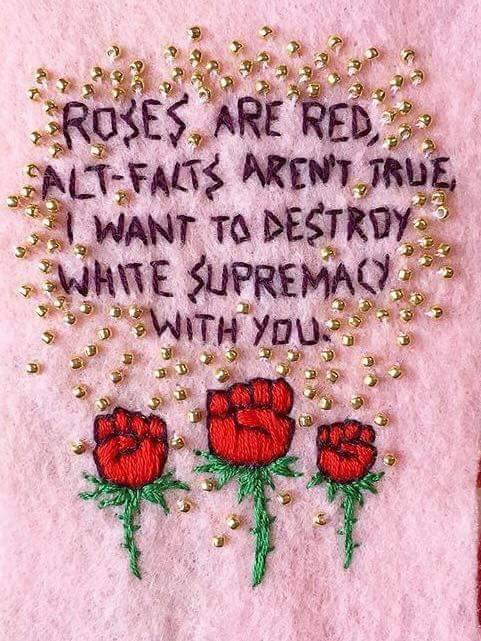
Alternative Facts.

It’s difficult to put into words exactly how triggering recent political events have been for me as a survivor of sexual violence.  It’s been difficult to know how to write about my feelings.  I’ve been reading the news, my feeds are covered in tweets, blogs, posts and comments related to the election.  But honestly, I can’t even look at his face without feeling nauseous and dizzy.  I don’t even want to type his name into my blog.

Why am I so triggered by this?  Some people around me have said, “it’s not our country, you have to just let it go.”  But that is a comment made from a place of privilege.  One that I’m not able to occupy because this election impacts me personally.  No, it isn’t my  country.  No, he isn’t my president.  But the fact that the democratic country to the south, has elected a man who has openly admitted to sexually assaulting women, is just too much to bear.  They say that accusing a man of rape will ruin his reputation. I think this is proof that that is a complete and utter lie.  Actually, it will make him leader of one of the most powerful countries in the world.

I’ve watched and heard snippets of news over the last few days.  I try to limit any viewing of the man himself, but I’ve gathered some important facts.  I’ve seen a new phrase being tossed around: “alternative facts.”

Quite frankly, this is terrifying to me.  I am very familiar with “alternative facts.”  The word I use for them is gaslighting.  I’ve already blogged about my experiences with gaslighting, but to refresh your memory, here is the Wikipedia definition of gaslighting:

Gaslighting is a form of manipulation through persistent denial, misdirection, contradiction, and lying in an attempt to destabilize and delegitimize a target. Its intent is to sow seeds of doubt in the targets, hoping to make them question their own memory, perception, and sanity.”

I experienced “alternative facts” when my abuser told me that I was responsible for the abuse he was perpetrating.  When he told me that if I was a “normal woman” I’d be okay with what he was doing.  I experienced “alternative facts” when he told me that the reason I didn’t like being assaulted in my sleep was because I already had PTSD.   I then experienced “alternative facts” when he claimed in court that I’d made up all the allegations of abuse, including the ones from my childhood, the ones he’d used to as an excuse for my discomfort.  I experienced “alternative facts” when my first abuser told me he would commit suicide if I ended the relationship.   I experienced “alternative facts”  when my ex-husband spread rumors about my mental health to all the health care professionals and school professionals involved with helping me and my children.   I experienced “alternative facts”  when the family law system told me that my disclosures of abuse were just “allegations” and were “irrelevant” to the determination of custody of my children.   I experience “alternative facts” dealing with Children’s Aid, when workers accuse me of coaching my children, and accuse my children of not being truthful.  I experienced “alternative facts” when the police officer who investigated my sexual assault told me he had tried to contact me multiple times and then closed the case (it was proved he never contacted me).

I’ve experienced systemic gaslighting in attempts by multiple people and institutions to silence me, to discredit me, to paint me as insane, to transform my self advocacy into “creating conflict” and to dismiss my feminist principles as extreme.

I am not alone.  Women and gender non-conforming folks who come forward with disclosures of their experiences of sexual violence face “alternative facts” at every turn.  Male survivors of sexual assault are gaslighted too, within a culture which tells them that men can’t be raped. Survivors are no strangers to gaslighting.  We are no strangers to having our ideas dismissed as hysteria.  We are no strangers to attempts to control us, our bodies, our minds and our souls.

I believe this is why millions of women marched on Washington and in cities and towns all over the world.  Women marched because they are tired of “alternative facts” and they have no interest in being gaslighted by anyone (least of all their government) anymore.

I marched because I didn’t want to surrender to a feeling of hopelessness.  I marched to show solidarity with those women who are less privileged then I am.  I marched to break the feeling of isolation that I’m experiencing.  I marched to know that I am not alone.  It was not my first protest, it was not my first march and it won’t be my last.

I know that marginalized groups have experienced oppression and “alternative facts” for centuries.  This is not a new phenomenon.  I know that and I acknowledge it.

But there is something incredibly unsettling and downright terrifying about someone who does it so publicly, so obviously and so without shame.

There is something deeply sickening about knowing that someone who hates the majority of people I care about (My LGBTQ+ friends, my Women of Colour friends, my friends who came here as refugees, my friends who live with disabilities, my trans friends, my own child, and all of my friends who are survivors of violence) has risen to power in such a way.

When I look at him, I see a reflection of all the perpetrators I have known.  I see privilege unchecked and unrecognized.  I see destructiveness, ignorance and hate.  I see all the things I fight against and oppose in my day to day life.

I see you.  I see your alternative facts.  But I call them gaslighting lies.  And they disgust me.

Welcome 2017…Burn 2016 to the Ground

20161221_170835Without a doubt, 2016 has been one of the worst years of my life.  I survived a massive, never ending family law trial.  My psychiatric records were released to my abuser.  My privacy was breached again and again.  My children’s privacy was destroyed again and again.  By the end of the court process I felt like I had only shards of trust left in anything.  My belief in justice was shaken to pieces.  My trust in the system to protect my family was gone.  As I entered into this Christmas season, I felt like believing in justice for my children was akin to believing in Santa Claus.  A myth, a tale told to pacify young infants.  There is no justice here.  Certainly not in 2016, and certainly not for my family.

I’ve been waiting patiently for 2016 to end.  On the Winter Solstice I burned a fire with my children, symbolizing the end of the year and welcoming back the light of the new year.  An end to the darkness and inviting the brighter days leading to summer.  In the fire I burnt away my fears and dark thoughts from 2016, leaving behind those bad memories and making space for positive karma for 2017.

I am a superstitious person.  Despite my scientific, thoughtful, highly rational mind…my obsessive compulsive nature leads me to have some strange superstitious, ritualistic thoughts.   Some of them are not quite spiritual, but take on an element of obsession.  I believe in signs.  I want to believe that things happen for a reason, even if we can’t see what that reason is.  There is no reason to explain the things I have endured in 2016.  None at all, except for oppression, broken systems, delays, inadequacies and incompetent workers.  No reasons that can satisfy me, or any reasonable person.  But at the end of the year, there are still many things to be grateful for.

I believe that I am a stronger person than anyone should ever have to be.  My children are also stronger than children should have to be.  I suppose in a way, this is something to be grateful for.  Though I almost cry out in pain at times, watching the innocent 2 year old children of my friends’, as they laugh and play with very little cares in the world.  I want that for my children again.  I miss their baby smiles and laughter.  It breaks my heart that they are no longer innocent, though they are still so young.  But they are strong and they are kind and they believe in justice, with a fierceness that has replaced their childhood innocence.  For that I am proud and grateful.

Things I am Grateful for at the start of 2017:

  1. A safe home that I love
  2. Wonderful caring neighbors and a beautiful neighborhood
  3. Enough money to buy the things I need for my family
  4. A job that allows me to help others, be challenged, learn and give back to my community
  5. My coworkers who I consider friends and who have supported me and helped me grow
  6. My family for always supporting me
  7. My children for giving me a reason to keep living and for being wonderful tiny humans
  8. My friends across the world, online and in real life, text and in person
  9. The rainbow community for supporting us and loving us and showing us where we belong
  10. For my citizenship and for this amazing, safe country I had the privilege of being born in
  11. For coffee, for tea, for coffee shops, for hot chocolate and for hot drinks everywhere
  12. For all the people I’ve met through my work, the people I’ve helped and everything I’ve learned from them this year
  13. For my car, for getting me and my family everywhere I need to go
  14. For my health, though it’s not perfect, I have a lot of ability
  15. For fresh air, for sunshine, for the woods, for nature, for being outside
  16. For the internet, cell phones and the ability to stay in touch
  17. For this blog, the ability to write and being able to share my experience with so many

Thank you all readers, for following my blog, for sharing it, for reading and commenting.  I wish you all the best for a peaceful, happy and healthy new year in 2017.  Be well.  I hope to see you all here in the New Year!

Not really accommodating.

red-phone-600x600.png

It’s frustrating trying to explain invisible disabilities to people who don’t understand disability.

It’s even more frustrating when people, places or organizations which claim to specifically accommodate or treat folks living with a specific disability or illness, don’t even remotely accommodate the symptoms of that condition.

I live with chronic, complex PTSD which has remained somewhat unresponsive to treatment.  I consider it a disability because for me, at this time, it appears to be permanent and it impacts my life on a daily basis.  It changes the way I think, act and complete tasks of daily living.  It also changes on a daily basis, which means some days I am quite simply more “able” than other days.

I recently sought alternative treatment at a clinic which claims to specifically treat people with PTSD.   This is their main focus is on helping clients with PTSD that has not responded to psychiatric medicine.

Logically, I thought that this clinic would be expert at accommodating the disability of PTSD.  Makes sense right?

I had a pretty good first experience there.  The doctor and the counselor I met with were helpful.   But the receptionist…not so much.

I had some issues with the treatment that was prescribed.  This was nobody’s fault.  But I needed to make another appointment to change the plan, shortly after the first appointment and sooner than planned.

To someone without PTSD and extreme anxiety this wouldn’t have been a big deal.  Just call, re-book the appointment and move forward.

But for me, it was a nightmare.

I felt like it was my fault.  I’d chosen the wrong plan to begin with.  They were going to think I was crazy for changing my mind.  They weren’t going to believe me about the side effects.  They were going to question me.  I felt embarrassed.  I felt ashamed.  I avoided making the call.  I invented stories in my head about how bad it would be going back. I felt angry that the plan hadn’t worked out.

I avoided calling the secretary and emailed the counselor.   He had told me I could contact him if I  had any issues and had seemed approachable.

Person with PTSD is going to choose to approach the least threatening person.  Person with PTSD (me) is going to choose email rather than speak to a person on the phone if they feel embarrassed.  The phone sometimes seems extremely intimidating to me.  What if I get nervous and say the wrong thing?  What if they say something that upsets me?  With email I can plan what I’m going to say and the response.  There is time to react calmly and clearly.

The secretary called me back.  I missed the call.

Then I avoided calling her back.  Anxiety was making the decision.

She called me again.  I missed the call.

I avoided calling her back.  Anxiety was making the decision.

My kids got sick, I had a stressful week at work, I procrastinated calling her back. I was busy with other things.  But I was also working through the anxiety, getting myself to a place where I felt I could make the call.

She left me three messages and probably about 3 weeks went by.

Today I called her back, expecting to apologize for not returning the call sooner, make an excuse about my kids being sick and then re-book my appointment.

But receptionist was cold and very abrupt.

You waited too long to call me back.  There are no more appointments.

I was confused.  I asked her until when.

Until the new year

I said that was no problem, could she book me in for January.

I don’t have the schedule for January

Um….okay…I was getting really anxious by this point.  I asked her to call me back in January and ended the call.

When I got off the call I was frustrated and angry.  I’d been anxious to return the call because I was afraid of being judged for needing to re-book the appointment in the first place.  I waited because of anxiety.  I waited because I felt stupid and I was judging myself.  The anxiety was related to my PTSD and anxiety is a common symptom of PTSD.  PTSD is the reason I was seeking the treatment in the first place.

I told myself the fear of being judged was irrational and that the clinic staff would understand and assist me in booking an appointment because they were there to help me.  I told myself that they would understand that someone with PTSD might be anxious about making a call and thus might procrastinate.  They might understand that someone could have a few rough weeks and not return a call.  I reassured myself.

I made the call.

But it turns out my anxiety wasn’t misplaced.  I wasn’t able to re-book my appointment.  They were annoyed that I didn’t call back right away.  And I’m now seriously questioning how well that receptionist knows how to accommodate someone living with the disability of PTSD.

It’s not about the fact that there was no appointment until January.  I’m fine with that.  I procrastinated, I wasn’t expecting to see the doctor tomorrow.  But the phone call could have been handled differently:

I’m sorry to hear your kids have been sick and you weren’t able to return my call.  I’m glad I have you on the phone now.  Unfortunately our appointment slots are booked up until after the holiday break, but can I fit you in for the New Year?”

Another option might be

It sounds like getting phone messages and returning calls is difficult for you, and email is easier.  Sometimes people with PTSD find calls difficult.  Don’t worry, we can book your appointments over email as an accommodation.  Let me book you in for January.

This post isn’t about that one receptionist and this one situation.  This post is about not making assumptions about why people behave the way they do. Especially if you work in an organization providing health care services!

It’s also about realizing that accommodation for people with disabilities means more than just building a ramp (though ramps are needed too, I’m not knocking ramps!).  It means realizing that disabilities impact different people in different ways.   Accommodation isn’t always something complicated or expensive.  Sometimes it could be as simple as using email as a way of communicating, or offering choices for methods of booking appointments or receiving information.  Accommodation starts with realizing that not everyone lives life the same way you do.  We all have different abilities and that’s okay.