Misdiagnosis.

20160425_190808[1]

This is the piece of paper I was given as a “formal” diagnosis back in 2001.  It was the first time I learned about PTSD.  It was also the first time I was misdiagnosed with Borderline Personality Disorder.  In reality, my PTSD is severe, my current Dr told me it was one of the worst cases he had ever seen.  But Dr. X, in his wisdom, after knowing me for a only a few months decided the impact of my trauma was “mild” and instead the main factor in my illness was untreated borderline personality disorder.  As far as I can see, this assumtion was made due to my self cutting behaviour.  He failed to take into account that before being abused I had no mental health problems.  He failed to take into account that self harm and anorexia are common coping techniques for sexual abuse, especially in young women.  He failed to notice that my out of control self harming behavior and suicide attempts began only AFTER taking a cocktail of psychiatric meds. He failed to see that I have almost none of the diagnostic criteria for BPD, except the self harm.  I had long term friends, stable relationships in my life.  I was not impulsive or risk seeking, except with regard to the self harm.

Over the next few months Dr X also placed a value judgment on this misdiagnosis of Borderline.  He was the first person I talked to about the sexual abuse, and as such I trusted him and looked to him for support.  This was a mistake.  I didn’t have a choice as to what psychiatrist I saw, he was the one assigned to me.  He gradually saw me less and less in his individual practice.  I would show up for appointment only to find he had left for the day or was on call in the ER.  Then he changed his practice to work solely in the urgent psychiatry clinic.  The only way to get an appointment was through the ER.

I had no family Dr and nobody to renew, monitor or change my medications.  He told all the psychiatrists at South Street that I was borderline and so they would not take me on as a patient.  He refused to give me a referral to a community psychiatrist and I had no family doctor.  I felt betrayed.  I felt rejected.  I felt worthless.

I started to use the ER on a regular basis, mainly after cutting myself.  I would ask for a psych consult about 50% of the times I cut myself.  I would ask the doctor on call to please assign me a regular psychiatrist to follow me.  I begged.  I pleaded.  I was rejected.  I was sometimes given an appointment at the urgent psychiatry clinic, where I knew I would see Dr. X again.  No way to break free, systemic barriers and misdiagnosis kept me trapped.  The more I protested, the more I harmed myself, the worse the situation got for me.

The treatment that I received at South Street was appalling. I know I am not the only one and I know this hospital is not the only one with issues.  Women survivors of childhood sexual, emotional and physical abuse are often misdiagnosed with borderline, a diagnosis I see as basically a wastepaper basket label.

I remember during my second last year at South Street, 2003, I attempted suicide again.  This time I cut myself extremely deeply, diagonally across my arm.  I remember lying on the floor in the hallway of the apartment I shared with my boyfriend.  I was dizzy, almost blacking out.  I felt the quiet empty feeling in my head and I tried to decide whether or not to keep pressure on the cut or let it bleed and let myself give in to the pull of unconsciousness.  I lay there for a while, I’m not sure how long.  I finally decided to go to the hospital.  I think I took a cab, but I’m not sure.

At the hospital, the medical doctor that first assessed me actually put me on a Form.  He got a security guard to sit in my curtained area to watch over me.  I remember I was studying for my 4th year Health Sciences exams.  Somehow the irony of this was lost on me at the time.  I had just tried to kill myself, I had a security guard watching me and I was studying for a university exam in the ER.  The medical doctors fixed up my cut with stitches.  By this time the routine of receiving stitches was, just that, routine.  I had received hundreds, sometimes as many as 50 at a time.  After I was fixed up I was transferred to the psych section of the ER.  I don’t remember too much about what happened but I do remember I was told that there were no beds, that I could not be admitted.  I told them that the cut had been a suicide attempt, not “just” self harming like I usually did.  I begged to be admitted. But the psychiatry doctor was firm, there were no beds for me.  I couldn’t understand it, the medical doctor had thought I was a risk to myself, so much so he had security watch over me, but psychiatry released me.  I learned over the years at South Street that as soon as a doctor had access to my past charts I was treated very differently.  I was generally taken seriously when a health care provider spoke to me and listened to me.  When that same health care provider saw my chart, I was turned away, disrespected, ignored and mistreated.  This is what misdiagnosis with BPD means to me.

I remember being discharged from the ER that day.  I was desperate.  I still wanted to die.  I remember standing in between the double doors of the ER crying.  I didn’t know where to go or what to do.  I felt hopeless.  It was late evening, it was spring or summer and it was still light outside.  As I stood there crying a door opened, it led out to the ambulance bay right beside the place I was standing.  Our of the door came a gurney, with a black body bag on it.  The door led to the morgue which was also in the basement of South Street.  The body was loaded into a funeral home vehicle and drove away.  The image impacted me and haunted me.  I wondered if my friend Darlene was wheeled out that very same door a year before. I was preoccupied with death.  I felt scared and I felt lost.  I just wanted someone to help me.  I’m not even sure I really wanted to die at that point, I just wanted the pain and confusion to stop.

Eventually I left.  I took the bus home, back to the apartment where I’d tried to end my life a few hours earlier.

I think that people often conclude that because an injury is self inflicted, that the person chose it.  That they are not traumatized by it or impacted by it.  But I believe that self inflicted trauma also needs to be recognized as a contributor to PTSD.  I think that my experiences within the psychiatric system alone could have caused PTSD in a healthy person.  In a person who was already traumatized they were that much more severe.  Sometimes comfort and sympathy are not provided to self injuring people.  We are treated as though we “knew better” and are essentially “wasting time and health care resources” or taking away care from those who “really need it.”  I believe that every person who self harms would have chosen a different option if they felt they truly had a choice.  Self harm isn’t cool, it’s not fun, it’s not something to envy or idolize.  It’s dangerous, it’s terrifying, it is not glamorous in any way.   It leaves lasting scars.  Scars I will live with for the rest of my life, and scars that trigger memories of times in my life I would much rather forget.  I get flashbacks around my self inflicted trauma in the same ways I do to the abuse inflicted on me by others.  And because I was abused in the health care system the two are not distinct.

There is no easy solution to these problems.  People who self harm need and deserve compassion.  PTSD should be taken seriously and not dismissed as a disordered personality.  PTSD is treatable.  Believing survivors is the first step.  Yes, this means as a society we all have to step up and acknowledge that violence and abuse is much more prevalent than we ever imagined.  We need to collectively work to end victim blaming and shaming and fight rape culture.  Because powerful white male doctors, with all their privileges, labeling my personality as disordered is rape culture.  I became sick and disabled because of abuse; I’m not disordered, I am a survivor.


Dental Floss. When the truth is I miss you so…

Wonder-Woman

I met my dear friend MJ during the summer months of 2002.  We were both patients in the Post-traumatic Stress Recovery Program at Homewood Health Centre in Guelph.  We became friends very quickly, even though we were both struggling.  In so many ways she was struggling, coping with the impact of years, a lifetime really, of abuse.  We were close in age, we were both looking for hope and for something to hold on to.

I won’t write too much about MJ’s story, because it is not my own.  I will say that she was also a survivor and spent a good portion of our friendship hospitalized in various places.

MJ and I would write letters to each other, cards mostly.  Words of encouragement.  We would speak by phone, sometimes almost daily and sometimes months would go in between.  The amount of contact varied along with our health statuses at any given moment.

MJ was the person who I felt completely understood my experience of living with PTSD.  She never judged me.  She was always so grateful for our friendship.  I could tell her my strangest thoughts and she knew exactly what I was going through.  She was one of the bravest people I’ve even known.

MJ and I had an inside joke.  I don’t remember anymore who started it, but I think it was her.  We both struggled with near constant thoughts of suicide and self harm.  But we would talk about holding on and about being there for each other.  She used to say “hold on to hope, even if what you are holding onto is as thin as dental floss.”  We often talked about holding onto the dental floss, each of us holding one end and clinging to life.

I supported MJ through many hospitalizations and numerous suicide attempts.  I always knew in my heart that MJ would not be with me forever.  I almost lost her too many times to count.  We had a special connection, one that I’ve only had with a few other people in my life. I would dream about her, nightmares about things happening to her. Waking with a terrible, panicked pit in my stomach, I would know the dream was true. We were so connected I often knew something was wrong or something had happened before she told me.  I would call and find that she was in hospital.

MJ died one year ago.  She died from complications from chronic, terminal PTSD.  I was not there, I did not get to say goodbye.  For some reason I was not invited to the funeral.  I found out over a week later when her Mom answered her cell phone.  I was sitting in my car and I instantly knew.  I cried as her Mom described what happened.

MJ did not die alone.  Her family was with her and she was peaceful.  I take great comfort in this.  I said thank you hundreds of times.

But my heart aches and aches.  I can’t believe she is gone.  I feel devastated that some people don’t survive violence. There are days when I think if I pick up the phone to call her she will answer.  If I get on a plane and fly to her city, she will be there waiting for me.  I dream about her still and wake up crying when I realize she is dead.  She will always be a true survivor to me, even though she didn’t make it out alive.

I still have all the cards she ever sent to me.  I have about 25.  I keep them, along with photos of us together, under my bed.  I’ve read and re-read them, my eyes filled with tears of gratitude that these small pieces of her, her words of encouragement to me, will always be with me.

If I could have one wish, to speak to anyone, living or dead, it would be her.  Just one more time.  I wonder if anyone else will ever understand me so well.  I know I won’t ever have a friend just like her.  The bonds that are formed through shared experiences of trauma are difficult to break.  And I don’t want to break them.  As much as this hurts, I don’t regret being her friend.

I miss you MJ.  I miss you so much.  I’m still here, I’m still holding my end of the dental floss.  I’m still trying to be the Wonder Woman I know you believed I was.  Thank you for being my friend.

Cowboy take me away
Fly this girl as high as you can
Into the wild blue
Set me free oh I pray
Closer to heaven above and
Closer to you closer to you”   -Dixie Chicks


Cumbersome.

elaws_regs_900741_ev001-5

“I have become cumbersome to this world…”  Seven Mary Three

Trigger warning

This song was playing on the radio in my boyfriend’s car.  We had parked outside the engineering building at the University of Western Ontario.  I waited in the car while he ran inside to hand in a late assignment.  It was about 3pm in June 2001.  I was deeply depressed and in the grips of side effects of benzos and SSRIs, toxic soup which turned my brain into an impulsive, self destructive, hopeless mess.  I felt like the song was a sign and a message to me that it was time to die.  we drove home and a few minutes later I was in the bathroom, taking my 3rd overdose.  I was serious this time and not messing around.

I remember sitting in my room, waiting to see what would happen.  I started feeling bad fairly quickly and this time I was fully aware of the entire experience.  My boyfriend drove me to the hospital and I remember during the drive realizing that an ambulance would have been more appropriate.

I remember sitting at the triage desk in the South Street ER, the nurse asking me questions: “How many pills did you take?”

Either my answer or my vital signs snapped everything into motion.  I remember her checking the E for Emergent on the triage form and I was taken immediately back into the department.  Things started to go downhill from there.  I was given activated charcoal to drink, this time I was fully awake and the taste and texture was horrific. I still have regular nightmares and flashbacks about this.  Even typing this I’m having flashbacks and feeling nauseous.  The nurses took blood samples and started an IV.  As we had found out on OD #2, I’m actually highly allergic to the antidote to the drug overdose.  This meant I was having a life threatening allergic reaction.

I remember my face getting hot and swollen.  I was receiving IV benedryl along with the antidote.  I was vomiting over and over, the charcoal wouldn’t stay inside me.  Eventually I was vomiting blood.  I was given IV gravol.

My sense of time was somewhat confused but at one point I remember them paging the internal medicine experts.  It was at this point I realized that I had F*#ed up.  I realized that I wasn’t going to die, clearly.  I felt like a failure at everything.  I couldn’t even get this right!  But at the same time I was petrified because I knew my body was not doing well.  My liver was having trouble processing the OD.  The specialist told me I needed the charcoal to absorb the drug and I would need the IV antidote for about 24 hours, I was being admitted to a medical floor.  He also told me if I ever did this again I would die from the allergic reaction to the antidote.

Shortly after the Dr  came back into my curtained area.  A tube was placed down my throat and into my stomach.  I was fully conscious and had no pain relief.  I could not longer speak.  My eyes were watering from the pain.  The nurse was supposed to come immediately to pour the charcoal directly into my stomach.  But for whatever reason she didn’t come and I was lying there unable to speak with a tube down my throat.  Finally the nurse came, poured the charcoal into me and then pulled out the tube.  I was gagging and crying.

Late that night I was taken upstairs to the 5th floor which was a cardiac monitoring floor. I needed a monitored bed because I had been admitted involuntarily on a Form 1 (72 hour psychiatric hold under the Mental Health Act).  I remember waking up, if I had even slept at all, and dragging my IV to the washroom to vomit black charcoal.  I could barely walk. I noticed that this part of the hospital was much fancier and the beds were much more comfortable than on the psych wards.  I remember at one point using the phone in the nursing station to speak to my parents.

In the morning breakfast came on a tray.  There was cream of wheat in a plastic bowl.  A few hours late the psychiatrists came to assess me.  I remember being angry and frustrated because they made me walk all the way down a long hallway to a meeting room to talk.  I could barely walk and it felt like an eternity.  I remember thinking they were punishing me on purpose, but maybe they just didn’t realize how terrible I felt.

I was moved to a bed on the 2nd floor, it was a general medical unit.  Since I was not in a monitored bed and not on the psych floor (locked ward) I was assigned a “sitter.”  Basically someone to sit in the room and watch me, presumably to ensure I did not harm myself again.  It was embarrassing and invasive.  This person just sat on a chair in my room.  If I went to the washroom they would stand outside the door and listen.

I remember the day being overwhelming and scary.  I was not grateful to be alive, I didn’t see it as a second chance.  I felt sick and I felt trapped.  I felt incompetent and alone.

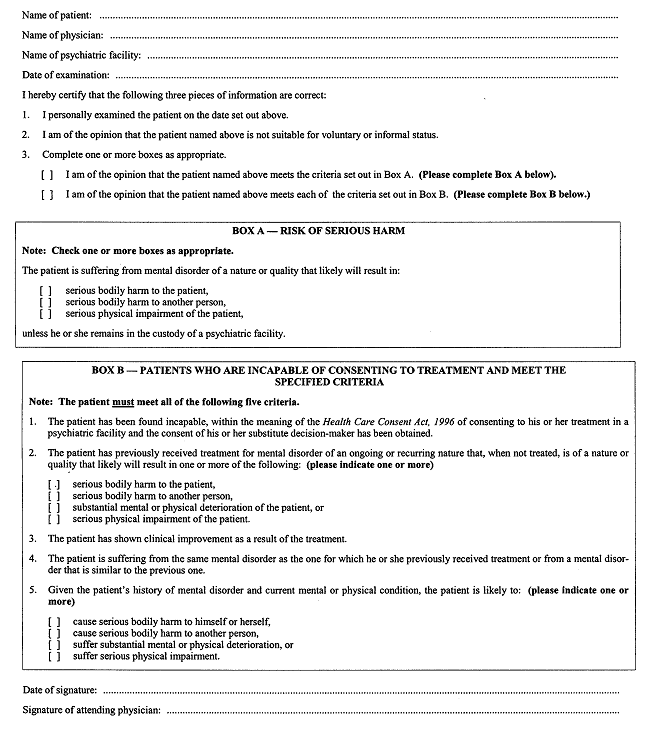
Late that evening I was medically cleared, the IVs were removed.   I was moved to the 7th floor.  I was not allowed to leave the unit.  After the 72 hours passed my Form was extended to a Form 3 which allowed them to keep me for up to 7 days.  Dr. X was the one to sign the papers.  He informed me that things had gone too far and he would not release me from the hospital unless my parents came to collect me.  I had no choice but to agree.

Involuntary hospitalization feels like being imprisoned.  Your right to freedom of movement is removed.  You must stay on the psych unit and you can’t go outside.  Sometimes they will let you go outside supervised but only on hospital property.  Did I need to be involuntarily held at that time? Probably yes.  Would I have harmed myself again at home?  Probably yes.  In fact, I went on to continue harming myself for years after this admission and I would be held involuntarily again.  I couldn’t talk myself out of this one.

It’s very difficult to explain what is in the mind of a person who wants to die.  Sometimes it feels like a terrible emptiness.  Sometimes it feels like looking at the world through dark glasses.  Sometimes it feels like a crushing weight, when you feel like you are separate from all living things, a shadow of yourself.  Sometimes it is racing, impulsive thoughts of harm.  Other times it is absolute quiet.  I’d be lying if I said I don’t still have thoughts of dying.  They come and go, as they have since I was 17 years old.

Thoughts of suicide are a warning sign for me.  They are a giant red flag waving.  Stop! Your stress levels are too high.  You have too few spoons.  You have too many triggers.  You need to slow down and self care.   Suicide is a symptom of depression and PTSD.  Hopelessness is a symptom.  It’s not a sign of weakness and it is not a sign of being “crazy.”  It’s a symptom of depression in the same way sniffling and coughing are symptoms of a cold. Suicide and suicidal attempts can also be a side effect of many psych meds and this was certainly true in my own life.  This is an issue with many layers.  Ironically, suicidal thinking can be a way of coping and trying to survive desperate times.

I am a suicide survivor.

.

Gaslighting

20160421_220940[1]

Gaslighting: a form of mental abuse in which a victim is manipulated into doubting his or her own memory, perception and sanity”  -Wikipedia

Gaslighting.  Gaslighting. Gaslighting.

It’s all I can think about these days.  It’s been 967 days since I moved out of the house I shared with my ex-husband.  2 years and almost 8 months.  I was naive back then, I actually thought that moving houses could end the gaslighting but I was wrong.  The incredible thing about gaslighting as a form of abuse is that its impacts last long after the abuse ends.  The manipulation gets inside the victim’s head.  The self doubt, which sometimes extends to an level which almost resembles paranoia, can be paralyzing.  “Maybe I am really crazy,  maybe I’m the one who is abusive,  maybe I’m the one responsible for the abuse, maybe he was right about me, maybe nobody will believe me…maybe, maybe, maybe…”

If you have ever found yourself thinking these types of thoughts within a relationship or after escaping, you may have been a victim of gaslighting.  It can happen within families of origin as well as dating relationships.  I also believe that (at least in my experience) the psychiatric, legal, police and child protection systems collude in gaslighting survivors of violence, especially woman, and especially marginalized women.  In a victim blaming, rape culture, our entire society is complicit in gaslighting survivors of violence.

My first abuser X was a gaslighter.  He manipulated me into believing that he could not live without me, that I was essential in his life and that he loved me deeply.  The thing about gaslighters is they know their victims, they know them in a way that is designed to search out weak spots, and gather information that can be used in a tailored and effective manipulation.  I am an empath, a caretaker, a caregiver, someone who thinks deeply about the well being of those around me and about the society we live in.  Empaths are particularly vulnerable to gaslighting, as the perpetrators are often narcissists. There are lots of interesting articles circulating about toxic relationships between empaths and narcissists.

I believe that X knew these things about me, things that in a healthy relationship are considered strengths, and he turned them against me as weapons.  He knew that threatening me directly would probably have little impact, so he talked about suicide in ways that strongly implied he would literally die without me.  I was 15-16 years old and I believed him completely.  I thought that I was helping him, I felt important and useful and even loved.  He would turn on the love and shower me with attention, notes, gifts and phone calls.  But when we were together he ignored my boundaries.  He didn’t seem to understand no or hesitation of any kind.  He just did what he wanted.  I began to feel like a sexual object, irrelevant and I learned skills like disassociation and distraction to minimize the impact of the sexual abuse.

Part of the gaslighting was making me believe I was helping him, and as long as I felt I was doing good I stuck around.   Part of the gaslighting was the intense shame I felt which prevented me from telling a single person I was being abused. I truly believed that if anyone knew I was sexually active I would be in trouble, I’d be labelled as a slut, my parents would be angry, his parents would judge me etc…  Looking back I realize that this intense shame was a side effect of being sexually abused and having my needs ignored and pushed past.  Instead of realizing that what was happening to me made me uncomfortable and thus, was bad, I began to think that I was inherently bad.   I believe this was also related to the messages I was getting during the sexual abuse, the mental abuse and gaslighting.

The first step is leaving the abusive situation.  But for readers who have not been abused, it’s important to realize that the survivor often takes the mental abuse with them because it has been deeply internalized.

If I need to hear over and over and over “You are not crazy,” please say it to me.

If I tell you that I feel crazy, bad, damaged and unworthy, please reassure me.

If it seems like I don’t believe your reassurance, I probably don’t, but I still need to hear it.

I don’t need you to fix me.  I need you to validate and believe me.  I need to hear consistent and safe messages and I need your patience.  I survived years of gaslighting and it may take years to undo the damage.

I’m not giving up when I say “I feel crazy.”  I’m terrified.  Truly scared that it might be true.  Even though you see me as a functioning adult individual, working, parenting, taking care of my life, a few small triggers can bring up all the feelings of the mental abuse.

I’m not saying these things to be dramatic or to get attention.  I’m looking for evidence to contradict the self doubt that years of gaslighting created in me.

The biggest gaslighting related trigger for me is not being believed or feeling like I am not believed, or even might not be believed.  Because gaslighting is designed to create self doubt and feelings of being crazy, when I feel others don’t believe my real experiences I can begin to question myself all over again.  What if I really am crazy?

Systemic and institutional abuse can be a form of gaslighting as well.  When a woman comes forward to tell her story and she is not believed, she may begin to doubt herself.  Systems are full of contradictions, double binds and no win situations.  In this way, they also create an atmosphere that is retraumatizing and crazy making.   The very systems an abused person may need to turn to in order to escape the abuse are likely to perpetuate more confusion, frustration and contradiction.

I’ve had gaslighting experiences within the psychiatric system, the health care system, the legal system, while working with the police and interacting with child protection services.  That’s a long list.

Break the cycle of abuse.  It’s just as easy as these few words:

I believe you.  It’s not your fault.  I’m so sorry this happened to you. You are not alone and you are not crazy, you are having normal coping reactions to surviving abuse

Repeat as often as possible, whenever self doubt arises.

It’s cheaper than psychiatric meds and has only positive side effects.


No, you don’t have the right to torture me

20160418_215945[1]

This is what the stigma of being misdiagnosed with borderline personality disorder means to me.  Trigger warning for description of self harm and abuse.

Monday November 8, 2004

I presented to the Emergency Room at South Street Hospital with a self inflicted cut on my arm.  By this time I had been using hospital psychiatric services for over 3 years.  I was a frequent flyer, a regular, a repeat customer and I was not popular.  I had experienced many unpleasant experiences in the ER.  I had grown accustomed to medical students poking at me and asking ridiculously offensive questions.  The worst was “Why don’t you cut yourself deeper so it would hurt more?”

I’m only going to say this once.  In my opinion someone who uses psychiatric services heavily is actually in MORE need, likely MORE desperate and experiencing MORE complex issues that someone who is visiting for the first time.  As mental illnesses progress folks become sicker and more marginalized by society.  What is needed are more individualized care plans, more compassionate care, more empathy and more listening to the survivor.  The survivor themselves is the expert in her own healing.  One size fits all models of care do not work, they have never worked, and will never work.  Each person is unique and experiences a unique mix of oppression and marginalization as they live with their illness.  Social and structural factors are an important thing to consider.  The survivor does not exist in a vacuum.

Believe me, if someone truly had options, they would NOT choose to spend their lives in psychiatric institutions.

Part of the reason I used the Emergency Room so frequently at that time was because I had neither a family doctor, nor a psychiatrist seeing me for ongoing care.  Lack of access to primary and preventative mental health care is a huge issue.  Another major barrier is the existence of a two-tiered mental health care system; whereby folks who have financial resources are able to access private care from psychologists and social workers and economically marginalized people (the sickest and most at risk) often face long waiting lists, lack of affordable housing and gaps in services.

By that time Dr. X had stopped seeing me.  This happened over a period of months.  First he would cancel appointments, then not show up for them.  I was busing across town to meet him and he just would not be there.  Then he switched from an outpatient practice and seeing inpatients on the 7th and 8th floor to working full time in the Urgent Psychiatry Clinic and the ER.  When he switched his practice I was not assigned to another doctor, nor was a given a community referral.  Thus, my only option was to attend at the ER to get a psych consult and an appointment with Urgent Psychiatry.  I begged and pleaded and searched for a new doctor but I was not able to find one.  I found out later that Dr. X had essentially blacklisted me at South Street and no psychiatrist would take me on because I had “borderline personality disorder.”  I was also denied access to the PTSD treatment program, after waiting on their list for 18 months.  I was told I didn’t meet the criteria for the program.  Ironic since PTSD is my main, if not only, diagnosis.

But I digress…back to November 8, 2004.

I waiting in the waiting room for about 1 hour before being brought back into the curtained treatment area known as OR 2.  When I was directed to a bed I began crying and was visibly upset.  A nurse arrived to take my history, but she was interrupted by Dr. P who dismissed her saying “you are wasting your time.”   Dr. P spoke to me in a curt and derogatory manner, asking to see my laceration.  He took a quick look at it and said he was going to staple it.  I began crying and asking him to please stitch the cut instead because staples really scared and triggered me.  Dr. P laughed at me and asked me to lie down and proceeded to quickly clean the cut.  He then held my arm down and proceeded to place 8 sutures into my forearm without using any local freezing or pain relief.  I was sobbing and screaming and he continued offering no sign of sympathy or concern.  I couldn’t understand why he was not following procedure and I was confused and distressed.  I felt as though I was being purposely targeted and tortured because my wound was self inflicted.  I felt like Dr. P wanted to “teach me a lesson.”  I was known to him from previous visits and I got the sense he did not want to see me in “his” ER again.

After he was finished the nurse came back and tried to calm me down.  She reported the incident to the charge nurse who also comforted me and offered me Advil.  I was then taken to the psych waiting area to meet with the doctor on call.  I was very upset, triggered and in a lot of pain.  I remember curling up into the smallest ball I could make in the uncomfortable plastic chair which was bolted to the ground.  The floor was covered in green tiles.  All the furniture was bolted down, presumably to stop patients from injuring themselves of others.  It was a cold room, I remember I was shaking and probably in shock.

I reported the incident to the College of Physicians and Surgeons a few days later.  The treatment I received was abusive and was physical assault.  I came to the hospital (already living with PTSD) and I was traumatized in a time of crisis.  I firmly believe that if my cut had not been self inflicted and if I had not been labelled within the hospital as a “hopeless case” this assault would not have taken place.

Procedure allowed Dr. P to write a response to my complaint.  In his response he actually admitted to speaking with Dr. X who told him that I “had long standing borderline personality disorder and that none of his colleagues would take [me] because of this.”  Incredible!  Psychiatrists in the hospital were actively denying me care due to a psychiatric misdiagnosis?  I wouldn’t believe it except I’ve seen my charts and I know it to be true.

Dr. P’s explanation for not using freezing was that he thought my arm was so full of scar tissue that I would not be able to feel the sutures.  This made no sense since I was screaming while he stitched my arm.  He wrote that he offered me anesthetic which was a lie.  Luckily the two nurses who were working supported my account of events.  Also the Dr did not note in the chart that I had refused local anesthetic which is standard protocol before proceeding without it.   I found out later that my complaint was not the first one made to the College about Dr. P and his behaviour in the ER.

The College upheld my complaint and Dr. P was ordered to appear before the College for discipline.   I’m not 100% sure what that entailed but my complaint was heard.  I did feel validated by that, but it did not undo the trauma that I experienced.

I experienced torture within a Canadian hospital.   This happened because of the label of borderline personality disorder.  This happened because I wasn’t getting better quickly enough, because I wasn’t acting in a way that was expected of a survivor of violence.

But this should not have happened, not to me, not to any person.  Especially not to a survivor of abuse.  Self harm was a normal coping reaction for me.  My personality is not disordered, I survived ongoing sexual and emotional abuse; as well as dangerous side effects to the very medications the hospital kept pushing at me.

My message to the world:

Please treat folks who harm themselves with care and compassion.  Chances are they are already judging themselves far more harshly than you ever could.  Self harm is a misunderstood coping technique, it is not a way to get attention.  If you haven’t harmed yourself, please don’t judge, you haven’t walked in our shoes.  The reasons why people turn to self harm are complex and layered. By showing love and compassion to the self-injuring person you could be literally saving their life.  We don’t want or need to be saved, we just want to be respected, heard, and valued.

If you do harm yourself, please know that you are loved and important.  I hope one day you will find other ways to cope.I support you and I am glad you are fighting rather than giving up.

The world is a better place because you are in it.


Don’t judge me. I’m coping.

hope-hero

The most important thing to remember about survivors of sexual, emotional and physical abuse is that if we are alive chances are we are coping and that’s a good thing.

One way the psychiatric system as a whole fails survivors, especially women, is by labeling our normal coping reactions as “symptoms” of various psychiatric illnesses.  Please consider this: it was the situations I survived that were not normal, the ways I coped were normal healthy reactions.  I did what I had to do to survive and that’s okay.

Yes, you are normal!  No, this is not your fault!  I believe you.

If you turned to “disordered eating” as a way of coping with your trauma, you are normal.

If you engage in self harming behaviours as a way of coping, you are normal.

If you take drugs and alcohol as a way of coping, you are normal.

If you zone out or disassociate as a way of coping (either voluntarily or involuntarily), you are normal.

These are all examples of common coping reactions that women utilize to survive the abnormal and terrifying situation of experiencing abuse.

You did the best you could at the time to survive and that was enough.  If I had known better or had other options, I might not have used anorexia, self harm and suicide attempts to cope.  Those tools worked for me for a time, until they didn’t.  When they stopped being useful to me and started causing more harm to me than good, I became motivated to learn new methods of coping.    I don’t have borderline personality disorder, I don’t harm myself to manipulate others or to seek attention.  I do it because I am a survivor of trauma, doing what survivors do best: surviving.

If you are working towards recovery be proud of yourself.  We aren’t aiming for perfection here, because it doesn’t exist.  Your best is enough.  You are enough.

I identify with the label PTSD and my experience with it is that it is chronic and more of a disability than an illness.   Living with PTSD takes an incredible amount of energy.  If you regularly hear me say “I’m tired, I’m so tired” I’m not whining.  I am fatigued and tired almost all time, some days worse than others.  And no, taking a nap won’t help but thanks for thinking of me.

Let me explain why living with PTSD is so exhausting.  It’s an invisible illness, for the most part you can’t see my struggles, but that doesn’t mean they are not real or valid.

Facts about PTSD and why it sucks away a massive amount of my energy each and every day:

  1. Even though I might be in bed for 8 hours in a given night I’m often experiencing nightmares.  Sometimes these nightmares cause me to wake in a panic attack, unsure what is real and what was just a dream.  I sometimes wake up covered in sweat, making sounds and fighting off imaginary threats.  When I wake up I often do not feel rested and I sometimes avoid going to bed at night when the dreams have been particularly troublesome.
  2. One word:  hypervigilance.  This means my danger sensors are on high alert 24/7, 365 days a year.  I can’t “just relax.”
  3. Hyperarousal and exaggerated startle response.  Every time there is an unexpected noise, or sometimes even an unexpected movement I jump about 10 feet in the air.  This is a symptom that people around me tend to notice and comment on.  Again, I cannot control it. Reassuring me that there is no danger does not stop the response.
  4.  Depression and anxiety.  Obsessive compulsive worries.  Yes, PTSD impacts my mood.  No, I can’t just “cheer up” or “think positive.”
  5. Flashbacks and body memories.  Yes, intellectually I know it happened “a long time ago” and that I’m “safe right now” but my body and my physiology haven’t caught up. I can go from feeling perfectly fine to crying, terrified and in physical pain within seconds and the trigger can be sometimes as inconsequential as a touch, a word, a memory crossing my mind.  Intense flashbacks are accompanied by panic attacks, rapid breathing, hot and cold sweats, disorientation, confusion between past and present.  After a particularly bad one it can take up to 7 days for the residual effects to pass.  And though technically, in the present moment, nothing bad has happened to me, I often feel as though the abuse has occurred all over again.  I feel exhausted, scared and sometimes hopeless about how little control I have over the memories.
  6. Flashbacks, body memories, hypervigilance etc are not the same as day to day worries.  They are not something I spend time thinking about or worrying about, it’s easier to understand them as physiological reactions, rather than connected to specific thoughts or behaviours.   This is not an intellectual problem, so no, I can’t just “look on the bright side”
  7. PTSD is often accompanied by deep shame and sense of self as being damaged, broken or somehow faulty.  Even though you might not see me this way, and struggle to understand why my self concept is so “distorted” please hear me and believe me.  I really do feel that internalized shame as a result of being abused.  Be patient with me, I can’t just “love myself.”  It’s more complicated than that.
  8. PTSD causes actual changes in your brain.  In the military it is referred to as an operational stress INJURY or post-traumatic stress INJURY and this makes perfect sense to me.  My brain was injured by the trauma I survived.  The eating issues and self harm behaviours are symptoms of PTSD, they were the ways I reacted and coped with the initial injuries.

For those of you who do not live with PTSD, I hope this explanation of my experience makes sense.

Last night I had a new flashback, to the original abuse with X, 20 years ago.  It wasn’t a lot of fun.  It led me to think about how PTSD uses up a massive amount of spoons (google spoon theory of chronic illness for more information).

I’m trying to be compassionate with myself tonight.  My hope levels are staggeringly low.  I’m tired of life, but I won’t give up.

Tonight I’m coping.  I hope you are coping too. 

Love letter to my body

20160416_232127[1]

April 22, 2004

To My Body,

I resent that you make me so uncomfortable.  I hate it when you trigger me. I hate it when you feel unsafe. I’m tired of feeling unsafe.  I wish you would just disappear or leave me alone. I don’t like it when you feel fat and dirty. I resent that you have power over how I feel. I’m fed up with you. You’ve caused me so much pain and suffering. I’m angry at you for making me feel ugly and unattractive.

I hate it when you feel too big and out of control.  I hate it when you feel too small and out of control. I hate it when you feel average. I want you to feel average. I want you to be a safe place to live. I resent that I can’t leave you behind.

I’m angry that you attracted abusers to me. I’m angry that you allowed yourself to be abused. I’m angry that you didn’t run away or fight back.  I’m tired of blaming you. I’m tired of not being able to forgive you.  I hate it when you cause me painful memories. I resent that you remember everything. I resent that I can’t replace you. I hate it that you feel dirty and broken. I want to be able to wash that feeling away.

I hate that you’ve had so much control over my life. I’m tired of you getting in the way of my happiness. I’m angry at your scars. I’m angry that you’ll never look normal. I’m angry because you make me hate myself.

I feel sad that you have been so badly hurt. I’m sad that you were violated. I feel awful because your boundaries were disrespected. I feel disappointed because you are permanently damaged. I feel hurt because you have not been respected. I feel sad because I have caused you so much pain and suffering. I feel awful because I blame you for everything. I feel awful because it wasn’t your fault.

I want to be able to forgive you. I feel afraid that I will never forgive you. I feel afraid that you will never heal. I feel afraid because you are vulnerable. I’m afraid I will abuse you again. I’m afraid someone else will abuse you again.  I wish I could protect you. I wish I could keep punishing you. I’m afraid that you will never feel whole again. I’m afraid of your suffering.  I feel awful because I know you are suffering.  I feel awful because I have never given you the chance to heal.  I feel awful because I don’t know if you can heal.

I’m scared of you.  I’m scared of the way you look.  I’m scared of the way you feel. I’m terrified because of how powerless you are. I’m terrified of how powerful you are.

I’m sorry that you have been abused. I’m sorry that I couldn’t protect you.  Please forgive me for the years I’ve spent abusing you.  Please forgive me for torturing you, scarring you, poisoning you and starving you.  I didn’t mean to destroy you.  I’m sorry that I still want to destroy you.  I’m sorry for all you’ve been through.  I’m sorry that the past cannot be erased or forgotten.

Please forgive me for not protecting you. I’m sorry that I don’t respect you. I’m sorry that others have not respected you.  Please forgive me for blaming you.

I’m ashamed of you, I hate you and I’m sorry.  I wish I could make you disappear so you wouldn’t be hurting anymore.  I wish I could take away your pain.  I wish I could learn to respect you.  I’m angry and sad that I feel so resentful.  I’m tired of being ashamed.  I’m so sorry for all these years of abuse.

I love you because you remind me that I have survived.  Thank you for the pain, thank you for reminding me that I’m alive. I understand that you are hurting. I want to let you grieve.  I forgive you for being sensitive and still in pain.  I understand that you need time to heal.

Thank you for not giving up on me. Thank you for giving me a second chance and a third chance and for not abandoning me.

I understand your pain. I hope that one day I will begin to forgive you.  I’m angry because I don’t trust you and because you don’t feel safe.  I wish I could learn to trust you. I hope one day you will feel safe. I feel sad because you don’t feel like you truly belong to me.  I’m sorry I haven’t forgiven you.

I’m angry that you are still alive.  Thank you for still being alive. I love you for that.  I hope one day you can find peace and safety.

-Me

Terminal illness (psychiatric style) aka suicide

b1569c9c37926d19db45218e74a56b2a

One of the side effects of having a chronic psychiatric illness is that you spend a lot of time in hospital, treatment and therapy groups.  One of the great aspects of this is all the amazing people I’ve had a chance to meet along my journey.  Perhaps the most tragic aspect of this story is the number of friends I’ve lost, when their mental illnesses became terminal.

I think it is time to stop saying “she committed suicide” or even “she completed suicide.”  It is more accurate to say things like “she died from chronic post-traumatic stress disorder,” or “she lost her battle with anorexia and alcohol addiction,”  or bluntly “depression killed her.”

Kirsten, Irene, Pammy Jo, Darlene, Marian, Lexi, Erin, Andrea

I will say their names so they are not forgotten.  These women ultimately did not survive the psychiatric and health care systems.   They died as a result of complicated, layered physical and mental health problems and, in many cases, social barriers and challenges as well.  Sexual, physical and emotional abuse killed some of my friends, though they died ultimately long after the abuse ended.  Many mental illnesses do not just appear out of the blue (in fact they rarely do).  I struggle to even call many of these deaths suicide.  I’d like to call some of them murder by PTSD.  If these women had not survived gender based violence or abuse within the health care system they quite likely would be alive today.

Quite simply, if my friends had not been abused I would be talking to them today instead of writing this blog post.

This afternoon I attended a memorial gathering for Lexi.  She died about 9 months ago.  She was beautiful, talented, creative young woman.

I find myself flying back, years in the past to when I experienced my first loss as a result of mental illness….

I met Darlene on 8East at South Street hospital, it was within my first few months there.  Possibly the 3rd admission.  She just slightly younger than me, perhaps 19 years old at that time.  I remember her roommate was a young woman with bulimia who was being tube fed with limited success.  I can still remember their voices laughing across the hallway.  They were listening to Nelly Furtado, Turn off the Light over and over, singing along.  Their room was full of stuffed animals.

Like me, Darlene was also a frequent flyer at South Street hospital and later at the Regional Mental Health Care London (better known by us as the LPH).   London Psychiatric Hospital.

Also like me, I believe she had also been labelled with borderline personality disorder as a result of frequent overdosing and high utilization of psychiatric services.  She was also a patient of Dr. X while at South Street.

July 23, 2002 I received a call from Darlene.  She started saying goodbye to me and I was confused.  I asked her if she was going to visit her Mom and she said no.  I quickly realized she was speaking about suicide.  I talked to her for a while and asked her permission to call 911.  She agreed.  I ended the call and send the paramedics to her house.  She was taken to the ER.  I later learned that she ate a roast beef sandwich while waiting for the doctor.  I have often wondered if that was her last meal.  A dry, cold, prepackaged hospital sandwich.  The thought breaks my heart.

She called me from a pay phone the next morning and explained she had been admitted at the LPH.  She had been chemically restrained, with an injection in her thigh and put into an observation room overnight.  She was angry and was being discharged and wanted me to come to meet her.  I took the bus across town to the hospital and the two of us took a cab to her apartment.  It was the first time I’d been there.  I had to leave her because I had an appointment to attend.  Another friend of ours stopped by and kept her company for the afternoon.  She was a young woman, about 16 years old.  The two of them went to the park and swung on the swings together.

The next day I was not able to reach Darlene by phone.  Scared, I called 911 thinking I would send the police to check on her.  The operator asked her name and my own name and then I was put on hold.  I was confused and started to feel a deep sinking sick feeling in my stomach.  After a few seconds someone else came on the phone, I assume it was  a police officer but I can’t remember.

Darlene is dead.

Sometime over the course of that phone call, or when the police officers came to my house I found out that after E went home, Darlene had returned to the Emergency Room at South Street asking for help.  She was turned away rather than being admitted.  Having had similar experiences myself, I can only imagine the staff were frustrated that she was back again so quickly.

Darlene walked a few short blocks away from the hospital and in front of a train around 8pm July 24.  She died alone, less than an hour after walking out the ER doors.  Outside of hospital staff, my friend and I were the last two people to see her alive.

This is what terminal psychiatric illness looks like.

This is the result of labeling someone borderline and attention seeking.

She was only a few days away from turning 21.  The system failed her.

After speaking with the police I drove to E’s house.  We went for a walk in the park by her house.  I had to tell this young woman, my friend, that her friend Darlene was gone.  It was one of the most difficult things I’ve ever had to do.  We sat on a rock in the park, crying and hugging each other.  I remember that a balloon floated by in the shape of Bert from Sesame Street.  It was a sunny day.

At her funeral, still in shock, we cried for our friend.  It was a strange service, her grey velvet casket sitting at the front of the room. There was no eulogy, no family members spoke.  The priest that spoke was a stranger and gave what sounded like a stock, religious speech.  He kept saying her name and it didn’t make sense to me. It was impossible to believe it was our friend who had died.  At the end of the service they played Angel by Sarah McLaughlan.  That song still makes me cry

I hope all of these women have found some comfort.  I certainly miss them.

When mental illness ends in suicide, a light goes out.  Suicide takes some of our brightest lights.  Grieving loss related to mental illness is complex and often not acknowledged openly by society.  I will write more about my own struggles with suicidal ideation, gestures and attempts.  I will write more about my friends.  The secrecy and stigma surrounding suicide needs to be broken in order to save lives.

My dear friends…

“In the arms of the angel, may you find some comfort here”


Follow me, follow me, follow me, down, down down…

20160413_222933[1]

I began taking a psychiatric drug cocktail around February 2001.  At that time I was mainly scratching my skin, enough to bleed, but superficial marks.  I was having almost daily panic attacks, insomnia and nightmares.  The idea was that the drug cocktail would help all these symptoms.

On my 3rd admission to South Street 7th floor, I met with Dr. X.   We were sitting in my hospital room.  I had a bed by the window and this was a ward room with four beds separated by curtains.   He sat on the chair that was provided for visitors and scrawled some words on a scrap piece of paper.

Major depression

Anorexia nervosa (in partial remission)

Post-traumatic stress disorder (mild)

Borderline Personality Disorder.

This moment changed the direction of the rest of my life.   Even today, at 35 years old the impacts haunt me.   Dr. X explained each of my diagnosis to me one by one.   When I learned about PTSD I felt a weight lift.  So many things suddenly made sense, why I startled so easily, the nightmares and intrusive thoughts.  PTSD was a psychiatric label, but for me it was a useful one.  It made me feel less alone, less crazy to know there was a word for what I had been experiencing since I was 15 years old.

The issue was the last line in his list.  Borderline Personality Disorder.  What did that mean?  How could my personality be disordered?  Remember that I had only just begun to recover and process memories of sexual abuse and that was the immediate trigger of my instability.   Dr. X explained that because of my self harming behaviour this was the diagnosis that fit best for me.   Over the years I would learn many things about borderline personality disorder and how it is used as a label to marginalize women survivors of violence and abuse.  But in the next few years all I learned was that as soon as a doctor in the hospital saw that diagnosis I would get treated differently, with less compassion, less humanity and less kindness.  Quite simply the hospital staff began to give up on me.

A terrible paradox began to occur.  The more I felt that the hospital staff and Dr. X did not believe and validate me, the more I acted out.  This was not a conscious decision, but I soon learned that without harming myself I would not get hospital care, and after a few more months, I began to be turned away from the Emergency Room on a regular basis, told there were no beds, that hospital stays did not benefit people who were borderline.

Something else was happening during this time period.  The toxic soup of psychotropic drugs were beginning to poison me.  I was 20 years old, still a young person.   SSRI anti-depressant medications can be very dangerous for some young people.  They can trigger impulsive self harm and even suicidal thoughts and actions.  They can create an almost hypomanic like state in someone who is not bipolar.   This is what happened to me.  But all the while I kept believing “Drs don’t give you medicine to make you sick”

Anti-anxiety and anti-psychotic medications slowed me down.  I found myself sleeping more than I wanted to, napping during the day, living in a fog.  I also became more intense and more impulsive with my self harming behaviours which escalated extremely quickly between February and April 2000.  Soon I was harming myself daily, sometimes multiple times a day.  My arms looked like a mess of scars, cuts and scrapes.

In April 2000, I bought an exacto knife and for the first time I cut deeply.  Down the rabbit hole, down, down, down…I went to the Emergency Room by myself and received 9 stitches by a medical student.  When the resident came back to check his work she told him the sutures were done incorrectly.  I waited, but she did not offer to fix it.   The first time left the worst scar,  6 years later it still hurt me so much I had plastic surgery to repair the scar tissue.   I imagine that if this wound had not been self inflicted, the resident would have corrected it and been concerned about the potential scar.

One week later, walking back from University I became consumed with thoughts about ending my life.  These thoughts had become an almost constant companion, but that day there was an impulsiveness that was new.  Almost without thinking I overdosed in my apartment.  Shortly after I told my boyfriend who drove me to the hospital.

I don’t remember very much about what happened after the car ride.  I do remember drinking activated charcoal.  I still have nightmares about this and I still have trouble drinking or eating things with a chalky texture.  It was black and I was drinking it from a bottle with a straw.  I was confused and kept asking why I was drinking it.

The doctors discharged me home after a few hours.  I vaguely remember the car ride, I remember throwing up in the parking lot of my apartment building and many more times that night.  I don’t remember going to bed or much of that evening.

It confused me that I was sent home.  Surely a disoriented, drugged young woman who had just tried to end her life was not the person who should be walking out of the hospital.  I must have told them I felt better, but I can’t imagine their thought process in discharging me so quickly.

This was not the last time I tried something like this.  Looking back from the perspective of a wiser adult I know that:

a) SSRIs or anti-depressants of any kind make me extremely ill/hypomanic, suicidal, impulsively self destructive, and more depressed

b) benzodiazapenes make me extremely suicidal after only a few doses, let alone after taking them daily for weeks.

c) almost every psychiatric drug has similar side effects (ie. making me act like someone who might have borderline personality disorder)

Yes, Drs do give people medication that makes them sick.  They do it every single day and then label those same people as sicker than they were previously, with labels that stick with them for life.  No matter how recovered I might be, no matter how well I am, no matter how functional, those three words (borderline personality disorder) still have the power to put me into a dark box.

I know that I’m not alone with this.  Many women who live with PTSD, and who have used self harm as a method of coping,have been labelled and marginalized this way.   And so many youth became ill taking anti-depressants that they now have black box warning labels advising of the increased risk of suicide.

Scars criss cross my entire body and sometimes I wonder, if I’d never consented to taking the medications if my body would look differently today.  I know my life would.


What’s it been? Over a decade? (20 years today)

20160412_224103[1]20160412_224734[1]

April 12, 1996

The day my whole life changed.  It was exactly 20 years ago this evening that I went on my first date with X.  We went to the same high school, were the same age, played the same instrument.  I was 15 years old and I was happy, popular, involved in school, healthy and enjoying my life.

Within a few short months of being in a relationship with X I was depressed, socially isolated and on a dangerous path to developing anorexia nervosa.

X and I dated for 11 months.  During that time I was sexually and emotionally abused on an almost daily basis.  Nobody knew.  The social isolation was a particularly harmful aspect of the emotional abuse.  X was jealous of just about anything I did other than spend time with him.  He used to write me lengthy notes and typed letters whenever we were apart.  At times it felt caring, loving and at other times slightly disturbing.

I began to numb myself in various ways.  I developed my own methods of coping with the ongoing abuse.  At one point during that year I caught the stomach flu.  I was mildly ill for a few days and not eating very much.   My body felt empty, floaty, my mind felt quiet…and I loved it.  I had stumbled upon a new coping technique, restricting eating.   It was never about calories, losing weight, or fitting into a societal ideal for me.  It was all about control, about numbing out about the quiet feelings in my mind (I later learned that this was a form of disassociation).

Sometimes people who have been abused write letters to their younger selves as a part of their healing.  If I could tell my 15 year old self something it would be this:

Dear Ana,

It’s not your fault.  You are not dirty.  Do not be ashamed of your body.  What is happening to you is abuse.  If you feel uncomfortable it is not right for you.

Tell someone.  People care about you, so many people care about you.  Ask for help.  Someone will believe you.   You don’t have to go through this alone.

Talking about this is scary, but believe me…20 years from now, when your body is covered in scars and you have long term side effects of self starvation, you will realize that speaking out is simpler than the alternative.

This doesn’t have to be a secret.  You are not alone.  Forgive yourself and surround yourself with people who treat you with respect.

I’m so sorry that nobody can see what you are going through.  I’m sorry none of the adults in your life have figured out what is going on.  I’m sorry, but you are going to have to be the brave one and explain it to them.

You didn’t deserve this.  Don’t turn your back on yourself.

You are loved.

x

Adult me