PES (Psychiatric Emergency Services)

INEWS101A-MentalHealthHolds

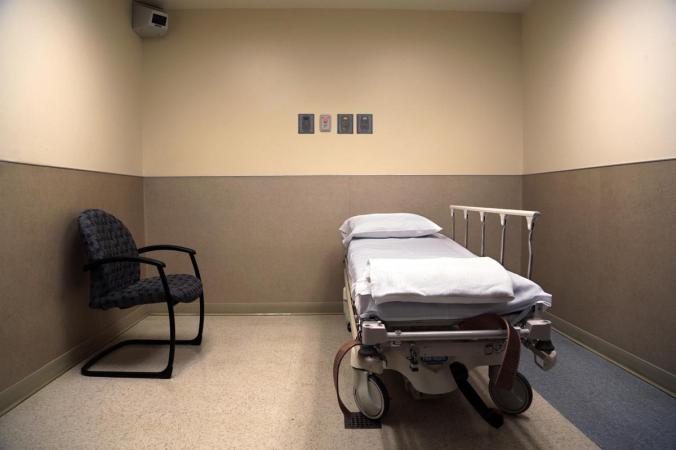
I’d been in the psychiatric emergency rooms at South Street hospital more times than I could count.  But that was an old hospital. The rooms were basically just regular rooms, except the chairs were bolted to the ground.  One of them had an ugly green tiled floor.  One of them had a stretcher in it.  There were chairs just outside for the security guards to sit.

In July 2011, I was in a different hospital emergency room.  This hospital was newer and had an updated PES (Psychiatric Emergency Services) department.  The door to the department was locked at all times.  There were 4 small rooms, similar to the one in the picture above except the chairs were bolted down, and one washroom.  In the washroom the toilet was metal and had no seat.  The sink was metal and attached to the wall.  In the central area between the 4 rooms there was a water fountain and two telephones attached to the wall.  In the central area there was also a stretcher with restraints on it. Separated by another locked door was the nursing station.  Each of the rooms had cameras in them (except the washroom).  The nursing station had a window which looked into the department.  The washroom reminded me of what I imagine a jail looks like.  In fact the whole experience was like being in jail.

My family was out of town visiting my ex-husband’s extended family.  I was in my last weeks of the practical placement that would complete my Masters degree.  Ironically my placement was in a psychiatric hospital.  The depression that had crept back into my life in the Fall of 2009 had worsened.  There were many reasons for this.  I felt desperate and I had tried all the medications that were available.  I began to seriously consider ECT (electroconvulsive therapy aka shock treatments).  This had been suggested to me in the past around 2004, fairly early on in my psychiatric survivorship story.  At that time I felt it was too soon, I hadn’t tried a whole class of medications.

In 2011 I felt like my options were suicide or ECT and I preferred the ECT.

I wasn’t coerced, I wasn’t pressured into it.  I sought out the treatment myself with the support of my outpatient psychiatrist.  Since he has no privileges at the local hospitals my best bet was to go to the ER and ask for a consult.

My plan was to do this as an outpatient.  But things went awry.   When I told the psychiatric resident how much I was struggling and how suicidal I was she wouldn’t let me leave.  The doctor on call told me I had to be admitted to the hospital and that if I didn’t agree to stay she would admit me on a Form, involuntarily.  At this point, locked in PES, I decided my best option was to cooperate.   I hadn’t brought anything with me, and there were no beds open on the Mental Health Unit, so I was forced to spend 24 hours locked in PES.

I can’t remember exactly when I cracked, but I phoned a friend.  I told him where I was and that I wasn’t allowed to leave.  I cried to him on the phone. He was a friend from school and I was so embarrassed to be calling him from the hospital.  I felt like it was my one call to the outside world after being arrested.   I didn’t want to tell my parents, but the next day I finally did, so they could bring me some clothes and items.

Staying overnight in PES was not a pleasant experience.  The lights were always partially dimmed in the center hallway.  There were no windows to the outside world.  This place was literally a prison.

The white sheet on the bed left lint and little pills all over my lululemon yoga jacket.  They are still there to this day!  Also to this day the smell of the soaps and sheets in hospitals triggers me.  Hospitals have this very specific smell, a mix of bleach and antibacterial soap (the cheapest kind).

Meals arrived on a tray, but there was nothing I wanted to eat.  Somehow in the morning, after almost no sleep and nothing to eat, I convinced the nurse to let me go to the cafeteria to buy a snack.  I argued that since I was a voluntary patient I should be allowed and for whatever reason they reluctantly agreed.  I ate a muffin and drank some hot coffee.

The doctors came back the next day, and eventually I was moved up to the 4th floor.  I stayed for one night on the unit.  I told the doctors what I wanted: outpatient ECT.  We called my ex-husband and discussed this with him.   Everything was agreed upon and I was given an appointment to meet the doctor the next week.  I convinced them that I would be safe at home and they discharged me.  They wanted me to stay but I wanted to leave.

The hospital always seems like a good idea from the desperation of home.  But once you are there you realize that it isn’t a very safe place either.  A good part of this is because you are at the mercy of others and have very little control over your own life.  That and the doctors have the power to hold you against your will at any time.

I wonder…why do they make PES look like a prison?

Why are psychiatric patients treated like criminals?

Surely someone could design a safe and secure section of the hospital that actually looked and felt healing.  I’m willing to bet the person that designed PES had previous experience designing prisons.

I’m not a criminal.  I would heal and relax more quickly if I was in a hospital environment that felt welcoming and relaxing.  The very environment of PES conveys a lack of respect and a perspective on the status of the patients/prisoners.  PES brings up a deep sense of shame in me.  I begin to feel crazy because I am trapped and forced to comply with the orders of the staff.  In PES, you feel you have hit rock bottom.

“You are crazy.  You can’t be trusted.  We think you are going to hurt us.  You need to be locked up for our safety and for your own.  Behave or you will be locked up here indefinitely. We couldn’t be bothered to make this place welcoming or comfortable.  Because you are crazy your comfort is not our priority.  Get used to it”

This is what mental health stigma looks like.


Post-it notes

images

Possibly one of the saddest moments in my entire story revolves around a post-it note.

During a particularly dark time in my life, sometime in early 2011, I wrote a series of 3 suicide post-it notes.  This is something I haven’t really shared with anyone.

I was completing my Master in Social Work, I was about to start my final placement.  I was working as a Teaching Assistant, attending classes and taking care of my kids.  On the outside I was functioning, but on the inside I was consumed with depression.  Looking back, I know a good part of the darkness was being caused by my increasing unhappiness within a sexually abusive marriage.  I began to feel like I had exhausted every option for recovery, every medication, every type of therapy, every treatment program and as a parent of two young kids I felt I had even fewer options.  I felt trapped and disconnected from myself and the ones I loved.

I don’t remember why I was upset or what happened that day, I do remember I wanted the pain to stop.  I was home alone, the kids were at school or daycare.  I saw a pad of yellow post-it notes one of the kids had left in my bedroom.  On it I scrawled three separate notes, one for my husband and one for each of my kids.  The notes basically said “I love you ___” and had a heart drawn under the words.   They looked like innocent little notes, the kind family members leave for each other to wish them a happy day.

But to me those were the most tragic post-it notes in existence.  In that moment where nothing was really making sense, I was saying goodbye.

I did hurt myself that day, but I went to the hospital to get it taken care of.  I didn’t tell the hospital staff about the post-it notes or about my despondent thoughts.  I let them fix me up and I went home.  I rarely discussed my suicidal thoughts in the Emergency Room unless I wanted to be admitted to the hospital.

When I got home my family was there and so were the post-it notes, unassuming and cheerful yellow papers.  But seeing them reminded me of my dark plans.  I hated those post-it notes with great passion.  They made me angry every time I saw them, but luckily anger was at least a feeling and not just numb emptiness.

The post-it notes stuck around the house for months before I finally threw them away.  I won’t ever forget them though.  They are a symbol of just how little anything ACTUALLY makes sense when you are severely depressed.  Things that seem logical in the moment are completely ridiculous and nonsensical when you are feeling brighter.  Choices that seem like the only option are revealed as unhelpful and fatalistic when you are recovered.

It’s important to hold onto this realization.  When you are severely depressed you are not thinking clearly.  When you are starved from an eating disorder you are not thinking clearly.  When you are triggered and in the middle of flashbacks you are not thinking clearly.

Don’t make decisions that could harm you or someone else when you are not thinking clearly.  Chances are you might regret it when you are calmer.   If possible focus on grounding and self care, or get help from others if you realize you are not thinking clearly.

Suicide wouldn’t have solved the problems in my life, it would have passed them on to my children, my parents and my close friends.  I can say this now, but I know for a fact that in a dark place I just won’t care.  The only thing I will think about is getting the pain to stop.

Luckily, in recovery, I know that depression is temporary and impulses to harm myself are passing thoughts.  Suicidal thinking and gestures are symptoms of depression and PTSD for some people.  Thinking about suicide can be a normal coping reaction to surviving violence.  Just thinking about suicide is not necessarily dangerous.  Sometimes it can be a way of feeling in control of something, which is actually a method of self preservation.  It is necessary to challenge the self destructive behaviours, but I try not to judge myself for the thoughts.

At the end of the day there is no difference between a person who sometimes thinks about suicide and one who does not.  There is not a special “crazy” class of folks who contemplate dying.  Suicide doesn’t discriminate.  Anyone can have the thoughts and it doesn’t make them weird, dangerous or a person to be feared or shunned.

Suicide survivors walk among us.

Sometimes the best thing you can do for a friend who contemplates suicide is to allow her to talk about her thoughts and impulses and listen without panicking and without judgment.  Validate her, let her know that you are sorry she is feeling SO awful that she feels life is hopeless.  Allow her to explore the thoughts with you, or encourage her to talk to a counselor, support worker, crisis line or doctor.  It isn’t your job to save her, it’s your job to be her friend.  Thank her for trusting you.  Let her know you care. By letting someone talk about suicide, you are reducing shame and creating a connection.

Connection is the opposite of depression.

Dental Floss. When the truth is I miss you so…

Wonder-Woman

I met my dear friend MJ during the summer months of 2002.  We were both patients in the Post-traumatic Stress Recovery Program at Homewood Health Centre in Guelph.  We became friends very quickly, even though we were both struggling.  In so many ways she was struggling, coping with the impact of years, a lifetime really, of abuse.  We were close in age, we were both looking for hope and for something to hold on to.

I won’t write too much about MJ’s story, because it is not my own.  I will say that she was also a survivor and spent a good portion of our friendship hospitalized in various places.

MJ and I would write letters to each other, cards mostly.  Words of encouragement.  We would speak by phone, sometimes almost daily and sometimes months would go in between.  The amount of contact varied along with our health statuses at any given moment.

MJ was the person who I felt completely understood my experience of living with PTSD.  She never judged me.  She was always so grateful for our friendship.  I could tell her my strangest thoughts and she knew exactly what I was going through.  She was one of the bravest people I’ve even known.

MJ and I had an inside joke.  I don’t remember anymore who started it, but I think it was her.  We both struggled with near constant thoughts of suicide and self harm.  But we would talk about holding on and about being there for each other.  She used to say “hold on to hope, even if what you are holding onto is as thin as dental floss.”  We often talked about holding onto the dental floss, each of us holding one end and clinging to life.

I supported MJ through many hospitalizations and numerous suicide attempts.  I always knew in my heart that MJ would not be with me forever.  I almost lost her too many times to count.  We had a special connection, one that I’ve only had with a few other people in my life. I would dream about her, nightmares about things happening to her. Waking with a terrible, panicked pit in my stomach, I would know the dream was true. We were so connected I often knew something was wrong or something had happened before she told me.  I would call and find that she was in hospital.

MJ died one year ago.  She died from complications from chronic, terminal PTSD.  I was not there, I did not get to say goodbye.  For some reason I was not invited to the funeral.  I found out over a week later when her Mom answered her cell phone.  I was sitting in my car and I instantly knew.  I cried as her Mom described what happened.

MJ did not die alone.  Her family was with her and she was peaceful.  I take great comfort in this.  I said thank you hundreds of times.

But my heart aches and aches.  I can’t believe she is gone.  I feel devastated that some people don’t survive violence. There are days when I think if I pick up the phone to call her she will answer.  If I get on a plane and fly to her city, she will be there waiting for me.  I dream about her still and wake up crying when I realize she is dead.  She will always be a true survivor to me, even though she didn’t make it out alive.

I still have all the cards she ever sent to me.  I have about 25.  I keep them, along with photos of us together, under my bed.  I’ve read and re-read them, my eyes filled with tears of gratitude that these small pieces of her, her words of encouragement to me, will always be with me.

If I could have one wish, to speak to anyone, living or dead, it would be her.  Just one more time.  I wonder if anyone else will ever understand me so well.  I know I won’t ever have a friend just like her.  The bonds that are formed through shared experiences of trauma are difficult to break.  And I don’t want to break them.  As much as this hurts, I don’t regret being her friend.

I miss you MJ.  I miss you so much.  I’m still here, I’m still holding my end of the dental floss.  I’m still trying to be the Wonder Woman I know you believed I was.  Thank you for being my friend.

Cowboy take me away
Fly this girl as high as you can
Into the wild blue
Set me free oh I pray
Closer to heaven above and
Closer to you closer to you”   -Dixie Chicks


Cumbersome.

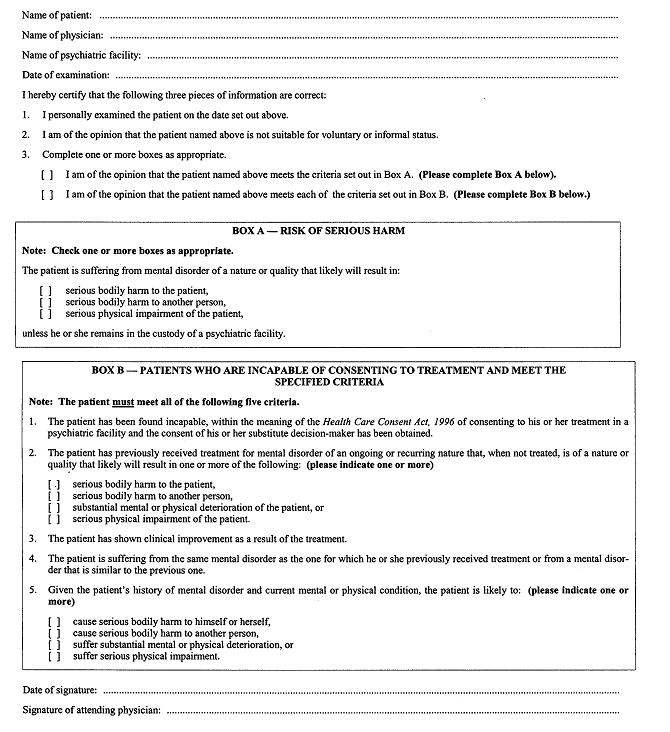
elaws_regs_900741_ev001-5

“I have become cumbersome to this world…”  Seven Mary Three

Trigger warning

This song was playing on the radio in my boyfriend’s car.  We had parked outside the engineering building at the University of Western Ontario.  I waited in the car while he ran inside to hand in a late assignment.  It was about 3pm in June 2001.  I was deeply depressed and in the grips of side effects of benzos and SSRIs, toxic soup which turned my brain into an impulsive, self destructive, hopeless mess.  I felt like the song was a sign and a message to me that it was time to die.  we drove home and a few minutes later I was in the bathroom, taking my 3rd overdose.  I was serious this time and not messing around.

I remember sitting in my room, waiting to see what would happen.  I started feeling bad fairly quickly and this time I was fully aware of the entire experience.  My boyfriend drove me to the hospital and I remember during the drive realizing that an ambulance would have been more appropriate.

I remember sitting at the triage desk in the South Street ER, the nurse asking me questions: “How many pills did you take?”

Either my answer or my vital signs snapped everything into motion.  I remember her checking the E for Emergent on the triage form and I was taken immediately back into the department.  Things started to go downhill from there.  I was given activated charcoal to drink, this time I was fully awake and the taste and texture was horrific. I still have regular nightmares and flashbacks about this.  Even typing this I’m having flashbacks and feeling nauseous.  The nurses took blood samples and started an IV.  As we had found out on OD #2, I’m actually highly allergic to the antidote to the drug overdose.  This meant I was having a life threatening allergic reaction.

I remember my face getting hot and swollen.  I was receiving IV benedryl along with the antidote.  I was vomiting over and over, the charcoal wouldn’t stay inside me.  Eventually I was vomiting blood.  I was given IV gravol.

My sense of time was somewhat confused but at one point I remember them paging the internal medicine experts.  It was at this point I realized that I had F*#ed up.  I realized that I wasn’t going to die, clearly.  I felt like a failure at everything.  I couldn’t even get this right!  But at the same time I was petrified because I knew my body was not doing well.  My liver was having trouble processing the OD.  The specialist told me I needed the charcoal to absorb the drug and I would need the IV antidote for about 24 hours, I was being admitted to a medical floor.  He also told me if I ever did this again I would die from the allergic reaction to the antidote.

Shortly after the Dr  came back into my curtained area.  A tube was placed down my throat and into my stomach.  I was fully conscious and had no pain relief.  I could not longer speak.  My eyes were watering from the pain.  The nurse was supposed to come immediately to pour the charcoal directly into my stomach.  But for whatever reason she didn’t come and I was lying there unable to speak with a tube down my throat.  Finally the nurse came, poured the charcoal into me and then pulled out the tube.  I was gagging and crying.

Late that night I was taken upstairs to the 5th floor which was a cardiac monitoring floor. I needed a monitored bed because I had been admitted involuntarily on a Form 1 (72 hour psychiatric hold under the Mental Health Act).  I remember waking up, if I had even slept at all, and dragging my IV to the washroom to vomit black charcoal.  I could barely walk. I noticed that this part of the hospital was much fancier and the beds were much more comfortable than on the psych wards.  I remember at one point using the phone in the nursing station to speak to my parents.

In the morning breakfast came on a tray.  There was cream of wheat in a plastic bowl.  A few hours late the psychiatrists came to assess me.  I remember being angry and frustrated because they made me walk all the way down a long hallway to a meeting room to talk.  I could barely walk and it felt like an eternity.  I remember thinking they were punishing me on purpose, but maybe they just didn’t realize how terrible I felt.

I was moved to a bed on the 2nd floor, it was a general medical unit.  Since I was not in a monitored bed and not on the psych floor (locked ward) I was assigned a “sitter.”  Basically someone to sit in the room and watch me, presumably to ensure I did not harm myself again.  It was embarrassing and invasive.  This person just sat on a chair in my room.  If I went to the washroom they would stand outside the door and listen.

I remember the day being overwhelming and scary.  I was not grateful to be alive, I didn’t see it as a second chance.  I felt sick and I felt trapped.  I felt incompetent and alone.

Late that evening I was medically cleared, the IVs were removed.   I was moved to the 7th floor.  I was not allowed to leave the unit.  After the 72 hours passed my Form was extended to a Form 3 which allowed them to keep me for up to 7 days.  Dr. X was the one to sign the papers.  He informed me that things had gone too far and he would not release me from the hospital unless my parents came to collect me.  I had no choice but to agree.

Involuntary hospitalization feels like being imprisoned.  Your right to freedom of movement is removed.  You must stay on the psych unit and you can’t go outside.  Sometimes they will let you go outside supervised but only on hospital property.  Did I need to be involuntarily held at that time? Probably yes.  Would I have harmed myself again at home?  Probably yes.  In fact, I went on to continue harming myself for years after this admission and I would be held involuntarily again.  I couldn’t talk myself out of this one.

It’s very difficult to explain what is in the mind of a person who wants to die.  Sometimes it feels like a terrible emptiness.  Sometimes it feels like looking at the world through dark glasses.  Sometimes it feels like a crushing weight, when you feel like you are separate from all living things, a shadow of yourself.  Sometimes it is racing, impulsive thoughts of harm.  Other times it is absolute quiet.  I’d be lying if I said I don’t still have thoughts of dying.  They come and go, as they have since I was 17 years old.

Thoughts of suicide are a warning sign for me.  They are a giant red flag waving.  Stop! Your stress levels are too high.  You have too few spoons.  You have too many triggers.  You need to slow down and self care.   Suicide is a symptom of depression and PTSD.  Hopelessness is a symptom.  It’s not a sign of weakness and it is not a sign of being “crazy.”  It’s a symptom of depression in the same way sniffling and coughing are symptoms of a cold. Suicide and suicidal attempts can also be a side effect of many psych meds and this was certainly true in my own life.  This is an issue with many layers.  Ironically, suicidal thinking can be a way of coping and trying to survive desperate times.

I am a suicide survivor.

.

Terminal illness (psychiatric style) aka suicide

b1569c9c37926d19db45218e74a56b2a

One of the side effects of having a chronic psychiatric illness is that you spend a lot of time in hospital, treatment and therapy groups.  One of the great aspects of this is all the amazing people I’ve had a chance to meet along my journey.  Perhaps the most tragic aspect of this story is the number of friends I’ve lost, when their mental illnesses became terminal.

I think it is time to stop saying “she committed suicide” or even “she completed suicide.”  It is more accurate to say things like “she died from chronic post-traumatic stress disorder,” or “she lost her battle with anorexia and alcohol addiction,”  or bluntly “depression killed her.”

Kirsten, Irene, Pammy Jo, Darlene, Marian, Lexi, Erin, Andrea

I will say their names so they are not forgotten.  These women ultimately did not survive the psychiatric and health care systems.   They died as a result of complicated, layered physical and mental health problems and, in many cases, social barriers and challenges as well.  Sexual, physical and emotional abuse killed some of my friends, though they died ultimately long after the abuse ended.  Many mental illnesses do not just appear out of the blue (in fact they rarely do).  I struggle to even call many of these deaths suicide.  I’d like to call some of them murder by PTSD.  If these women had not survived gender based violence or abuse within the health care system they quite likely would be alive today.

Quite simply, if my friends had not been abused I would be talking to them today instead of writing this blog post.

This afternoon I attended a memorial gathering for Lexi.  She died about 9 months ago.  She was beautiful, talented, creative young woman.

I find myself flying back, years in the past to when I experienced my first loss as a result of mental illness….

I met Darlene on 8East at South Street hospital, it was within my first few months there.  Possibly the 3rd admission.  She just slightly younger than me, perhaps 19 years old at that time.  I remember her roommate was a young woman with bulimia who was being tube fed with limited success.  I can still remember their voices laughing across the hallway.  They were listening to Nelly Furtado, Turn off the Light over and over, singing along.  Their room was full of stuffed animals.

Like me, Darlene was also a frequent flyer at South Street hospital and later at the Regional Mental Health Care London (better known by us as the LPH).   London Psychiatric Hospital.

Also like me, I believe she had also been labelled with borderline personality disorder as a result of frequent overdosing and high utilization of psychiatric services.  She was also a patient of Dr. X while at South Street.

July 23, 2002 I received a call from Darlene.  She started saying goodbye to me and I was confused.  I asked her if she was going to visit her Mom and she said no.  I quickly realized she was speaking about suicide.  I talked to her for a while and asked her permission to call 911.  She agreed.  I ended the call and send the paramedics to her house.  She was taken to the ER.  I later learned that she ate a roast beef sandwich while waiting for the doctor.  I have often wondered if that was her last meal.  A dry, cold, prepackaged hospital sandwich.  The thought breaks my heart.

She called me from a pay phone the next morning and explained she had been admitted at the LPH.  She had been chemically restrained, with an injection in her thigh and put into an observation room overnight.  She was angry and was being discharged and wanted me to come to meet her.  I took the bus across town to the hospital and the two of us took a cab to her apartment.  It was the first time I’d been there.  I had to leave her because I had an appointment to attend.  Another friend of ours stopped by and kept her company for the afternoon.  She was a young woman, about 16 years old.  The two of them went to the park and swung on the swings together.

The next day I was not able to reach Darlene by phone.  Scared, I called 911 thinking I would send the police to check on her.  The operator asked her name and my own name and then I was put on hold.  I was confused and started to feel a deep sinking sick feeling in my stomach.  After a few seconds someone else came on the phone, I assume it was  a police officer but I can’t remember.

Darlene is dead.

Sometime over the course of that phone call, or when the police officers came to my house I found out that after E went home, Darlene had returned to the Emergency Room at South Street asking for help.  She was turned away rather than being admitted.  Having had similar experiences myself, I can only imagine the staff were frustrated that she was back again so quickly.

Darlene walked a few short blocks away from the hospital and in front of a train around 8pm July 24.  She died alone, less than an hour after walking out the ER doors.  Outside of hospital staff, my friend and I were the last two people to see her alive.

This is what terminal psychiatric illness looks like.

This is the result of labeling someone borderline and attention seeking.

She was only a few days away from turning 21.  The system failed her.

After speaking with the police I drove to E’s house.  We went for a walk in the park by her house.  I had to tell this young woman, my friend, that her friend Darlene was gone.  It was one of the most difficult things I’ve ever had to do.  We sat on a rock in the park, crying and hugging each other.  I remember that a balloon floated by in the shape of Bert from Sesame Street.  It was a sunny day.

At her funeral, still in shock, we cried for our friend.  It was a strange service, her grey velvet casket sitting at the front of the room. There was no eulogy, no family members spoke.  The priest that spoke was a stranger and gave what sounded like a stock, religious speech.  He kept saying her name and it didn’t make sense to me. It was impossible to believe it was our friend who had died.  At the end of the service they played Angel by Sarah McLaughlan.  That song still makes me cry

I hope all of these women have found some comfort.  I certainly miss them.

When mental illness ends in suicide, a light goes out.  Suicide takes some of our brightest lights.  Grieving loss related to mental illness is complex and often not acknowledged openly by society.  I will write more about my own struggles with suicidal ideation, gestures and attempts.  I will write more about my friends.  The secrecy and stigma surrounding suicide needs to be broken in order to save lives.

My dear friends…

“In the arms of the angel, may you find some comfort here”


Follow me, follow me, follow me, down, down down…

20160413_222933[1]

I began taking a psychiatric drug cocktail around February 2001.  At that time I was mainly scratching my skin, enough to bleed, but superficial marks.  I was having almost daily panic attacks, insomnia and nightmares.  The idea was that the drug cocktail would help all these symptoms.

On my 3rd admission to South Street 7th floor, I met with Dr. X.   We were sitting in my hospital room.  I had a bed by the window and this was a ward room with four beds separated by curtains.   He sat on the chair that was provided for visitors and scrawled some words on a scrap piece of paper.

Major depression

Anorexia nervosa (in partial remission)

Post-traumatic stress disorder (mild)

Borderline Personality Disorder.

This moment changed the direction of the rest of my life.   Even today, at 35 years old the impacts haunt me.   Dr. X explained each of my diagnosis to me one by one.   When I learned about PTSD I felt a weight lift.  So many things suddenly made sense, why I startled so easily, the nightmares and intrusive thoughts.  PTSD was a psychiatric label, but for me it was a useful one.  It made me feel less alone, less crazy to know there was a word for what I had been experiencing since I was 15 years old.

The issue was the last line in his list.  Borderline Personality Disorder.  What did that mean?  How could my personality be disordered?  Remember that I had only just begun to recover and process memories of sexual abuse and that was the immediate trigger of my instability.   Dr. X explained that because of my self harming behaviour this was the diagnosis that fit best for me.   Over the years I would learn many things about borderline personality disorder and how it is used as a label to marginalize women survivors of violence and abuse.  But in the next few years all I learned was that as soon as a doctor in the hospital saw that diagnosis I would get treated differently, with less compassion, less humanity and less kindness.  Quite simply the hospital staff began to give up on me.

A terrible paradox began to occur.  The more I felt that the hospital staff and Dr. X did not believe and validate me, the more I acted out.  This was not a conscious decision, but I soon learned that without harming myself I would not get hospital care, and after a few more months, I began to be turned away from the Emergency Room on a regular basis, told there were no beds, that hospital stays did not benefit people who were borderline.

Something else was happening during this time period.  The toxic soup of psychotropic drugs were beginning to poison me.  I was 20 years old, still a young person.   SSRI anti-depressant medications can be very dangerous for some young people.  They can trigger impulsive self harm and even suicidal thoughts and actions.  They can create an almost hypomanic like state in someone who is not bipolar.   This is what happened to me.  But all the while I kept believing “Drs don’t give you medicine to make you sick”

Anti-anxiety and anti-psychotic medications slowed me down.  I found myself sleeping more than I wanted to, napping during the day, living in a fog.  I also became more intense and more impulsive with my self harming behaviours which escalated extremely quickly between February and April 2000.  Soon I was harming myself daily, sometimes multiple times a day.  My arms looked like a mess of scars, cuts and scrapes.

In April 2000, I bought an exacto knife and for the first time I cut deeply.  Down the rabbit hole, down, down, down…I went to the Emergency Room by myself and received 9 stitches by a medical student.  When the resident came back to check his work she told him the sutures were done incorrectly.  I waited, but she did not offer to fix it.   The first time left the worst scar,  6 years later it still hurt me so much I had plastic surgery to repair the scar tissue.   I imagine that if this wound had not been self inflicted, the resident would have corrected it and been concerned about the potential scar.

One week later, walking back from University I became consumed with thoughts about ending my life.  These thoughts had become an almost constant companion, but that day there was an impulsiveness that was new.  Almost without thinking I overdosed in my apartment.  Shortly after I told my boyfriend who drove me to the hospital.

I don’t remember very much about what happened after the car ride.  I do remember drinking activated charcoal.  I still have nightmares about this and I still have trouble drinking or eating things with a chalky texture.  It was black and I was drinking it from a bottle with a straw.  I was confused and kept asking why I was drinking it.

The doctors discharged me home after a few hours.  I vaguely remember the car ride, I remember throwing up in the parking lot of my apartment building and many more times that night.  I don’t remember going to bed or much of that evening.

It confused me that I was sent home.  Surely a disoriented, drugged young woman who had just tried to end her life was not the person who should be walking out of the hospital.  I must have told them I felt better, but I can’t imagine their thought process in discharging me so quickly.

This was not the last time I tried something like this.  Looking back from the perspective of a wiser adult I know that:

a) SSRIs or anti-depressants of any kind make me extremely ill/hypomanic, suicidal, impulsively self destructive, and more depressed

b) benzodiazapenes make me extremely suicidal after only a few doses, let alone after taking them daily for weeks.

c) almost every psychiatric drug has similar side effects (ie. making me act like someone who might have borderline personality disorder)

Yes, Drs do give people medication that makes them sick.  They do it every single day and then label those same people as sicker than they were previously, with labels that stick with them for life.  No matter how recovered I might be, no matter how well I am, no matter how functional, those three words (borderline personality disorder) still have the power to put me into a dark box.

I know that I’m not alone with this.  Many women who live with PTSD, and who have used self harm as a method of coping,have been labelled and marginalized this way.   And so many youth became ill taking anti-depressants that they now have black box warning labels advising of the increased risk of suicide.

Scars criss cross my entire body and sometimes I wonder, if I’d never consented to taking the medications if my body would look differently today.  I know my life would.